
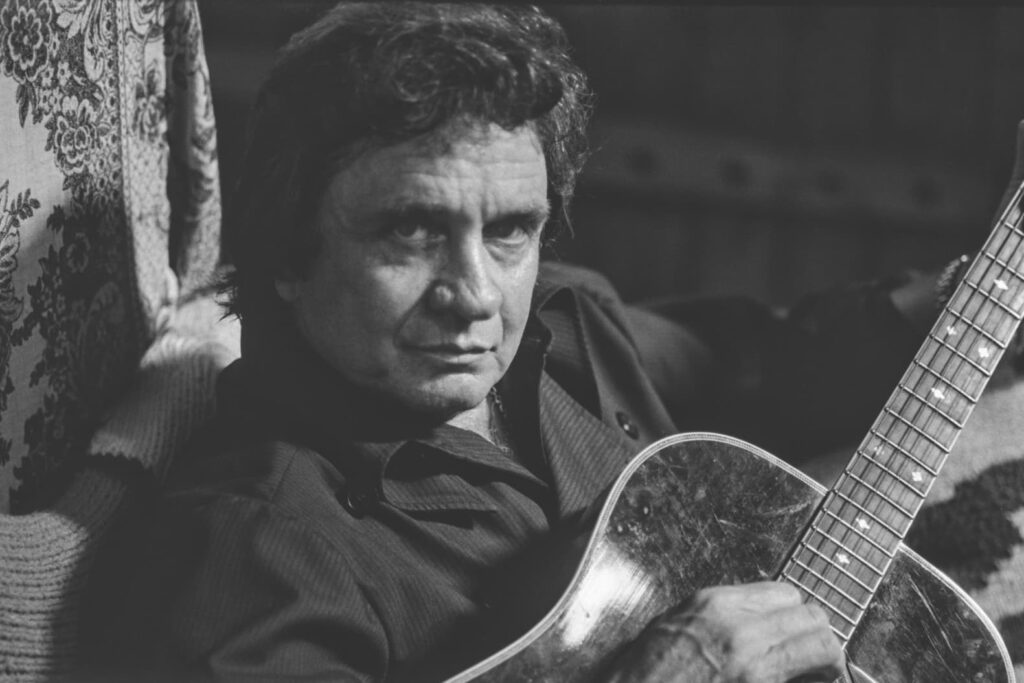
A haunting meditation on guilt, fate, and the weight a single moment can place on a man’s soul
Johnny Cash’s “I Hung My Head” is one of those rare recordings that feels less like a song and more like a confession whispered from the edge of memory. Though many listeners today associate the piece entirely with Cash, the song was originally written and released by Sting in 1996. It wasn’t until 2002, when Cash included it on his final studio album American IV: The Man Comes Around, that the story found the voice it always seemed destined for: a voice worn by time, shadowed by regret, and rich with the gravity of a life lived close to the bone.
Unlike Cash’s earlier chart-topping years, “I Hung My Head” was never released as a single, so it did not enter major charts on its own. But its presence on American IV an album that reached No. 2 on the Billboard Top Country Albums and No. 22 on the Billboard 200 cemented it as one of the most emotionally powerful pieces from the twilight of his career. Critics and fans alike often single it out as a moment where Cash becomes something more than a performer; he becomes a storyteller carrying the burden of every man who has ever looked back at a terrible mistake and asked himself why.
What gives the song such durability is its stark narrative. Cash sings from the perspective of a young man who, in a moment of reckless curiosity, fires a rifle and accidentally kills an innocent rider passing by. The rest of the story unfolds like a long walk toward judgment slow, heavy, and filled with the echoes of a conscience unraveling. In Cash’s hands, the song becomes a meditation on remorse, accountability, and the way a single impulse can cleave a life into a “before” and an “after.”
Where Sting’s original version was rhythmically complex and framed with modern textures, Cash’s interpretation strips the song down to the emotional truth at its core. His delivery is fragile, almost trembling, as if each line were pulled from a man remembering something he wished he could forget. The arrangement sparse acoustic guitar, gentle pacing, no adornment lets his voice carry the entire moral weight of the narrative. It is this bareness, this almost uncomfortable intimacy, that makes Cash’s version definitive for many listeners.
There’s a deeper historical resonance as well. By 2002, Cash was nearing the end of his life, and he approached every song on American IV with a sense of finality, as though he were putting his spiritual accounts in order. “I Hung My Head” fits that emotional landscape with uncanny precision. It becomes not just a fictional tale of guilt, but a window into the human tendency to reflect on the irreversible choices we make choices that can haunt us across decades.
The song also touches something universal: the way memory can become heavier as one grows older. Cash doesn’t shout or dramatize; he simply tells the story the way a man might confess to a friend in a quiet room, admitting that he still dreams of the moment that changed everything. The regret in his voice is not youthful, frantic regret it is weathered, familiar, almost resigned.
And perhaps that’s why this recording has continued to resonate long after Cash’s passing. It is a reminder that every life contains moments we replay in the quiet hours, moments that shape us, humble us, or follow us like shadows across the years. “I Hung My Head” offers no easy answers, no heroic redemption only the truth that guilt, once planted in the heart, grows slowly and silently, asking to be understood.
In the end, the song stands as one of the most poignant late-career performances of Johnny Cash, a man who transformed simple melodies into timeless reflections on the human condition. It remains a haunting testament to the power of storytelling and to the weight that even a single moment can carve into a lifetime.