
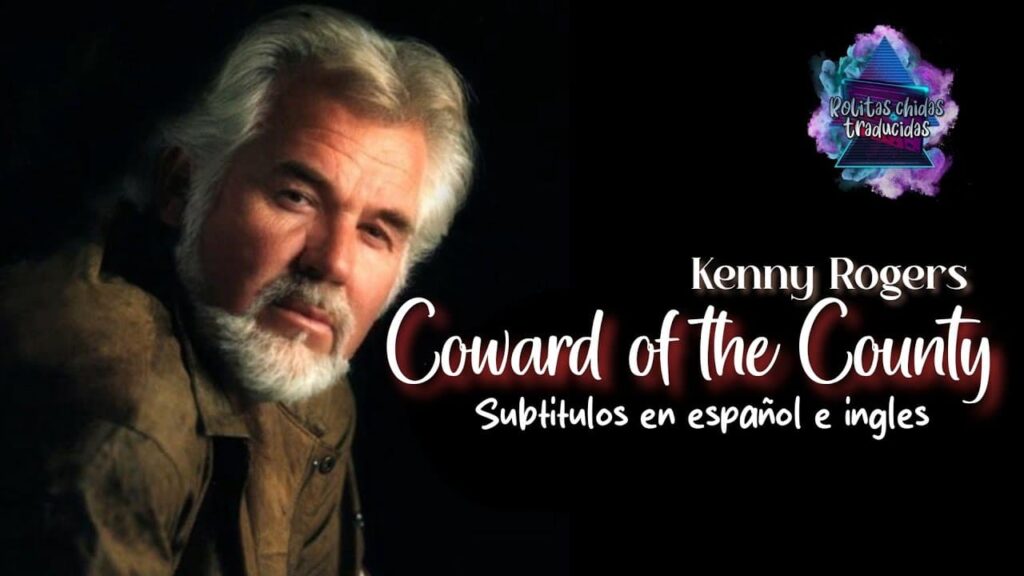
A haunting moral tale about restraint, courage, and the moment a man is forced to stand
Few songs in popular music have carried the weight of story, ethics, and emotional conflict as powerfully as “Coward of the County” by Kenny Rogers. Released in November 1979 as a single from the album Kenny, the song quickly became one of the defining recordings of his career. Upon its release, it reached No. 1 on the Billboard Hot Country Singles chart and crossed over to No. 3 on the Billboard Hot 100, an extraordinary achievement for a country narrative ballad rooted in moral complexity rather than radio-friendly simplicity.
From the very first verse, “Coward of the County” establishes itself not as a song, but as a parable. Written by Roger Bowling and Billy Edd Wheeler, the story centers on Tommy, a young man branded a coward by his community for refusing to fight. Kenny Rogers’ calm, measured delivery is essential here—he does not judge, dramatize, or exaggerate. Instead, he tells the story as if it were being remembered years later, with the clarity that only time can provide.
At the heart of the song is a promise: Tommy’s father, on his deathbed, urges his son to turn the other cheek, warning that violence leads only to loss. This message of restraint defines Tommy’s life and becomes the reason he endures ridicule and humiliation. The nickname “Coward of the County” is not merely an insult it is a misunderstanding of moral strength.
Musically, the arrangement is deceptively gentle. Acoustic guitars, subtle strings, and a steady rhythm support Rogers’ voice without overpowering it. This restraint mirrors Tommy’s own character. The music waits patiently, allowing the tension to build slowly, almost uncomfortably, until the inevitable breaking point arrives.
That turning point when Tommy’s loved one is brutalized by the Gatlin boys transforms the song from reflection into reckoning. What makes this moment so powerful is that the violence itself is never described in graphic detail. Instead, the listener feels the weight of injustice through implication. When Tommy finally confronts the men who hurt him, the act is not framed as revenge, but as a final defense of dignity.
The song’s most enduring line “Sometimes you gotta fight when you’re a man” is not a celebration of aggression, but a painful acknowledgment of reality. The story does not glorify violence; it mourns the necessity of it. Even in triumph, there is no joy only resolution.
This moral ambiguity is precisely why “Coward of the County” resonated so deeply across generations. In an era when many hit songs favored simplicity or escapism, Kenny Rogers delivered a narrative that trusted the listener’s intelligence and emotional maturity. His background as a folk and pop crossover artist allowed him to bridge storytelling traditions, bringing country music’s narrative depth to a wider audience.
The success of the song also solidified Rogers’ reputation as a master interpreter of human stories. He did not write the song, but few could have delivered it with such quiet authority. His voice warm, slightly weathered, and deeply empathetic allowed listeners to feel compassion for every character involved, even those who acted cruelly.
The album Kenny, which also featured “Lucille” and “You Decorated My Life,” became one of his most commercially successful releases, reaching No. 1 on the Billboard Top Country Albums chart. Within that collection, “Coward of the County” stands apart not because it is louder or more dramatic, but because it dares to ask difficult questions about honor, restraint, and the cost of silence.
Decades later, the song remains profoundly relevant. Its message is not bound to a specific time or place. It speaks to the tension between principle and survival, between patience and action. In “Coward of the County,” Kenny Rogers reminds us that true courage is not always visible and that sometimes, the strongest choices are the ones made long before the world is watching.