
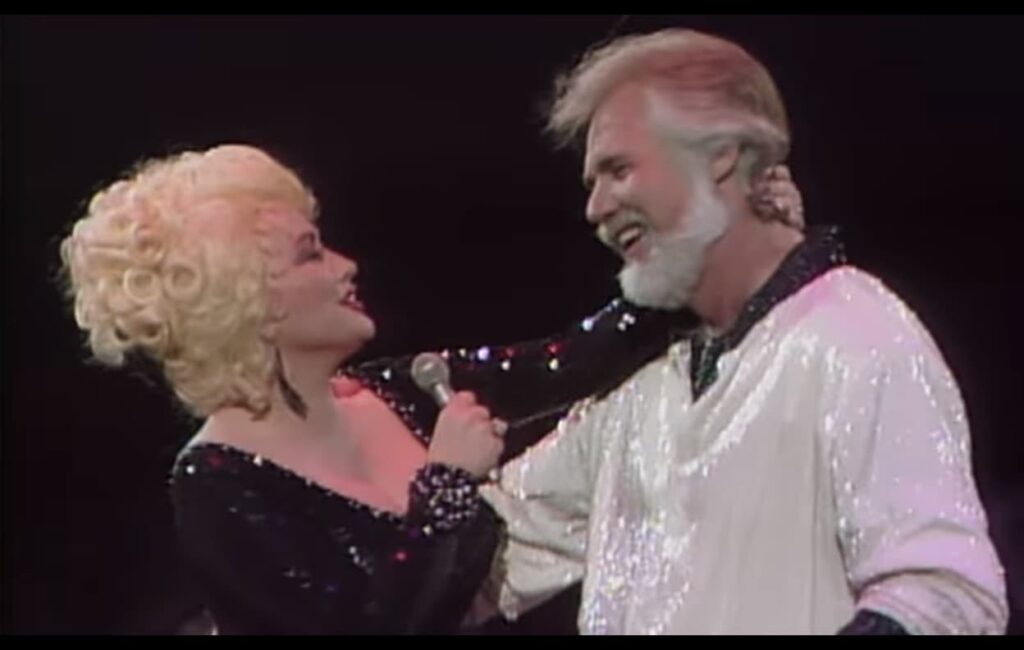
A gentle vow spoken in borrowed time, where two familiar voices turn loneliness into quiet belonging
When Kenny Rogers and Dolly Parton sang “We’ve Got Tonight” together during the Real Love Tour in 1985, the moment carried a special emotional weight that went far beyond a duet. It was not simply two famous voices sharing a stage; it was the meeting of trust, history, and emotional honesty, delivered with a tenderness that only comes from artists who understand both love and solitude.
Originally written and recorded by Bob Seger in 1978 for his album Stranger in Town, “We’ve Got Tonight” was a quiet departure from rock bravado. Seger’s version reached No. 13 on the Billboard Hot 100, resonating with listeners who recognized the song’s central truth: not every connection promises forever, but some moments matter deeply because they are fleeting. The song later gained renewed popularity through Kenny Rogers’ 1983 duet with Sheena Easton, which climbed to No. 6 on the Billboard Hot 100 and topped the Adult Contemporary chart, introducing the song to a wider, more reflective audience.
By the time Kenny Rogers and Dolly Parton brought the song to the stage in 1985, it had already become something of a modern standard. Yet their live performance transformed it once again. This was not a song about seduction or desperation. In their hands, it became a gentle acknowledgment of human vulnerability — two people admitting that, for now, being alone together is enough.
What immediately sets this performance apart is the emotional balance between the two voices. Kenny Rogers, with his warm, weathered baritone, delivers the opening lines with quiet resignation rather than regret. There is no bitterness in his phrasing, only acceptance. He sings as someone who has lived long enough to know that life rarely offers clean answers. Dolly Parton, entering softly, brings light without sentimentality. Her voice, clear and compassionate, does not promise rescue — it offers understanding.
Their long-standing musical partnership plays a crucial role here. By 1985, audiences already associated Kenny Rogers and Dolly Parton with trust, harmony, and emotional sincerity through songs like “Islands in the Stream”, which had topped the Billboard Hot 100 in 1983. That shared history allows “We’ve Got Tonight” to feel safe rather than risky. There is intimacy, but no tension. The connection is emotional, not physical — rooted in companionship rather than impulse.
Musically, the live arrangement remains restrained. The tempo is unhurried, giving space for each line to settle. The instrumentation supports rather than leads, allowing the voices to carry the narrative. The pauses between phrases are as meaningful as the lyrics themselves, suggesting reflection rather than urgency. This is a performance that trusts silence.
Lyrically, the song confronts a truth many prefer to avoid: sometimes all that can be offered is the present moment. There are no promises of tomorrow, no illusions about permanence. Lines like “I know it’s late, I know you’re weary” speak not of romance in its early bloom, but of comfort found after disappointment. In the context of this live performance, those words feel especially honest. There is no attempt to dress them up. They are delivered plainly, respectfully.
Visually, the stage presence reinforces the song’s meaning. There are no dramatic gestures, no theatrical movement. Kenny Rogers and Dolly Parton stand close, attentive to each other, as if sharing a private conversation rather than performing for a crowd. The audience becomes a witness rather than a participant, invited to listen rather than applaud.
In the broader landscape of both artists’ careers, “We’ve Got Tonight” occupies a meaningful space. It reflects Kenny Rogers’ enduring focus on emotional realism and storytelling, while highlighting Dolly Parton’s rare ability to bring warmth without illusion. Together, they remind us that maturity in music is not about volume or spectacle, but about truth delivered gently.
Long after the final note fades, this performance lingers because it speaks to something universal and quietly profound. It honors the idea that even when certainty is gone, connection still matters. In that shared moment onstage in 1985, Kenny Rogers and Dolly Parton gave the song its most human form not a declaration of love, but a simple, honest offering of presence.