
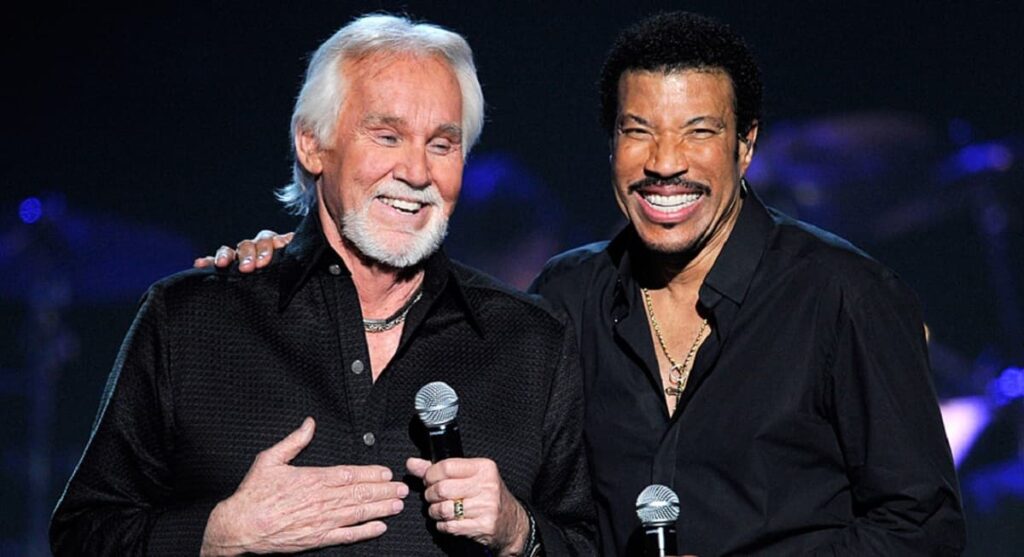
A conversation across generations where wisdom, risk, and grace meet at the same table
When Kenny Rogers and Lionel Richie came together on “The Gambler” for CMT Crossroads, the moment carried far more weight than a simple duet. It was a meeting of two voices shaped by different paths, different audiences, and different eras yet united by a shared understanding of storytelling, timing, and emotional truth. This performance did not introduce a new hit to the charts, but it reintroduced an old one to memory, framed by reflection rather than ambition.
Originally released in 1978, “The Gambler” became the defining song of Kenny Rogers’ career. Written by Don Schlitz, the song reached No. 1 on the Billboard Hot Country Singles chart and climbed to No. 16 on the Billboard Hot 100, a rare crossover success that cemented Rogers as a storyteller who could speak beyond genre boundaries. More than its chart performance, however, the song became a cultural parable quoted, referenced, and remembered long after its initial run.
By the time of the CMT Crossroads performance, “The Gambler” was no longer just a song. It was a piece of shared language. Bringing Lionel Richie into that space added a new dimension. Richie, known for his work with The Commodores and his solo career filled with soulful introspection, approached the song not as an outsider, but as a listener who understood its emotional architecture.
The genius of this duet lies in restraint. Neither singer tries to reinvent the song. Instead, they inhabit it. Kenny Rogers, with his weathered, conversational delivery, sounds like the keeper of a long-held truth. His voice carries the calm authority of someone who has lived with these lyrics for decades. Each line feels settled, as if it no longer needs explanation.
Lionel Richie, by contrast, brings a reflective warmth a listener’s voice within the song itself. When he joins in, the performance shifts subtly. The advice offered by the gambler feels newly examined, not challenged, but absorbed. Richie’s phrasing is gentle, respectful, almost contemplative. He does not overpower the moment; he listens his way into it.
Musically, the arrangement remains faithful to the original structure. The tempo is steady, unhurried. There is no rush toward the chorus, no dramatic crescendo. This pacing reinforces the song’s central idea: wisdom cannot be hurried. The lines “You’ve got to know when to hold ’em, know when to fold ’em” are not delivered as slogans, but as observations learned the hard way.
What makes this CMT Crossroads performance especially resonant is its sense of time. “The Gambler” has always been about choices, consequences, and acceptance. Hearing it sung decades after its release adds layers that were not present in 1978. The song now carries history not only of its narrator, but of the man who made it famous.
The visual dynamic between Rogers and Richie reinforces this feeling. There is no competition, no spotlight struggle. Instead, there is mutual respect. This is not a passing of the torch, nor is it nostalgia for its own sake. It is recognition two artists acknowledging the durability of a well-told story.
In the broader context of Kenny Rogers’ legacy, this duet feels like a quiet affirmation. “The Gambler” was never about gambling itself. It was about understanding limits, reading people, and accepting loss without surrendering dignity. These themes age well because they are human, not fashionable.
For Lionel Richie, participating in this performance highlights his deep connection to narrative songwriting. Though his musical language differs, his own catalog has always valued emotional clarity and lived experience. In “The Gambler,” he finds familiar ground.
Today, this duet stands as more than a live collaboration. It is a reminder that some songs grow richer with time not louder, not flashier, but deeper. “The Gambler” no longer needs to prove anything. In the shared voices of Kenny Rogers and Lionel Richie, it simply tells its story once more calmly, honestly, and with the quiet confidence of something that has endured.