
A quiet testament to commitment where effort, patience, and belief turn love into something that lasts.
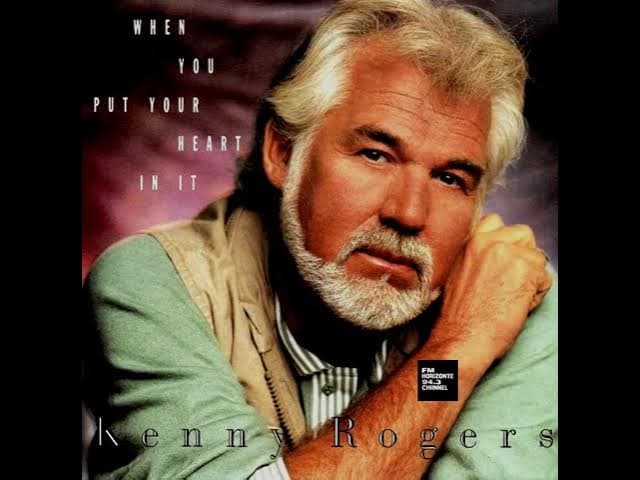
When Kenny Rogers released “When You Put Your Heart In It” in 1990, it arrived without the dramatic tension or narrative twists that often defined his biggest hits. Instead, it offered something more reflective and, in many ways, more enduring: a calm affirmation that real love is not proven by words alone, but by consistency, effort, and the willingness to stay. It was a song that didn’t chase attention — it earned trust.
“When You Put Your Heart In It” was written by Paul Overstreet and Don Schlitz, two of Nashville’s most respected songwriters, known for crafting songs that balanced emotional honesty with universal themes. The track was released as a single from Kenny Rogers’ album Something Inside So Strong (1990). Upon its release, the song reached No. 15 on the Billboard Hot Country Songs chart, a respectable showing during a period when country music was shifting toward younger voices and a more polished, contemporary sound. Its chart position, however, tells only a small part of the story.
By 1990, Kenny Rogers was no longer chasing relevance. His legacy was already secure. What made this song matter was not where it landed, but how it fit into the arc of his career. “When You Put Your Heart In It” feels like a song chosen deliberately one that reflects perspective rather than ambition. Rogers sings it not as someone discovering love, but as someone who understands what it asks in return.
From the opening lines, the song establishes its emotional territory. There is no grand declaration, no sweeping promise of perfection. Instead, the lyrics acknowledge difficulty, uncertainty, and the quiet work that love requires. The central idea is simple but profound: when you truly commit when you put your heart in it — things begin to change. Not magically. Gradually.
Musically, the arrangement mirrors this message. The production is clean and restrained, built around gentle instrumentation that never overwhelms the vocal. The tempo is steady, unhurried. Nothing rushes toward a climax. The song unfolds the way trust does slowly, deliberately, without shortcuts. This pacing allows the listener to sit with the words, to hear the spaces between them.
Kenny Rogers’ vocal performance is the song’s emotional anchor. His voice carries a seasoned calm, a slight grain that suggests experience rather than weariness. He does not push the melody or dramatize the lyric. Instead, he delivers it with clarity and warmth, as if offering advice that has been learned rather than rehearsed. There is compassion in his tone for the listener, and for the human effort the song describes.
What distinguishes “When You Put Your Heart In It” from many love songs is its refusal to idealize. Love here is not effortless. It is not guaranteed. It requires attention and intention. The song recognizes that commitment is a choice made repeatedly, not a moment sealed forever. That perspective gives the song its emotional weight.
Within the album Something Inside So Strong, the track stands out for its quiet confidence. Surrounded by songs that address social awareness, inner strength, and moral conviction, “When You Put Your Heart In It” serves as a personal counterpart the inward application of those same values. It suggests that integrity begins not only in public action, but in private devotion.
The meaning of the song extends beyond romance. Its message applies just as naturally to friendship, family, and personal purpose. Putting your heart in something implies vulnerability. It implies risk. And yet, the song argues gently that the risk is worth taking because half-hearted living leads nowhere meaningful.
As country music evolved in the early 1990s, songs like this became less common on the charts. The genre began favoring sharper hooks and brighter production. In that context, “When You Put Your Heart In It” feels almost timeless rooted in an older tradition of storytelling where emotional truth mattered more than trend.
Over the years, the song has remained quietly present in Kenny Rogers’ catalog, often rediscovered rather than constantly replayed. It reveals itself best in moments of reflection, when the listener is no longer looking for excitement, but for understanding. It does not shout its message. It trusts that the message will land when the time is right.
There is something deeply human about that trust. Kenny Rogers built his career on empathy on stepping into the emotional lives of others and giving voice to their unspoken thoughts. In “When You Put Your Heart In It,” he does so without narrative or character. He speaks directly, honestly, and without pretense.
Decades later, the song remains a reminder that the most meaningful commitments are rarely dramatic. They are steady. They are patient. They are built quietly, one decision at a time. And when the heart is truly invested, the results may not be immediate but they endure.
In that sense, “When You Put Your Heart In It” is not just a song. It is a philosophy set to music. One that reflects a life lived with intention, and a voice that understands the value of staying when leaving would be easier.