
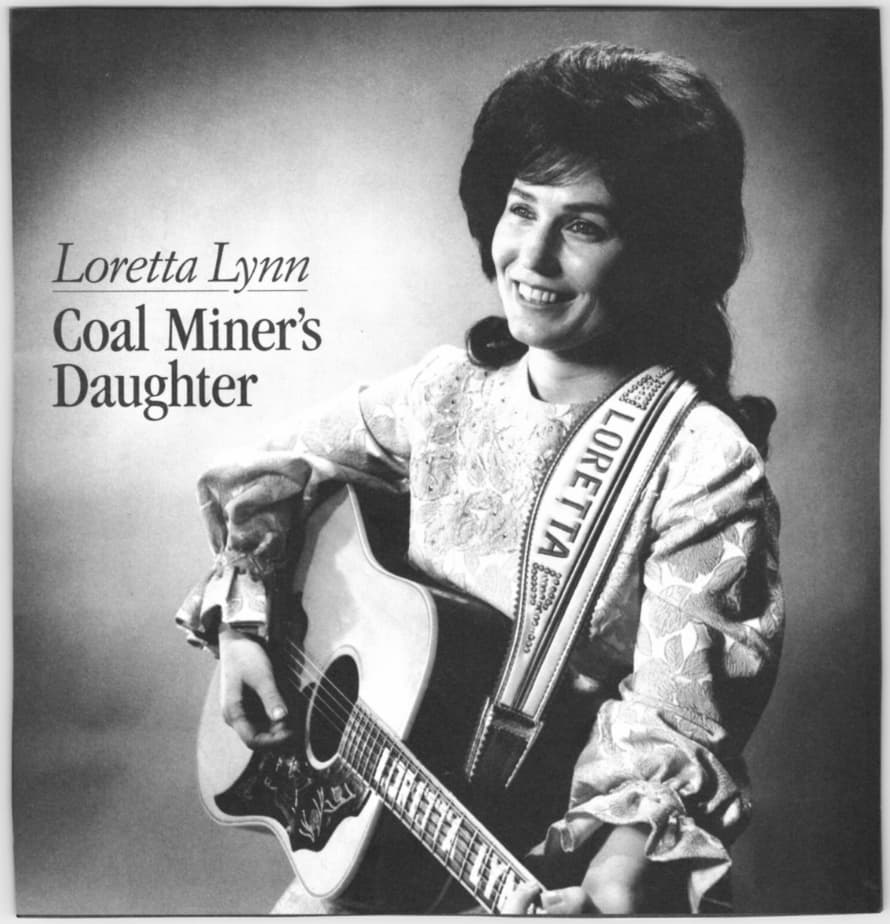
A Daughter’s Testament to Grit, Poverty, and the Poetry of Survival
When Loretta Lynn released “Coal Miner’s Daughter” in 1970 as the title track from her album Coal Miner’s Daughter, she did more than score another country hit — she carved her own legend into the bedrock of American music. The song reached No. 1 on the Billboard Hot Country Singles chart, cementing Lynn’s place not merely as a star of Nashville’s golden era but as one of its most authentic narrators. In an age when many female artists were steered toward polished romanticism, Lynn turned inward and backward, transforming her own hardscrabble childhood in Butcher Hollow, Kentucky, into a universal hymn of working-class endurance and familial devotion.
At its surface, “Coal Miner’s Daughter” is a straightforward autobiographical sketch — a recollection of growing up poor yet proud in a small Appalachian community where survival was both a hardship and an honor. But beneath that plainspoken veneer lies something larger: the codification of an American archetype. Lynn’s lyrics form a narrative bridge between individual memory and collective identity, celebrating rural dignity at a time when modernization threatened to erase such stories from the nation’s cultural consciousness. The power of the song lies not in grand gestures or melodramatic sentiment but in its unadorned truthfulness — each detail rendered with journalistic precision yet delivered with the warmth of familial storytelling.
Musically, the composition embodies the very soil it springs from: simple chord progressions, acoustic textures, and a melody that moves with the easy gait of conversation. Producer Owen Bradley’s arrangement resists overproduction; instead, he frames Lynn’s crystalline voice with subtle accompaniment — guitars, fiddle, and restrained percussion — allowing every syllable to resonate like oral history passed down on a front porch at dusk. Her delivery is neither nostalgic nor self-pitying; it carries the quiet pride of someone who knows that hardship does not diminish beauty but defines it.
What makes “Coal Miner’s Daughter” endure is its dual identity: it is both personal memoir and cultural document. In recounting her father’s toil and her mother’s sacrifices, Lynn gives voice to countless families whose lives were shaped by similar struggles across Appalachia and beyond. The song honors labor without romanticizing poverty; it acknowledges deprivation while exalting love as the sustaining force that kept those households alive through winters of want. This honesty transformed Lynn from performer to chronicler — a working woman singing for those whose stories rarely reached the microphone.
More than five decades later, “Coal Miner’s Daughter” remains one of country music’s defining texts — an anthem of authenticity that transcends genre boundaries. It stands as both autobiography and mythmaking, proving that sometimes the simplest truths — sung plainly by a miner’s daughter — can echo louder than any grandiose dream Nashville ever sold.
 Oldies Songs