
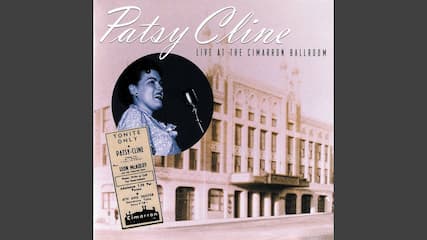
A Night That Refused Silence. When Pain Met Applause at Cimarron Ballroom
At a time when live recordings rarely captured raw human vulnerability, Patsy Cline delivered a performance that would later become one of the most emotionally revealing documents in country music history. The release of Live at the Cimarron Ballroom brought that moment back into public consciousness, accompanied by news footage and interviews featuring figures such as Jan Howard, Charlie Dick, and historian Bruce Hinton.
Recorded on July 29, 1961 in Tulsa, Oklahoma, the concert took place under extraordinary circumstances. Just six weeks earlier, Cline had survived a devastating car accident that left her with severe injuries, including a broken hip. Yet she returned to the stage, still physically fragile, to perform before a live audience.
What makes this performance remarkable is not only the setlist filled with signature songs such as I Fall to Pieces and Walkin’ After Midnight, but also the candid dialogue between songs. In these unscripted moments, Cline openly addressed her condition, telling the audience she was “out of wind” after her hospital stay, turning the concert into a deeply personal exchange rather than a polished show.
The recording captures a rare duality. On one hand, there is the commanding vocalist whose voice helped redefine country music’s emotional range. On the other, there is a woman confronting her own mortality while standing under stage lights. This contrast gives the album its enduring power. It is not simply a performance. It is a testimony.
Interviews included in the news footage reinforce this perspective. Charlie Dick, who later played a key role in preserving her legacy and supporting the release of archival recordings, emphasized how moments like Cimarron revealed the true spirit behind the legend. Meanwhile, Jan Howard’s reflections highlight the awe that fellow artists felt toward Cline’s ability to transform pain into music.
Released decades later in 1997, the album serves as both a historical artifact and a living experience. It allows listeners to step into a night where vulnerability was not hidden but shared.
In retrospect, the performance carries an added layer of poignancy. Less than two years after that night, Cline would lose her life in a plane crash at the age of thirty.
That knowledge turns every note from the Cimarron Ballroom into something more than music. It becomes a voice reaching across time, reminding audiences that even in moments of pain, there can be extraordinary beauty.