
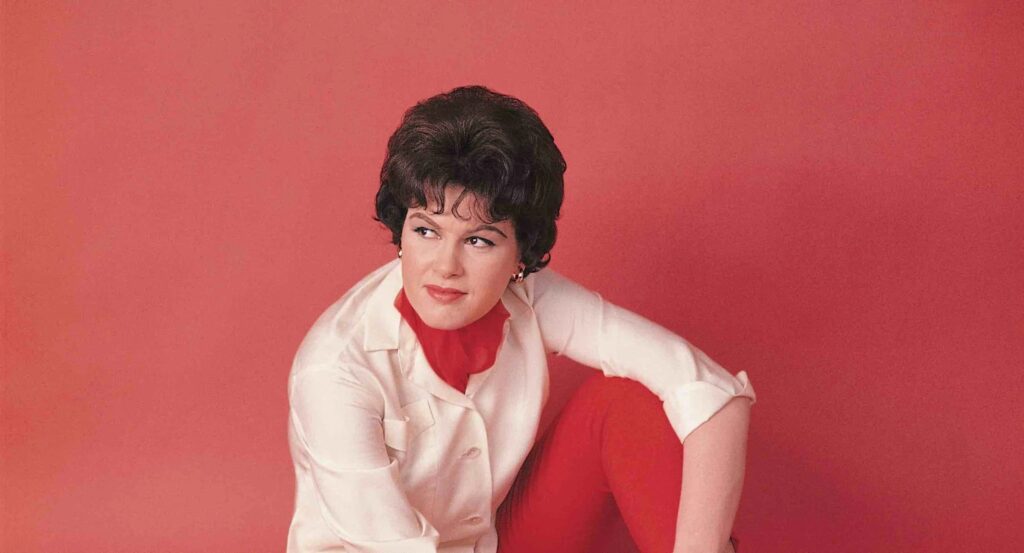
A plaintive cry of heartache softly echoed by one of country music’s timeless voices
When Patsy Cline recorded Seven Lonely Days on August 24, 1961, and included it on her album Showcase (released November 1961), she took a well-worn song and made it her own transforming its original pop cadence into a poignant, feminine lament that resonates with loss, longing, and the ache of lonely nights.
Originally written by Earl Shuman, Alden Shuman, and Marshall Brown and first made famous by artists such as Georgia Gibbs in 1953 the song’s early versions found chart success in pop markets. But when Patsy Cline embraced the song nearly a decade later, she reshaped it with her warm, expressive tone and a subtle country-pop sensitivity that suited heartbreak’s soft ache.
In her rendition, frequently accompanied by the gentle backing of The Jordanaires, Patsy turns each “lonely day” and “lonely night” into something tangible a week stretched by tears, a heart grown heavy under the weight of separation. The lyrics themselves are heartbreak in their simplest form:
“Seven lonely days make one lonely week, seven lonely nights make one lonely me…”
There’s no grand drama, no overwhelming instrumentation, just Patsy’s voice textured, soulful, and honest. It feels like a quiet confession late at night, a letter never sent, a memory revisited in the dim glow of a lamp. For many listeners, that intimacy becomes its power.
Because Seven Lonely Days was released as an album track rather than a single, it did not chart under Cline’s name. However, the album Showcase itself served as a vessel for several of her important recordings, and over time “Seven Lonely Days” found a place in the hearts of fans especially those who knew longing and heartache, and appreciated Patsy’s ability to give sorrow a gentle but unflinching voice.
What adds deeper resonance is the contrast between the song’s original pop-oriented versions and Patsy Cline’s more introspective take. Where the 1950s recordings might have conveyed heartbreak with a lighter touch, Cline’s interpretation feels rooted in memory, regret, and a kind of resignation as if she sings not only for herself, but for anyone who has ever counted the days and nights after love has ended. The minimal accompaniment, the tender vibrato in her voice, the slight melancholy in every phrase all of it works to transform a simple song into a soul-stirring experience of tenderness and sorrow.
Listening to Seven Lonely Days today can feel like opening an old photograph album: familiar faces, quiet moments, memories tinged with longing. For those who lived through the radio age when songs played on crackling speakers, when every needle drop carried emotion it can evoke evenings of solitude, whispered confessions, and the small drifts of sadness that settle long after goodbyes.
Thanks to Cline’s interpretation, the song has endured beyond trends and decades, even when other versions faded into obscurity. It stands as a quiet testament to the power of heartbreak rendered honestly a song that doesn’t demand pity, but evokes a deep empathy.
Above all, Seven Lonely Days reminds us that sometimes sorrow doesn’t come in grand gestures or loud cries. Sometimes it arrives in the hush between notes, in the soft trembling of a voice recalling what once was. Through Patsy Cline’s gentle delivery, those seven lonely days and nights become a universal echo, a poignant shared memory across generations.
 Oldies Songs