
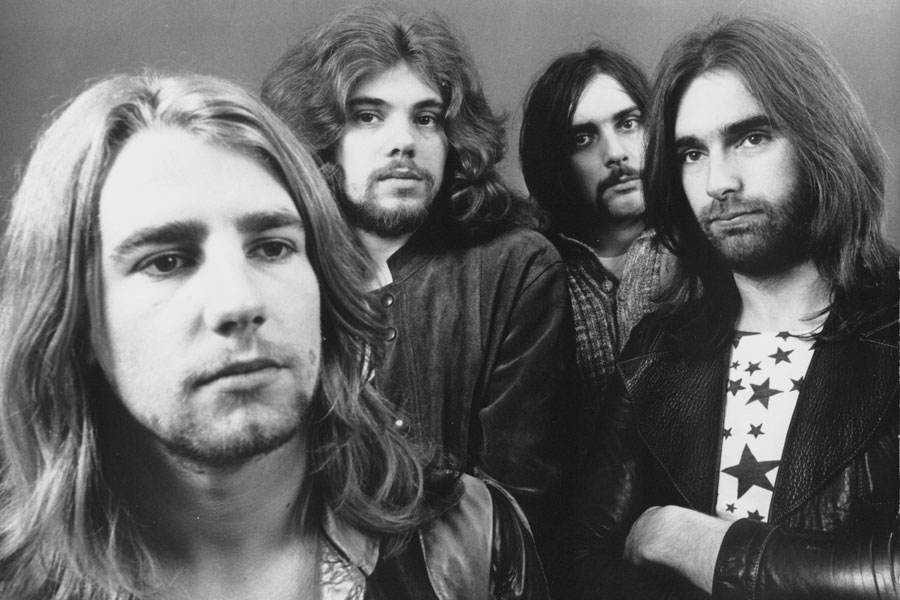
The Song That Did Not Need a Climax to Last Forever
In the catalogue of Status Quo, few songs capture their essence as purely as Rain. Released in the mid 1970s, the track stands as a defining example of the band’s signature boogie rock style. Yet its lasting impact does not come from lyrical complexity or dramatic structure. Instead, it lies in something far more subtle and enduring, the hypnotic power of rhythm.
On the surface, Rain appears deceptively simple. Its lyrics evoke a sense of repetition, emotional cycles, and a lingering mood that refuses to fade. The rain itself becomes a metaphor, not for sadness alone, but for persistence. It suggests a feeling that continues, returns, and quietly shapes the listener’s inner world. Unlike traditional rock anthems that build toward explosive choruses, Rain maintains a steady pulse. It does not rush. It does not demand attention. It draws the listener in gradually.
This quality becomes even more striking in a live setting. Within a concert, Rain often functions as a transitional moment rather than a peak. Positioned between more explosive tracks, it creates a shift in atmosphere. The audience moves from excitement into immersion. The groove settles in, and something changes. Rather than reacting outwardly, listeners begin to move in sync, almost unconsciously. The performance becomes less about spectacle and more about shared rhythm.
Behind the scenes, the creation of Rain reflects the same philosophy. The band relied on tight coordination rather than technical complexity. Every element had to align perfectly. A slight deviation in timing could disrupt the entire flow. This made the song a quiet test of cohesion, revealing the strength of the group’s internal chemistry. It was not about individual brilliance, but about collective precision.
Over the decades, Rain developed a deeper connection with audiences. It may not have been the most commercially dominant track, but it became one of the most emotionally resonant. During later reunion performances, when classic members returned to the stage, the song carried an added weight. The familiar groove was unchanged, yet the context had evolved. Time had passed, and the repetition within the music began to mirror the passage of years itself.
What makes Rain remarkable is its refusal to conform to expectation. It does not seek to overwhelm. It lingers. It builds memory rather than momentary impact. In doing so, it reveals a different kind of power in rock music, one rooted not in volume or speed, but in continuity.
When the final notes fade, Rain leaves behind more than sound. It leaves a feeling that continues, much like the rain it describes, steady, familiar, and impossible to ignore.