
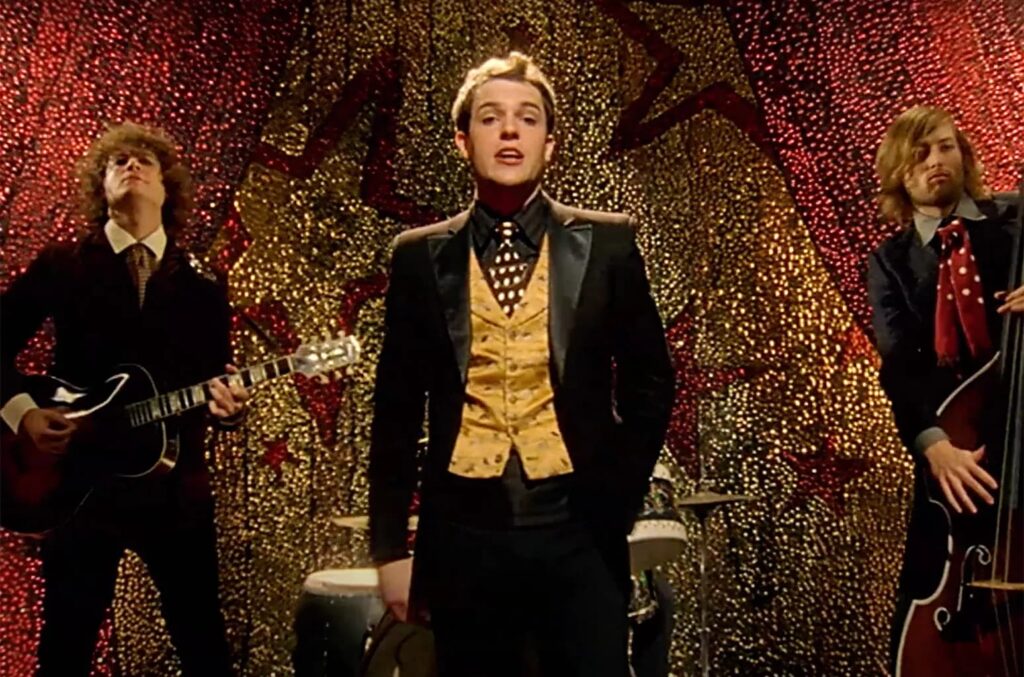
A Restless Mind Trapped in Jealousy, Where Youthful Desire, Paranoia, and Memory Collide in a Single Night
When The Killers released “Mr. Brightside” in 2003, few could have predicted that this urgent, anxious anthem would become one of the most enduring songs of the 21st century. Appearing first as the debut single from their landmark album Hot Fuss (2004), the song marked the arrival of a band that understood something timeless about human emotion: that jealousy, once awakened, never truly fades. Upon its initial release, “Mr. Brightside” reached No. 10 on the UK Singles Chart, while in the United States it climbed to No. 10 on the Billboard Hot 100 in 2005, an impressive feat for a debut single from an unknown Las Vegas band. Over time, the song would achieve something far rarer than chart success it would become a cultural constant.
What sets “Mr. Brightside” apart is not its complexity, but its obsession. Written by Brandon Flowers and Dave Keuning, the song was inspired by a real moment of betrayal early in Flowers’ life, when he discovered that someone he loved was unfaithful. Unlike many songs that explore heartbreak from a distance, this one remains trapped in the instant of realization. There is no resolution, no emotional progression. The narrator does not heal. He relives.
From the opening line, the song plunges directly into the mind of someone spiraling inward. The lyrics repeat themselves deliberately, almost compulsively, mirroring the way jealousy circles the same thoughts again and again. This repetition is not a weakness it is the song’s defining strength. “Mr. Brightside” understands that pain does not always evolve. Sometimes it simply echoes.
Musically, the track draws heavily from post-punk revival influences, particularly bands like The Smiths and New Order, yet it never feels derivative. The driving guitar riff, sharp and relentless, acts like a racing pulse. The rhythm never allows the listener to rest, just as the narrator cannot rest. There is urgency in every measure, a sense that something has already gone wrong and cannot be undone.
Vocally, Brandon Flowers delivers the performance with theatrical restraint rather than melodrama. His voice is tense, controlled, and quietly desperate. He does not scream; he confesses. That choice gives the song its emotional credibility. It feels personal, almost uncomfortable, as though the listener has stepped into someone else’s private thoughts at the exact moment they wish they could escape them.
Upon the release of Hot Fuss, critics quickly recognized “Mr. Brightside” as the album’s emotional core. While other tracks showcased ambition and style, this song revealed vulnerability. Over the years, its popularity only grew. In the UK, it became a phenomenon unlike anything seen before remaining on the UK Singles Chart for hundreds of weeks, re-entering again and again through downloads, streams, and renewed interest across generations. It has since been certified multi-platinum and is widely regarded as one of the most successful British chart singles of all time, despite being recorded by an American band.
The meaning of “Mr. Brightside” has evolved as its audience has aged. What once felt like youthful paranoia now sounds like something deeper: the fear of being replaced, the quiet dread of imagining what happens when trust breaks. It speaks to the universal human tendency to replay moments we cannot change, to imagine scenes we never witnessed, and to suffer not only from reality, but from our own imagination.
Unlike many songs tied closely to a specific era, “Mr. Brightside” feels suspended in time. It does not belong to the early 2000s alone. Its emotional landscape is older, rooted in feelings that have existed as long as love itself. That is why it continues to resonate not as nostalgia, but as recognition.
Today, “Mr. Brightside” stands as more than a hit single. It is a reminder that some songs survive because they tell the truth without offering comfort. The Killers captured a moment of emotional chaos and refused to resolve it. In doing so, they created a song that listeners return to not because it soothes, but because it understands.
And perhaps that is its lasting power. Long after the clubs have closed and the lights have dimmed, “Mr. Brightside” remains a restless confession echoing in the dark, reminding us how fragile certainty can be, and how memory has a way of keeping old feelings painfully alive.