
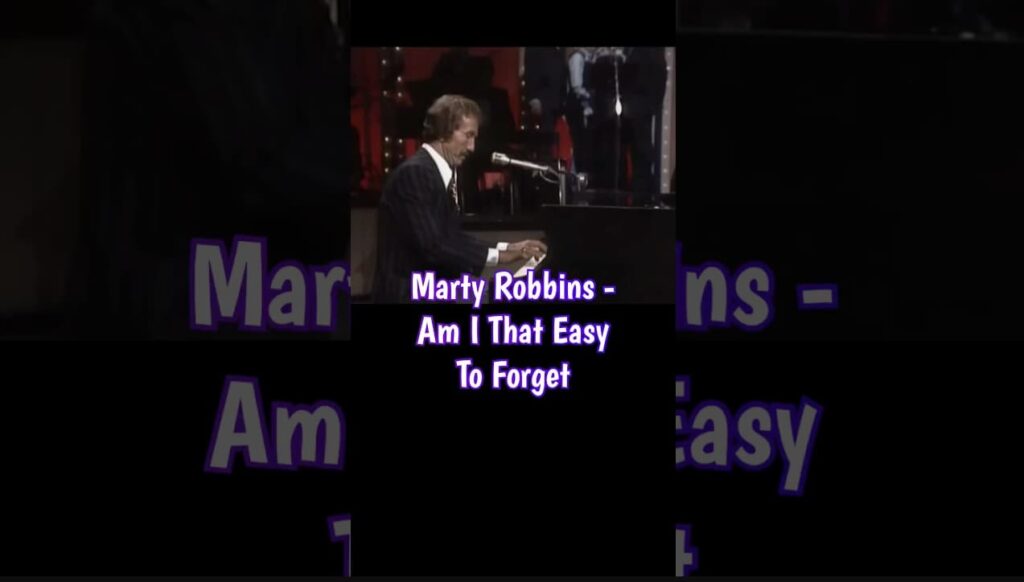
Marty Robbins Performs “Am I That Easy To Forget” on Marty Robbins Spotlight 1978
There are moments in music where time seems to pause, where the noise of the world fades and all that remains is a voice telling the truth. Watching Marty Robbins perform “Am I That Easy To Forget” on Marty Robbins Spotlight in 1978 is one of those moments. It is not just a television performance. It is a quiet conversation between an artist and his audience, carried by decades of experience, heartbreak, and musical wisdom.
As a longtime fan of Marty Robbins, and as someone who has spent years listening carefully to the evolution of American country music, this performance feels deeply personal. By 1978, Robbins was no longer the young hitmaker chasing charts or trends. He was an elder statesman of the genre, a storyteller who had lived every word he sang. And in this particular rendition, that lived experience is impossible to ignore.
A Song That Refuses to Age
“Am I That Easy To Forget” is a song with a long history in country music. First recorded in the early 1950s, it has been interpreted by many artists over the decades. Yet when Marty Robbins sings it in 1978, the song feels less like a standard and more like a confession.
The question at the heart of the song is simple but devastating. Can a love that once felt eternal disappear so easily? Robbins does not ask this question with bitterness or anger. He asks it with resignation, with the quiet dignity of someone who already knows the answer but needs to say the words out loud.
What makes this performance remarkable is how restrained it is. There are no dramatic vocal flourishes, no exaggerated gestures. Robbins trusts the song. He allows the melody to breathe, and he lets silence do some of the work. Each pause feels intentional, as if he is giving the listener time to reflect on their own memories of love and loss.
The Setting of Marty Robbins Spotlight
Marty Robbins Spotlight was more than just another television appearance. It was a platform that allowed Robbins to present himself on his own terms. By the late 1970s, television variety shows were changing, and many artists struggled to adapt. Robbins, however, seemed perfectly at ease.
The stage is simple, almost understated. There is no attempt to overwhelm the viewer with visual spectacle. This minimalism works in the song’s favor. The focus remains squarely on Robbins, his voice, and the story he is telling.
As a viewer, you feel invited into the room rather than kept at a distance. It feels like watching a trusted friend sing in your living room, sharing something fragile and sincere. That intimacy is rare on television, and Robbins achieves it effortlessly.
Marty Robbins in 1978
By 1978, Marty Robbins had already secured his place in music history. From chart-topping hits to iconic Western ballads, his career had spanned multiple styles and eras. Yet what stands out in this performance is how little he seems concerned with legacy or reputation.
There is a sense that Robbins is singing for himself as much as for the audience. His voice, while slightly weathered compared to his earlier recordings, carries a depth that only time can give. The smoothness remains, but it is now layered with experience. Every note feels earned.
As a fan, this is one of the most rewarding aspects of watching his later performances. You are not just hearing a song. You are hearing the sum of a life devoted to music. Robbins does not hide his age or try to sound younger than he is. Instead, he leans into it, allowing the years to enrich the performance.
Vocal Interpretation and Emotional Weight
Vocally, Robbins approaches “Am I That Easy To Forget” with remarkable control. He does not push his voice beyond its natural limits. Instead, he uses subtle shifts in tone and dynamics to convey emotion.
There is a softness in his delivery that suggests vulnerability. At the same time, there is an underlying strength that keeps the song from collapsing into self-pity. Robbins understands that heartbreak does not need to be loud to be powerful.
One of the most striking moments comes near the end of the song, when he lingers slightly on a phrase, allowing it to hang in the air. It is a small choice, but it changes everything. In that moment, the question of being forgotten feels painfully real, not just for the narrator of the song, but for anyone who has ever loved deeply.
Musical Arrangement and Atmosphere
The arrangement supporting Robbins is tasteful and unobtrusive. The instruments serve the song rather than compete with it. Gentle guitar lines and subtle accompaniment create a warm, enveloping sound that complements Robbins’ voice perfectly.
There is a timeless quality to the arrangement. It does not sound dated, even decades later. This is a testament to the musicianship involved and to Robbins’ instincts as a performer. He knew when to step forward and when to let the music carry him.
As someone who pays close attention to musical details, I find this balance particularly impressive. It reflects a deep understanding of how to communicate emotion through sound without excess.
A Fan’s Perspective
Watching this performance as a fan is both comforting and bittersweet. Comforting because it reminds you why Marty Robbins mattered, and still matters. Bittersweet because it captures an artist in the later chapters of his life, aware perhaps that time is moving forward, but still fully present in the moment.
There is a sense of gratitude in the way Robbins sings. Gratitude for the song, for the audience, and for the opportunity to keep sharing music. That gratitude resonates strongly with viewers who have followed his career for years.
For newer listeners, this performance can serve as an entry point into Robbins’ world. It demonstrates that his appeal was never just about hits or genre. It was about honesty, storytelling, and connection.
The Enduring Legacy of the Performance
“Marty Robbins Performs Am I That Easy To Forget on Marty Robbins Spotlight 1978” is more than a title. It is a snapshot of an artist at peace with his craft. Decades later, the performance continues to resonate because it speaks to universal emotions that never go out of style.
In an era where music is often consumed quickly and forgotten just as fast, performances like this remind us of the power of slowing down and listening. Robbins invites us to sit with our feelings, to acknowledge loss without shame, and to find beauty in vulnerability.
As a fan and a student of music history, I return to this performance often. Each time, I hear something new. A subtle inflection, a quiet breath, a moment of stillness. These details are what make great performances timeless.
Closing Thoughts
Marty Robbins did not need grand gestures to leave a lasting impression. In this 1978 performance, he simply stood, sang, and told the truth. That was enough.
“Am I That Easy To Forget” becomes, in his hands, not just a question about romantic love, but a meditation on memory itself. On what we carry with us, and what we leave behind. And as long as performances like this continue to be watched and cherished, the answer becomes clear.
Marty Robbins is not easy to forget.
 Timeless Melodies
  Oldies Songs