
A Portrait of Loneliness, Regret, and Quiet Truth in the Cold Light of Sunday Morning
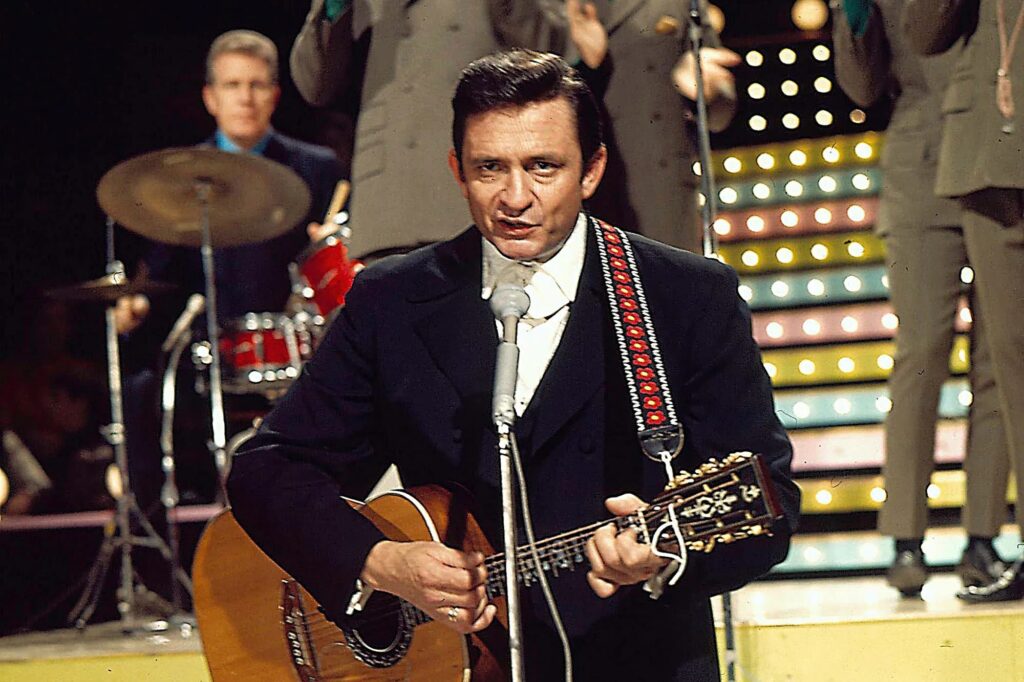
“Sunday Morning Coming Down” stands as one of the most honest and emotionally unguarded songs ever sung in American music, and when Johnny Cash performed it live, the song took on an even heavier, more reflective weight. This was not merely a performance—it was a public confession delivered in a calm, steady voice, shaped by years of living, loss, faith, and hard-earned wisdom.
The song was written by Kris Kristofferson in 1969, during a period when he was still struggling for recognition, working as a janitor at Columbia Records. Inspired by Ray Stevens’ “Sunday Morning Coming Down,” Kristofferson wrote a lyric that captured the emptiness of waking up after a life lived too hard, too fast, and too alone. When Johnny Cash recorded the song and released it in 1970, it reached No. 1 on the Billboard Hot Country Singles chart, becoming one of Cash’s most significant late-career hits. It also won Song of the Year at the 1971 Country Music Association Awards, marking a turning point in how country music addressed vulnerability and realism.
While the studio version is powerful in its restraint, Cash’s live performances of “Sunday Morning Coming Down” reveal something deeper. On stage, Cash no longer sounds like a narrator telling someone else’s story. He sounds like a man standing still inside the song. Each line carries the gravity of experience, especially in moments where silence briefly hangs between words. Those pauses matter. They feel lived-in.
The opening images—“There’s a Sunday morning sidewalk / Wishing, Lord, that I was stoned”—set the tone immediately. This is not rebellion for its own sake. It is exhaustion. In Cash’s live delivery, the lyric lands without shock, without drama. He does not need to emphasize it. The truth of it is enough. By the time he reaches the line about “the cleanest dirty shirt,” the audience understands that the song is not about substances or failure, but about the quiet humiliation of facing oneself in daylight.
What makes Johnny Cash uniquely suited to this song is his voice at this stage of his life. It is weathered, stripped of ornament, and emotionally transparent. He does not sing around the pain—he allows it to exist without apology. In live performances, especially those from the early 1970s, the audience often falls silent. This is not entertainment in the usual sense. It is recognition.
The heart of “Sunday Morning Coming Down” lies in its final verse, where the church bells ring and the singer realizes there is “nothing short of dying” that is half as lonesome as the sound. Cash’s delivery here is devastating in its calmness. There is no self-pity, only awareness. The bells represent faith, community, and belonging—everything the narrator feels separated from. And yet, the song does not condemn religion, nor does it glorify despair. It simply tells the truth of standing outside grace and knowing it.
Historically, this song marked a shift in country music’s emotional vocabulary. It opened the door for deeper introspection, for songs that acknowledged doubt without shame. Johnny Cash, already an icon, lent the song credibility and moral weight. His decision to sing Kristofferson’s lyric—unaltered, uncensored—was an act of artistic courage.
In live settings, Cash often introduced the song with minimal commentary, letting the audience sit with it on their own terms. There is a sense of respect in that choice. He trusted the song. He trusted the listener.
Today, “Sunday Morning Coming Down” remains timeless because it addresses a feeling that never ages: the quiet reckoning that comes when the noise fades and one is left alone with memory and consequence. Johnny Cash’s live performances preserve that feeling in its purest form. No studio polish, no protective distance—just a man, a microphone, and a song that tells the truth gently, but without mercy.
It is not a song that asks for sympathy. It offers understanding instead. And in that understanding, many have found themselves reflected—standing on that same sidewalk, hearing the bells, and feeling the weight of another Sunday morning coming down.
 Oldies Songs