
A Quiet Journey of Goodbye, Where Distance Becomes the Language of Love
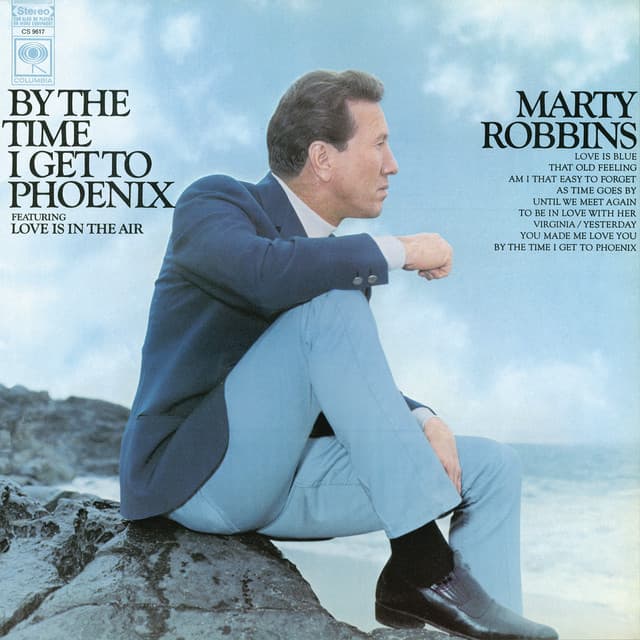
When Marty Robbins recorded “By the Time I Get to Phoenix”, he was stepping into one of the most emotionally refined songs of the American songbook—one that speaks not through confrontation, but through absence. Written by Jimmy Webb, the song had already begun its remarkable journey before Robbins touched it, yet his interpretation stands apart for its restraint, maturity, and inward reflection. It is not a song about leaving in anger, but about the slow, inevitable realization that love has already ended long before the journey begins.
Originally written in 1965, “By the Time I Get to Phoenix” was first recorded by Johnny Rivers, whose version reached No. 62 on the Billboard Hot 100. The song’s true breakthrough came with Glen Campbell, whose 1967 recording climbed to No. 2 on the Billboard Hot 100, No. 1 on the Adult Contemporary chart, and earned multiple Grammy Awards. By the time Marty Robbins recorded the song for his 1967 album Today, it had already become recognized as a modern classic—one of the earliest and finest examples of Jimmy Webb’s gift for emotional storytelling.
Yet Robbins did not approach the song as a competitor to Campbell, nor as an attempt to redefine it. Instead, he re-centered it within his own musical world. Known for his warm baritone and narrative sensitivity, Marty Robbins treated “By the Time I Get to Phoenix” as a private letter rather than a dramatic confession. Where some versions emphasize orchestral sweep, Robbins leaned into emotional clarity.
The story behind the song is deceptively simple. A man leaves a relationship without announcing his departure. As he travels—from Phoenix to Albuquerque, then to Oklahoma—the listener is guided through imagined moments when his absence will finally be noticed. The genius of Jimmy Webb’s writing lies in this structure: the song unfolds in future tense, suggesting that emotional separation has already occurred. The journey is merely catching up with the truth.
In Marty Robbins’ hands, this quiet devastation becomes even more intimate. His vocal delivery is measured, never rushed. Each line feels weighed, considered, as if spoken by someone who has already made peace with the pain. There is no bitterness here, no accusation. What remains is resignation—the understanding that love sometimes fades without a single dramatic moment to mark its end.
Musically, Robbins’ version stays true to the song’s reflective core. The arrangement is gentle, understated, allowing the melody to breathe. This simplicity gives greater emphasis to the lyrics, which unfold like thoughts spoken during a long drive. Robbins’ voice, steady and unforced, carries a tone of emotional fatigue rather than heartbreak—a subtle but powerful distinction.
Within the context of the album Today, the song fits naturally. Released in 1967, the album showcased Marty Robbins moving comfortably between country, pop, and contemporary balladry. While it did not produce major chart-topping singles, Today reflected an artist confident enough to choose songs for their emotional truth rather than commercial certainty. “By the Time I Get to Phoenix” stands as one of the album’s most thoughtful moments.
The deeper meaning of the song lies in its portrayal of emotional distance. The narrator does not leave to punish or to escape; he leaves because staying would mean continuing a relationship that no longer exists in spirit. The silence between the two people has grown louder than words. Robbins understands this nuance, and he sings it with empathy rather than judgment.
Over time, the song has come to represent a turning point in popular songwriting—a move away from simple love stories toward more psychologically complex narratives. Jimmy Webb’s work opened new emotional territory, and artists like Marty Robbins helped give that territory depth and credibility through interpretation rather than embellishment.
Listening to Robbins’ version today, one hears a man reflecting on the quiet endings that shape a life. Not every goodbye is spoken aloud. Not every heartbreak arrives suddenly. Sometimes, love fades mile by mile, city by city, until only distance remains.
In the end, “By the Time I Get to Phoenix” as sung by Marty Robbins is not about travel or departure. It is about emotional honesty—the courage to recognize when a chapter has already closed. With dignity, restraint, and deep understanding, Robbins turns a modern classic into a personal meditation on loss, acceptance, and the long road that follows the end of love.
 Oldies Songs