
A tender meditation on memory and innocence, where love survives not in time, but in a single unforgettable image
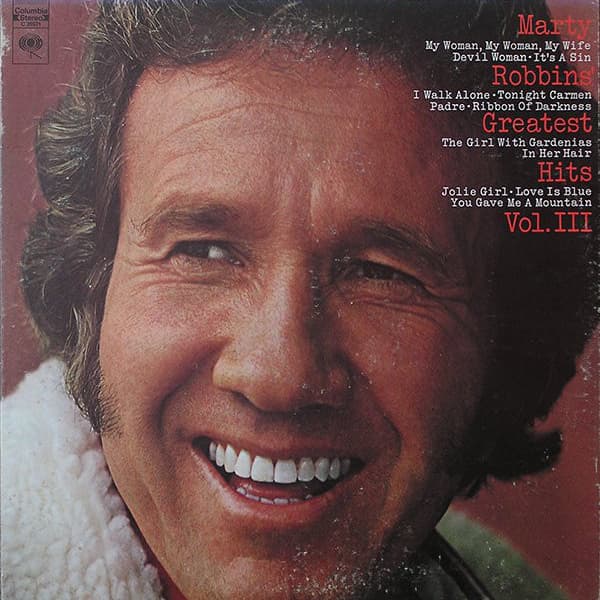
When discussing Marty Robbins, it is easy to focus on his towering hits, his chart-topping Western ballads, or his commanding presence in country music history. Yet some of his most enduring artistic statements are found not on the singles charts, but quietly nestled within his albums. “The Girl With Gardenias In Her Hair” is one such song — a deeply reflective piece that never sought commercial attention, and yet continues to resonate with uncommon emotional clarity.
The song first appeared on More Gunfighter Ballads and Trail Songs (1960), the follow-up to Robbins’ landmark album Gunfighter Ballads and Trail Songs. While the album itself was a major success, reaching No. 6 on the Billboard Pop Albums chart and No. 2 on the Country Albums chart, “The Girl With Gardenias In Her Hair” was never released as a single and therefore did not enter the Billboard singles charts. That absence, however, is precisely what gives the song its quiet dignity. It was never shaped for radio play. It was written to be felt.
Musically, the song is restrained and intimate. There are no dramatic flourishes, no sweeping crescendos. The arrangement allows Robbins’ voice to carry the entire emotional weight. His delivery is calm, measured, almost conversational — the voice of a man looking back rather than crying out. This was a hallmark of Robbins’ artistry: the ability to suggest deep emotion without ever forcing it upon the listener.
Lyrically, the song revolves around a single, haunting image — a young woman with gardenias in her hair. Gardenias, traditionally symbols of purity, devotion, and unspoken love, serve as a powerful metaphor. Robbins does not describe the relationship in detail. He doesn’t need to. Instead, he offers fragments: a moment, a presence, a memory preserved in scent and sight. The girl is not defined by action or dialogue, but by how she is remembered.
What makes “The Girl With Gardenias In Her Hair” especially poignant is its emotional maturity. This is not a song about betrayal or anger. There is no accusation, no plea for reconciliation. The love depicted here belongs to the past, and both singer and listener understand that it will remain there. The sadness comes not from loss alone, but from the awareness that some moments are too perfect to survive reality.
In the broader context of Marty Robbins’ work, the song reveals another dimension of his storytelling. While he is often celebrated for epic narratives filled with conflict and resolution, here he chooses stillness. The story does not move forward — it circles gently around a memory, returning again and again to the same image, as if afraid that letting go would erase it entirely.
This approach aligns beautifully with the emotional undercurrent of the early 1960s, a period when American popular music was beginning to shift, yet still deeply rooted in melody and narrative. Robbins stood at that crossroads, bridging traditional country storytelling with a more introspective, almost literary sensibility.
Over time, “The Girl With Gardenias In Her Hair” has become a cherished deep cut among listeners who seek something quieter, something reflective. It rewards patience. Each listen reveals another nuance — a pause in Robbins’ phrasing, a gentle emphasis on a word, a sense of acceptance beneath the longing.
In the end, the song is not about a girl, nor even about love lost. It is about memory itself — how certain images outlive entire relationships, how the past continues to whisper long after the present has moved on. Marty Robbins understood that not all stories need an ending. Some simply need to be remembered.
And as long as this song is played, the girl with gardenias in her hair remains exactly as she was — untouched by time, forever alive in song.
 Oldies Songs