
A weary return to familiar ground where memory, myth, and regret quietly converge
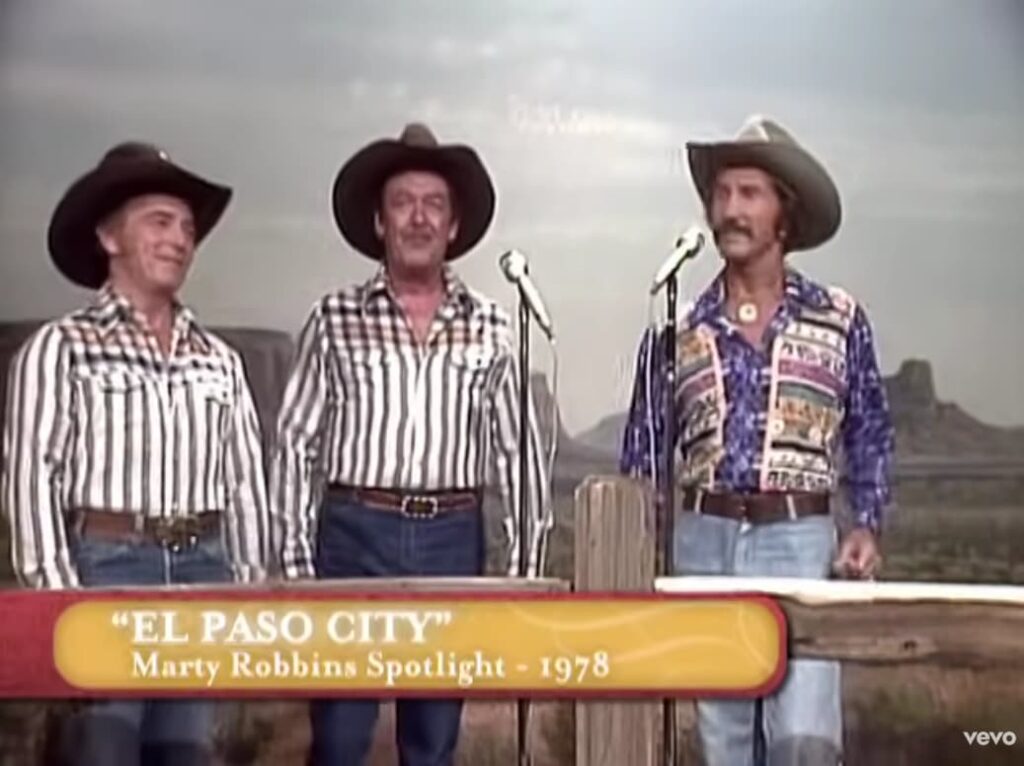
When Marty Robbins performed El Paso City live on Marty Robbins Spotlight in 1978, he was revisiting one of the most introspective works of his later career. Originally released in 1976 as the title track of the album El Paso City, the song climbed into the Top 10 on Billboard’s Hot Country Singles chart, reaffirming Robbins’s remarkable ability to remain artistically relevant decades after his initial rise. Unlike the explosive success of El Paso, this sequel of sorts arrived quietly, carried not by novelty or drama, but by reflection. By the time Robbins sang it under studio lights in 1978, El Paso City had already established itself as something rare in popular music: a meditation on legacy written by the very artist who created it.
Where El Paso galloped headlong into tragedy, El Paso City walks slowly through memory. The song is not a narrative ballad in the traditional sense, but a conversation between past and present. Robbins frames himself as a man haunted by a place he cannot fully explain, bound by a story he once told so convincingly that it now feels like lived experience. The brilliance of the song lies in its meta narrative structure. The singer is both creator and captive of the myth. El Paso is no longer just a setting. It is a psychological landscape, a symbol of unfinished emotional business and the strange power of stories to shape identity.
In the 1978 Spotlight performance, Robbins delivers the song with a gentleness that deepens its meaning. His voice, richer and more measured than in his early years, carries a tone of quiet resignation. There is no attempt to dramatize the connection to the original ballad. Instead, Robbins allows the lyrics to unfold like a confession. Lines about waking from dreams of Rosa’s Cantina feel less like callbacks and more like admissions. This is a man acknowledging that the characters he once imagined never truly left him.
Musically, El Paso City mirrors this introspection. The arrangement is smooth, restrained, and almost conversational, leaning into the countrypolitan style that defined much of Robbins’s 1970s work. The melody does not demand attention. It invites contemplation. In the Spotlight setting, stripped of spectacle, the song’s emotional architecture becomes even clearer. Robbins stands not as a cowboy or narrator, but as a songwriter reflecting on the cost of creation itself.
What makes this performance especially poignant is the awareness of time. By 1978, Robbins had already lived several musical lives: rockabilly pioneer, Western balladeer, pop crooner, and country statesman. El Paso City feels like a moment where all those selves intersect. It is not nostalgia for youth, but an acknowledgment of how deeply one defining work can mark a lifetime.
In singing El Paso City on Marty Robbins Spotlight, Robbins offered more than a performance. He offered perspective. It was the sound of an artist standing at the crossroads of memory and meaning, looking back not with regret, but with understanding. And in doing so, he reminded us that the most enduring songs are not always the ones that race toward the ending, but the ones that linger, asking what remains after the story has already been told.
 Timeless Melodies
  Oldies Songs