
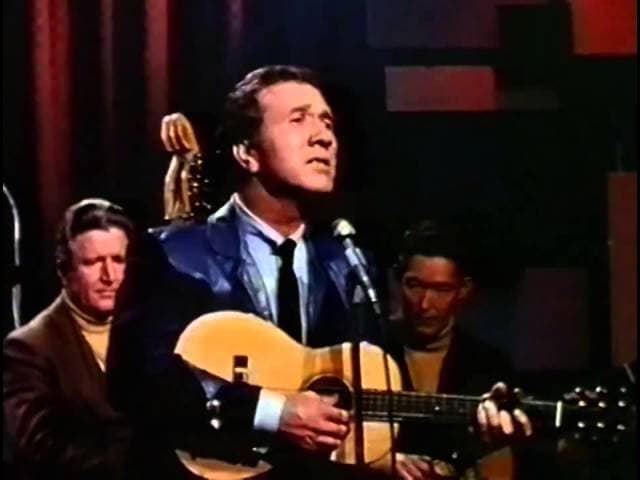
A calm confession of love’s quiet unraveling, where honesty arrives only after all the excuses are gone
In the long and distinguished career of Marty Robbins, few songs capture emotional self-awareness as gently and truthfully as “Making Excuses.” Released in 1972, the song stands as one of Robbins’ most mature statements — not dramatic, not accusatory, but deeply reflective. It is a song about the slow realization that love has faded, and that the hardest part is not leaving, but admitting why.
“Making Excuses” was issued as a single in early 1972 and became one of the final major chart successes of Robbins’ career. The song climbed to No. 2 on the Billboard Hot Country Singles chart, where it remained for several weeks, narrowly missing the top position. It also reached the Top 10 on the RPM Country chart in Canada, confirming its broad emotional appeal. At a time when country music was beginning to shift toward slicker production and sharper themes, Robbins delivered something quieter — and listeners responded.
Written by Marty Robbins himself, the song carries the unmistakable weight of personal insight. Robbins had always been a master storyteller, often using vivid characters and narrative drama. Here, however, the story is internal. There are no gunfighters, no grand romances, no cinematic finales. Instead, the drama unfolds in the mind of a man who has been lying gently, repeatedly to himself.
Lyrically, “Making Excuses” revolves around avoidance. The narrator admits to inventing small reasons to delay the inevitable conversation, the unavoidable truth. These excuses are not cruel; they are human. He is not angry, nor is he betrayed. He is simply no longer in love, and that realization carries its own quiet sorrow. What makes the song powerful is that Robbins never casts blame. The failing of love is presented as something gradual, almost accidental.
Musically, the arrangement mirrors this emotional restraint. The tempo is unhurried, the instrumentation clean and supportive. Gentle acoustic textures and subtle steel guitar lines frame Robbins’ voice without overwhelming it. There is no urgency in the music, only a steady forward movement much like the emotional progression of the song itself. Producer Billy Sherrill, known for shaping emotionally rich country records, allowed the song to breathe, trusting its honesty to carry the weight.
Vocally, Marty Robbins delivers one of his most understated performances. His voice is warm but weary, calm yet conflicted. He does not dramatize the words. Instead, he sounds like someone thinking out loud, finally admitting what he has known for some time. That conversational tone creates intimacy, drawing the listener into the moment of realization rather than the aftermath.
The song’s emotional strength lies in its acceptance. There is no promise of reconciliation, no plea for understanding. The narrator knows that love cannot be repaired once truth has been postponed for too long. In this way, “Making Excuses” feels less like a breakup song and more like a confession spoken not to the other person, but to oneself.
Within the broader context of Marty Robbins’ career, the song reflects an artist fully comfortable with emotional complexity. By the early 1970s, Robbins had already achieved legendary status through Western ballads, pop crossovers, and chart-topping country hits. He no longer needed to prove his versatility. “Making Excuses” shows him choosing honesty over spectacle, subtlety over drama.
The song also resonates because it reflects a universal emotional pattern. Many relationships do not end in arguments or betrayals, but in silence and delay. Robbins captures that emotional gray area with remarkable clarity. The excuses are not malicious; they are protective. They allow time to pass without confrontation until time itself becomes the answer.
Over the years, “Making Excuses” has remained a favorite among listeners who appreciate country music’s ability to explore emotional truth without exaggeration. It does not rely on clever wordplay or striking imagery. Its power comes from recognition the moment when the listener hears their own unspoken thoughts reflected back to them.
In the end, Marty Robbins offers no judgment, only understanding. The song does not condemn the narrator for his hesitation. It simply acknowledges that love sometimes ends quietly, not because of one great failure, but because honesty arrives too late.
Long after the final note fades, “Making Excuses” lingers as a reminder that the most difficult conversations are often the ones we postpone the longest. And in giving voice to that hesitation, Marty Robbins once again proved that true storytelling does not need noise only truth, spoken gently.
 Oldies Songs