
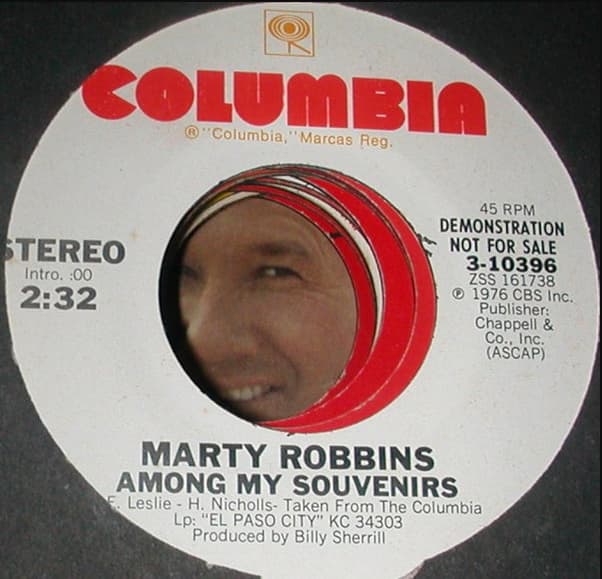
A Ballad of Memory and Melancholy, Where Love Lingers in the Fading Light of Yesterday
When Marty Robbins released “Among My Souvenirs” in 1957, his voice carried a wistful tenderness that seemed to slow time itself. The song appeared on his album The Song of Robbins, a collection that paid homage to the great torch songs of an earlier era. Robbins’ rendition of “Among My Souvenirs”—originally a standard from 1927—reached the Billboard country charts, reaffirming his uncanny ability to bridge generations through his music. By the time it found its way into his repertoire, Robbins had already established himself as one of country music’s most versatile storytellers, and this recording demonstrated his capacity to transform a well-worn ballad into something deeply personal and emotionally luminous.
At its heart, “Among My Souvenirs” is a meditation on memory—the way love survives in fragments, in keepsakes, in the quiet spaces between what once was and what remains. Robbins approached the song not as a performer reviving an old hit, but as a man communing with the ghosts of his own heart. His interpretation is stripped of theatricality; instead, it glows with restraint. The gentle orchestration, steeped in mid-century Nashville elegance, allows Robbins’ voice to carry the emotional burden. He doesn’t weep; he remembers. Each phrase feels like a brushstroke on fading sepia, painting the contours of a love that has become a relic, yet refuses to vanish entirely.
The song’s origins trace back to the late 1920s, a time when sentimental ballads dominated radio waves and dance halls. But Robbins’ version, coming three decades later, imbued it with a distinctly postwar sensibility. It spoke to a generation familiar with loss—not just romantic, but existential. The lyrics evoke tangible relics of intimacy—a letter, a photograph, a forgotten trinket—yet beneath them lies a universal ache: the recognition that memory itself is both comfort and captivity. Robbins’ phrasing captures that paradox beautifully. He lingers over certain words as if reluctant to let them go, his voice trembling between remembrance and release.
What makes this performance endure is its emotional honesty. Robbins had a gift for dissolving the boundaries between genres—country, pop, western balladry—and here he distilled them into pure feeling. “Among My Souvenirs” becomes not just a song, but a ritual of remembrance. It reminds us that every love, once lived, leaves behind its tokens: a melody, a moment, a trace of perfume on the air. In Robbins’ hands, these souvenirs become sacred—testaments to the human need to hold on, even as time insists we let go.
 Timeless Melodies
  Oldies Songs