
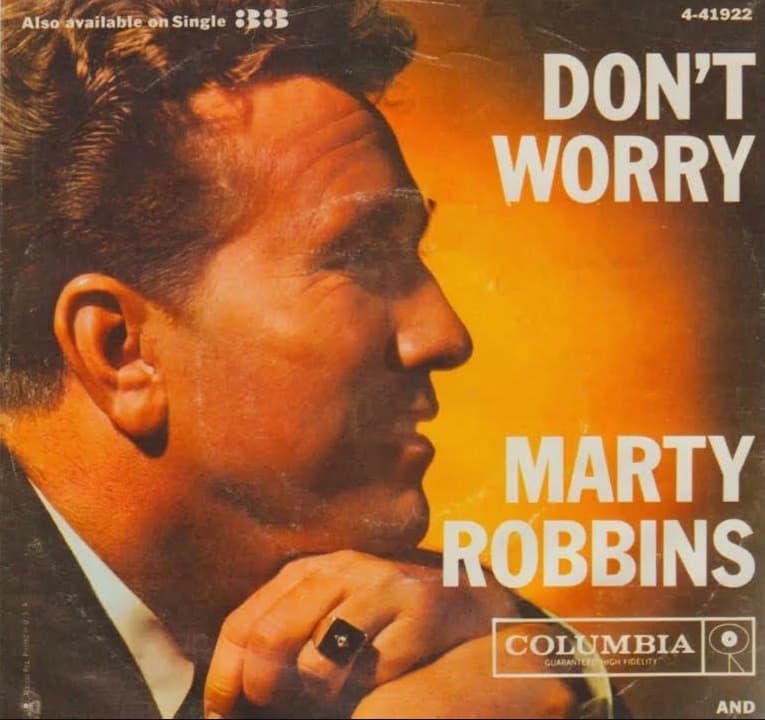
When Heartache Meets Innovation: A Country Ballad That Accidentally Redefined Sound
When Marty Robbins released “Don’t Worry” in 1961, it stood as a tender country ballad, steeped in the melancholy ache of love’s uncertainty. Featured on his album More Greatest Hits, the song quickly rose to prominence, spending multiple weeks atop the Billboard Hot Country & Western Sides chart and crossing over to the Billboard Hot 100, where it reached the Top 5—a rare feat for a country single at the time. Yet what made “Don’t Worry” endure beyond its chart life was not only its emotional resonance but also a serendipitous technical error that changed the sound of popular music forever.
The story goes that during the recording session at Nashville’s Quonset Hut Studio, guitarist Grady Martin’s six-string bass accidentally ran through a faulty channel on the mixing board. The result was a distorted, fuzzy tone—a warm, growling imperfection that would later be recognized as one of the first appearances of electric guitar “fuzz.” Rather than discard the take, Robbins and his producer Owen Bradley left it in. The effect became iconic, lending a ghostly undercurrent to Robbins’ smooth, sorrow-tinged voice. In that moment of technological happenstance, country music brushed shoulders with the birth of psychedelic rock and electric experimentation—a testament to how accidents can sometimes become history’s most inspired brushstrokes.
But even without its sonic accident, “Don’t Worry” is a masterwork of emotional restraint and quiet devastation. Robbins delivers his lines with a kind of stoic tenderness, embodying a man who consoles another—perhaps himself—as he faces love’s inevitable erosion. The song’s melody moves with languid grace, each phrase suspended between hope and resignation. It is less a plea than a lullaby for disillusionment: gentle words offered against the encroaching certainty that love cannot always be saved by reassurance alone.
Robbins’ artistry lies in his ability to make simplicity profound. The arrangement—anchored by softly brushed drums, pedal steel sighs, and that haunting fuzz bass—feels timeless because it leaves space for silence, for breath, for contemplation. It captures what country music at its best always sought: truth told plainly but sung beautifully. “Don’t Worry” invites listeners to inhabit that space between heartbreak and acceptance, between knowing and pretending not to know.
In retrospect, the song stands at a fascinating crossroads in American music—the meeting point between old Nashville polish and the dawning experimental spirit of the 1960s. Marty Robbins, ever versatile and unafraid to blur genre lines, delivered more than just another country hit; he gave us a moment where vulnerability met innovation, where human fragility found an unexpected companion in electronic imperfection. More than six decades later, “Don’t Worry” still hums with that accidental magic—the sound of sorrow refracted through circuitry, echoing into eternity.
 Timeless Melodies
  Oldies Songs