
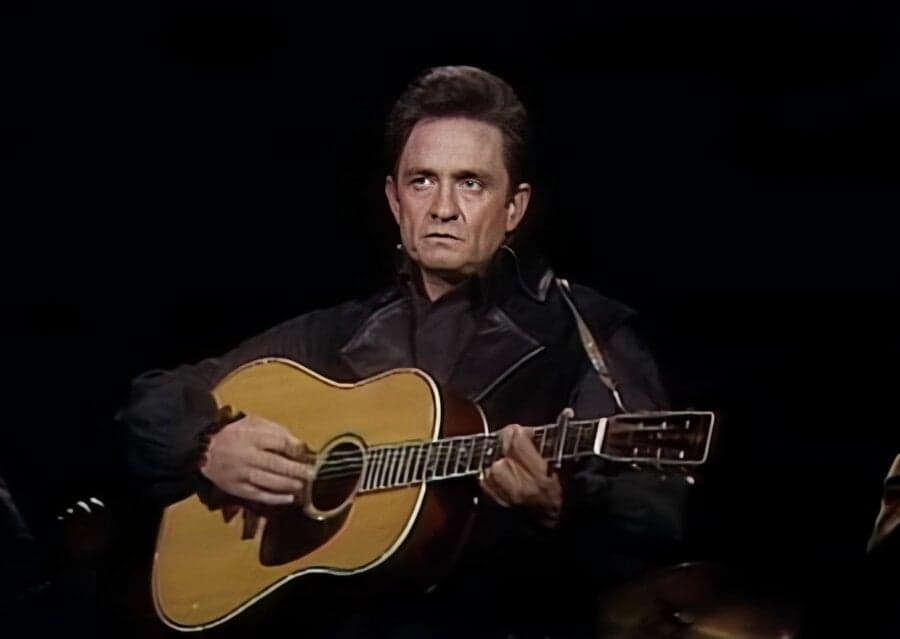
A wild, self-parody about identity swallowed by absurdity — “The Chicken in Black” by Johnny Cash
“The Chicken in Black” is a tongue-in-cheek, surreal story song in which Johnny Cash lampoons himself and the pressures of his persona, turning a brain transplant into a full-blown novelty tale.
Released in 1984, “The Chicken in Black” charted modestly, reaching #45 on the U.S. Billboard Country chart. At the time, Cash’s relationship with his record label — Columbia Records — was strained, and the song has often been interpreted as a deliberate act of mockery. By releasing this oddball single, Cash was arguably “dismantling his own legacy,” using a comedic, exaggerated story to make a pointed commentary on his career and his label.
The narrative is delightfully absurd. In the lyrics, Cash complains of terrible headaches, and a doctor diagnoses him by saying that his body “has outlived [his] brain.” In a once-in-a-lifetime medical twist, he’s sent to New York, where another doctor transplants into him the brain of a dead bank robber. Soon after, he returns to Nashville, but he’s not the same: his new brain drives him to commit bank robberies, complete with guitar-case holdups, while he declares himself “the Manhattan Flash.”
The plot gets even more bizarre. When Cash pleads to get his old brain back, the doctor replies that it has been implanted into a chicken — and not just any chicken, but one that is now a country music star with a contract, performing on a “Johnny Chicken Show.” It’s an almost Dadaist fantasy, a whimsical twist on fame, identity, and bodily autonomy.
But behind the humor lies something deeper. According to critics and biographers, Cash used the song to voice frustration with his label at the time. By poking fun at himself — his “Man in Black” image, his public identity, his artistic legacy — he was also criticizing Columbia Records for how they managed his music. In his second autobiography, Cash himself admitted to later disliking the song, calling it “intentionally atrocious” after the public reaction was mixed, especially from his friends and family.
Musically, the song is relatively straightforward country, but it leans into the drama of its own silliness. Cash delivers his lines with a wry, almost deadpan delivery, playing the ridiculous parts earnestly — which paradoxically makes them funnier. The production under Billy Sherrill matches the comedic tone, giving space for the story without turning overly slick or glam.
In a way, “The Chicken in Black” stands out in Cash’s catalog as one of his most self-aware and risky recordings. It is not a ballad of sorrow, redemption, or love — but a deliberate parody, a moment when Cash leaned into humor to reflect on his fame, his art, and perhaps even his desperation
Years later, the song has found a strange revival. In recent times, it trended on TikTok, with users making comical videos of their pets or staging mini-skits to the chorus. The renewed attention has given “The Chicken in Black” a second life, turning a quirky, often forgotten song into a cult favorite.
Ultimately, this track reveals a side of Johnny Cash rarely seen in his more serious work: his willingness to laugh at his own myth, his discomfort with his public persona, and his readiness to use humor as a tool of subversion. It’s bizarre, audacious, and, yes — intentionally ridiculous — but in that ridiculousness lies a bold, raw humanity.
 Oldies Songs