
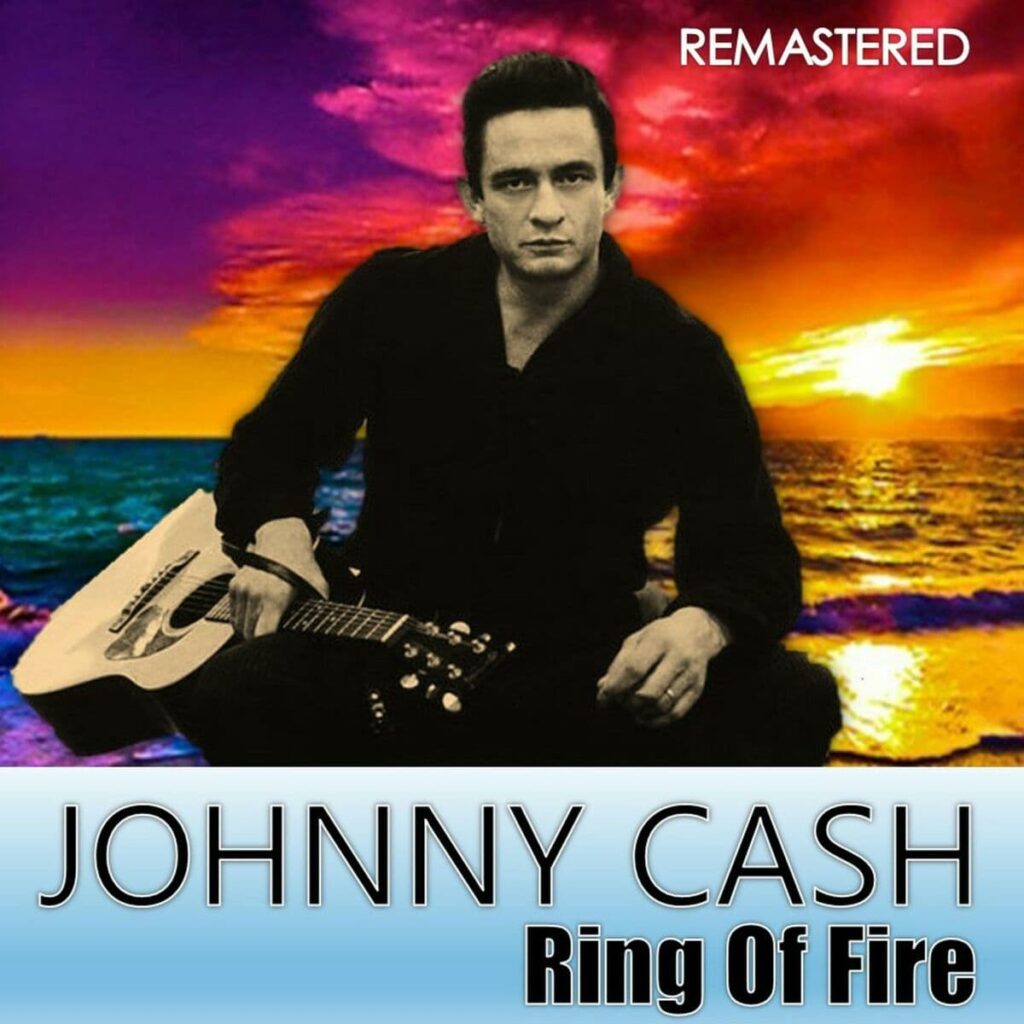
A blazing metaphor for love’s fierce flame and its inescapable pull “Ring of Fire” by Johnny Cash
“Ring of Fire” is a powerful declaration of passionate, consuming love written in fire and sung with the steady intensity that only Johnny Cash could deliver.
When Johnny Cash released “Ring of Fire” in 1963, it quickly became one of his defining hits. The song ascended to #1 on the Billboard Country Singles chart, holding that place for several weeks, and crossed over to the pop audience, reaching #17 on the Billboard Hot 100. Its success was not just a fleeting chart moment it marked a turning point in Cash’s career, cementing the song as a timeless classic.
The story behind “Ring of Fire” is rooted deeply in love, heartbreak, and personal transformation. The song was written by June Carter (who would later become June Carter Cash) and Merle Kilgore. June Carter, reflecting on her relationship with Cash, used the metaphor of a burning ring to describe the uncontrollable, all-consuming nature of their love: she once said, “There is no way to be in that kind of hell … no way to extinguish a flame that burns, burns, burns.” What makes it even more personal is that the imagery apparently came from a book her uncle A.P. Carter once owned a fitting origin for a song so deeply enmeshed in country’s musical roots.
Cash’s version was not the first. Anita Carter, June’s sister, had already recorded the song as “(Love’s) Ring of Fire” for her Mercury Records album Folk Songs Old and New. But Johnny Cash, moved by the song, claimed he had a vivid dream of it “accompanied by Mexican horns.”With that dream as inspiration, he insisted on adding a mariachi-style trumpet section a bold choice for his sound at the time.The trumpet work, played by Bill McElhiney and others, gives the song its distinct, unforgettable fire.
Musically, “Ring of Fire” is deceptively simple yet richly arranged. Cash’s deep, resonant voice carries both strength and vulnerability as he sings of falling “into a burning ring of fire.” The instrumentation steady guitar, drums, and those blazing trumpets builds a sense of urgency, matched by backing vocals from The Carter Family and other singers.
Lyrically, the song captures a paradox: love that is sweet, but wild; love that binds, but also threatens. Lines like “The taste of love is sweet / When hearts like ours meet,” followed by “Oh, but the fire went wild,” speak to a love that is both tender and dangerous. Cash’s daughter, Rosanne Cash, later reflected that the song, for the family, speaks to “the transformative power of love.”
The impact of “Ring of Fire” is profound. It became the title track of the compilation album Ring of Fire: The Best of Johnny Cash, released in 1963 by Columbia Records, which collected many of his key singles from that early Columbia era. That album itself went on to be a flagship for Cash, helping to define his legacy in the years to come.
But beyond charts and albums, “Ring of Fire” endures because it speaks to something elemental in love how it can lift you, burn you, and change you irrevocably. For listeners who remember the warm glow of a vinyl record player, or quiet radio evenings, the song remains timeless. Cash’s voice, steady and unwavering even through the metaphorical flames, makes us feel the weight of love’s heat the danger, the beauty, and the truth that sometimes, the most profound connections are forged in fire.
 Oldies Songs