
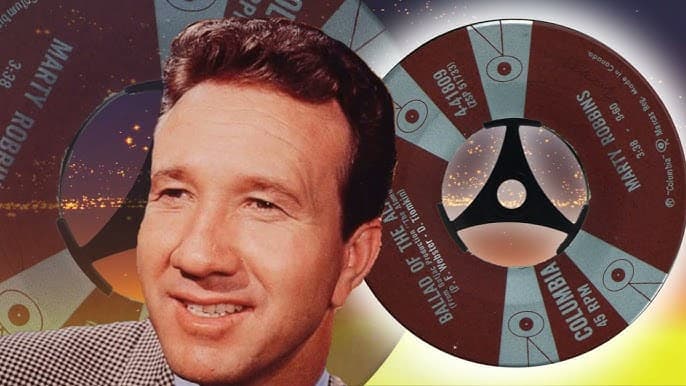
A Reverent Musical Tribute to Valor and Memory: Marty Robbins – “Ballad of the Alamo”
“Ballad of the Alamo” is one of Marty Robbins’ most majestic and narratively powerful songs a sweeping musical retelling of one of the most poignant moments in American history, rendered with poetic dignity and deep emotional weight.
Long before contemporary artists turned to intricate concept albums, Robbins a consummate storyteller—embraced history itself as his muse. Ballad of the Alamo was first recorded and released in 1960 in conjunction with the epic film The Alamo, starring John Wayne. Written by renowned composer Dimitri Tiomkin and lyricist Paul Francis Webster for the movie’s soundtrack, Robbins’ version became the definitive musical telling of the Battle of the Alamo, transforming historical narrative into song.
Musically and culturally, this song stands apart from typical country fare. Its rich, somber melody and evocative phrasing lift it toward the realm of cinematic balladry, a bridge between folk tradition and historical epic. Robbins’ performance captured the imagination of a wide audience; the single spent 13 weeks on the Billboard pop charts, peaking at No. 34, a notable achievement for a nearly six-minute track rooted in historical storytelling rather than pop-oriented hooks.
The lyrics unfold like a chronicle sung by a witness to memory rather than mere recounting. From the opening image of the ruins of the fortress near San Antonio to the ghostly echoes of bugles between sunset and sunrise, the song sets a scene that is at once haunting and reverent. It names legendary figures such as Colonel William Barret Travis, Davy Crockett, Jim Bowie, and Captain Dickinson men who stood together in a desperate stand for freedom against overwhelming odds.
In Robbins’ telling, we feel the tension and courage of that fateful siege in 1836: volunteers gathering from Texas and Tennessee, muskets and squirrel guns held side by side against an invading force, and Travis drawing a line in the sand as a symbolic test of resolve none of the defenders choosing to leave. Before Santa Anna’s forces, the defenders held firm, resisting walls breached and hope fading until the tragic end.
What makes Ballad of the Alamo resonate so deeply, beyond its historical content, is the emotional layering woven into its structure. After recounting the siege and its inevitable fall, the narrative shifts to a solitary cowboy riding near the ruins a century later. He observes grazing cattle where once cannons roared and finds his eyes misting, his heart swelling with respect and awe. This transition from historical epic to personal reflection is the song’s beating heart an invitation for listeners to connect their own sense of memory, loss, and reverence with the echoes of a storied past.
Robbins’ ability to convey such gravitas was not accidental. He was already celebrated for narrative masterpieces like “El Paso,” where musical storytelling feels as vital as any novel or film. In Ballad of the Alamo, that gift reaches a pinnacle: a fusion of lyrical history and emotional realism that makes listeners feel as if they stand beside the defenders in the dust and sun.
The song’s public and critical embrace spanning radio play, charting success, and enduring recognition speaks to its power. Members of the Western Writers of America later selected the theme song from The Alamo soundtrack, which includes Ballad of the Alamo, as one of the Top 100 Western songs of all time, underscoring its significance not just as a country record, but as a cultural artifact.
For many listeners, the song carries a deep nostalgic weight. It evokes evenings around the radio or early LP listening, moments when music was a gateway to imagination and memory. Its narrative sweep recalls the era when songs did more than entertain they taught, memorialized, and connected generations to the past through melody and voice.
Ballad of the Alamo remains more than a historic recounting; it is a musical monument built of story and song, a tribute to courage and sacrifice that lives on in the spine of every chord and the solemn cadence of every verse. In Robbins’ voice, the echoes of history become a living emotion a reminder that music can immortalize not only people and places, but the very spirit of resolve that defined an age.
 Oldies Songs