
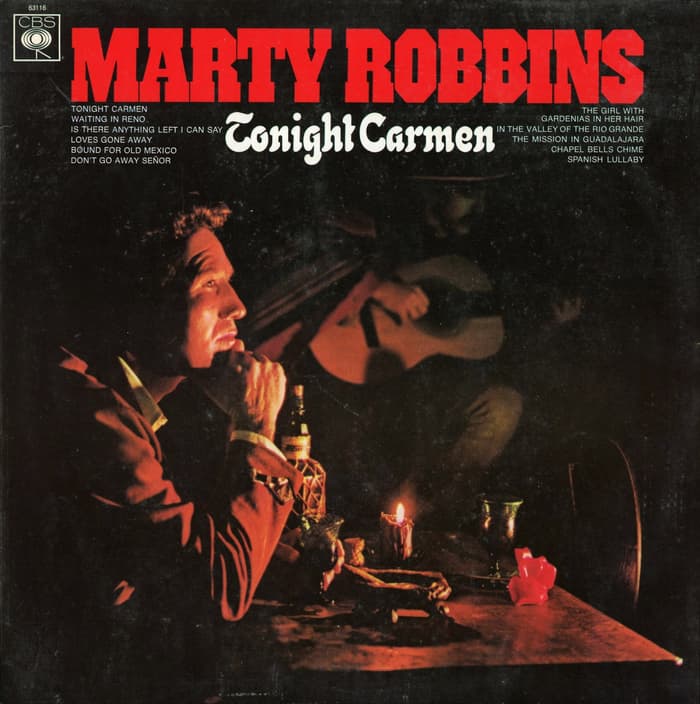
A Midnight Promise and a Dangerous Tomorrow: Love on the Edge in “Tonight Carmen”
“Tonight Carmen” stands as one of the most emotionally charged and quietly dramatic songs in Marty Robbins’ career a piece that blends romance, urgency, and fatalism into a single, unforgettable moment. It is a song about love that cannot wait, affection sharpened by danger, and the haunting awareness that tomorrow may never arrive. Unlike Robbins’ famous Western epics, this is not a story of gunfire or open plains, but of time running out and hearts choosing passion over safety.
Released in 1967, “Tonight Carmen” was issued as a single and also served as the title track of the album Tonight Carmen, released by Columbia Records. At a time when country music was evolving toward smoother, more polished sounds, Robbins delivered a song rooted in classic narrative tension. The response was immediate and powerful. “Tonight Carmen” reached No. 1 on the Billboard Hot Country Singles chart, becoming one of Marty Robbins’ last chart-topping hits and reaffirming his place as one of country music’s great storytellers.
From its opening lines, the song establishes urgency. The narrator is a man living dangerously, aware that his life is defined by risk and impermanence. He does not promise forever. He does not pretend stability. Instead, he offers honesty: tonight is all he can give. That admission so direct and unromantic on the surface becomes the song’s deepest expression of love. In Robbins’ world, truth matters more than reassurance.
The character of Carmen is central, yet deliberately mysterious. She is not described in detail, which allows her to become symbolic a figure representing love, innocence, or the normal life the narrator knows he cannot fully claim. By asking for her presence “tonight,” he is not asking for escape, but for connection before fate intervenes. This tension between desire and resignation gives the song its emotional weight.
Musically, “Tonight Carmen” is elegant and restrained. The arrangement features smooth guitar lines, subtle orchestration, and a steady rhythm that never overwhelms the vocal. Everything is carefully balanced to serve the story. There is no excess drama in the instrumentation; the drama lives entirely in the lyrics and Robbins’ delivery. This restraint is one of the song’s greatest strengths.
Marty Robbins’ voice in 1967 had reached a mature peak. It carried warmth, control, and an unmistakable sense of authority. On “Tonight Carmen,” he sings with calm intensity, never raising his voice unnecessarily. The emotion is conveyed through phrasing rather than volume slight pauses, softened endings, and a tone that suggests acceptance rather than fear. He sounds like a man who has already made peace with the consequences of his life.
Lyrically, the song reflects one of Robbins’ recurring themes: love under impossible circumstances. Much like his Western ballads, the narrator here is shaped by a world that offers little mercy. But unlike “El Paso” or “Big Iron,” the danger remains largely offstage. It is implied rather than shown. That implication makes the song more intimate and, in many ways, more haunting. The listener fills in the gaps, sensing that violence or death is never far away.
Within the album Tonight Carmen, the song functions as an emotional centerpiece. The record leans heavily into themes of longing, uncertainty, and emotional honesty, marking a shift from Robbins’ earlier, more action-driven storytelling. It reflects an artist who understood that maturity does not diminish drama it refines it. Robbins no longer needed gunshots to command attention. A single honest moment was enough.
The success of “Tonight Carmen” on the charts is particularly significant when viewed in context. By the late 1960s, Robbins had already achieved legendary status. For a song so restrained, so quietly tragic, to reach No. 1 speaks to the trust listeners placed in his voice. They believed him. They recognized the emotional truth he conveyed without embellishment.
There is also a moral complexity in the song that deepens its impact. The narrator does not present himself as a hero. He does not ask Carmen to share his dangerous life only his final evening of certainty. This awareness, this refusal to romanticize recklessness, gives the song a sense of dignity. Love here is not idealized; it is honest, flawed, and deeply human.
Over time, “Tonight Carmen” has endured as one of Marty Robbins’ most affecting performances. It resonates not because it offers comfort, but because it respects reality. It acknowledges that some lives are lived in the shadow of consequence, and that love, when it appears, must sometimes be seized without promises.
In the end, “Tonight Carmen” is a song about choice the choice to love fully in the present, even when the future is uncertain. Through Marty Robbins’ measured, heartfelt performance, it becomes a meditation on time, risk, and the quiet courage it takes to be honest about both. It is not a song that fades when it ends. Like the night it describes, it lingers long after the last note has disappeared.
 Oldies Songs