
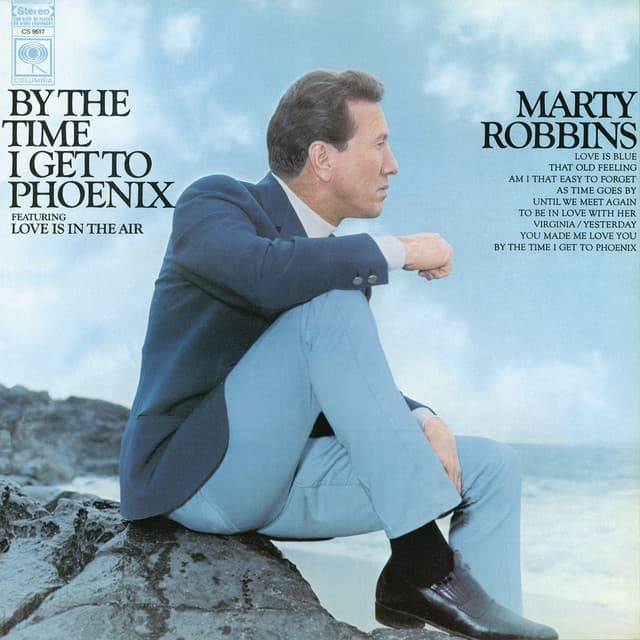
When Affection Drifts Gently Through Memory: Quiet Romance in “Love Is in the Air”
“Love Is in the Air” reveals a softer, often overlooked side of Marty Robbins one that steps away from gunfighters, lonely highways, and dramatic fate, and instead lingers in the gentle territory of emotional closeness. This song is not about love as destiny or tragedy, but love as atmosphere: something felt rather than declared, sensed rather than proven. In Robbins’ hands, that idea becomes deeply moving, especially when heard through the lens of time and reflection.
The song was recorded and released in 1978, appearing on the album Love Is in the Air, issued by Columbia Records. By this point in his career, Marty Robbins was no longer chasing trends or youthful urgency. He was an established voice recognized, trusted, and free to sing with patience. The album itself reflected that maturity, favoring warmth and emotional clarity over drama. While “Love Is in the Air” was not a major singles-chart hit, it found its place among listeners who valued Robbins’ ability to communicate feeling without spectacle.
What makes “Love Is in the Air” special is its emotional restraint. The lyrics do not describe a grand romance or a defining moment. Instead, they focus on subtle signs the way a room feels different, the way silence becomes comfortable, the way presence alone carries meaning. Robbins sings as if he has lived long enough to recognize that love does not always announce itself loudly. Sometimes, it simply arrives and stays.
This perspective marks a clear contrast to much of Robbins’ earlier work. Songs like “El Paso” or “Big Iron” relied on narrative tension and vivid storytelling. Here, the tension is internal and quiet. The drama lies not in action, but in awareness. Robbins seems to suggest that love, when genuine, does not need explanation. It becomes part of the air we breathe unseen, essential, and easily taken for granted.
Musically, “Love Is in the Air” is smooth and unhurried. The arrangement leans on gentle guitar lines, soft strings, and subtle harmonies that never overshadow the vocal. Everything is designed to create space space for the listener to settle in, to reflect, to remember. Robbins’ voice, deeper and more seasoned by the late 1970s, carries a calm assurance. There is no push for emphasis, no dramatic rise. He sings as though speaking to someone sitting close by.
This vocal maturity is crucial to the song’s emotional impact. Robbins does not sound like a man discovering love for the first time. He sounds like someone who has known it, lost it, lived alongside it, and learned to recognize its quieter forms. That experience gives the song its credibility. The affection expressed feels earned rather than imagined.
Within the context of the album Love Is in the Air, the song acts as a thematic anchor. The record as a whole leans toward warmth, reassurance, and emotional steadiness qualities that resonated strongly with listeners who had grown alongside Robbins’ career. While the album did not dominate the charts, it reinforced his reputation as an artist who aged with dignity, allowing his music to mature naturally rather than chasing relevance.
There is also a gentle nostalgia embedded in “Love Is in the Air.” Not nostalgia for a specific time or place, but for a feeling those moments when love felt effortless, when simply being near someone was enough. Robbins does not dwell on loss or regret here. Instead, he acknowledges love as a presence that can still be felt, even after life has complicated everything else.
In the broader sweep of Marty Robbins’ legacy, this song may seem modest, even understated. Yet that modesty is precisely its strength. It represents the wisdom of an artist who understood that not every truth needs to be dramatized. Some truths are best spoken softly, trusted to resonate with those who recognize them.
Over time, “Love Is in the Air” has become the kind of song that reveals itself more fully with repeated listening. It does not demand attention on first encounter. Instead, it waits much like the emotion it describes until the listener is ready to notice it. When that moment comes, the song feels less like entertainment and more like companionship.
In the end, “Love Is in the Air” stands as a quiet affirmation from Marty Robbins: that love does not always arrive with fireworks or farewell tears. Sometimes, it simply surrounds us, steady and unseen, shaping our days in ways we only understand when we pause to listen.
 Oldies Songs