
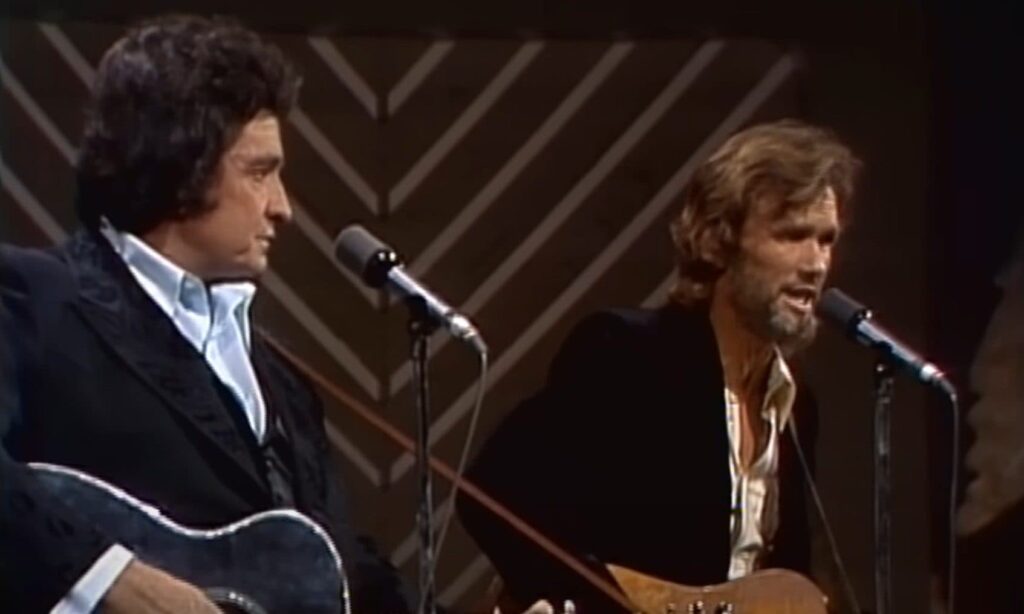
Two Outlaws on One Current: Brotherhood, Memory, and Motion in “Big River”
“Big River” is one of Johnny Cash’s defining songs a restless, forward-moving narrative driven by regret, pursuit, and the unstoppable pull of fate. When performed together by Johnny Cash & Kris Kristofferson, the song takes on an added layer of meaning. It becomes not just a tale of a man chasing lost love down the Mississippi, but a meeting point of two generations of outlaw poets, bound by respect, shared scars, and a deep understanding of American music’s darker emotional currents.
Originally written and recorded by Johnny Cash in 1958, “Big River” was released as a single on Sun Records and later included on the album Johnny Cash with His Hot and Blue Guitar!. Upon its release, the song reached No. 4 on the Billboard Hot Country Singles chart, marking one of Cash’s earliest major successes. At a time when country music often leaned toward sentimentality, “Big River” stood out for its toughness, economy, and emotional momentum.
The song is built around a simple but powerful idea: the Mississippi River as both literal geography and emotional metaphor. As the narrator follows his lost love from St. Paul to New Orleans, the river becomes a silent witness indifferent, vast, and endlessly moving forward. Unlike the singer, the river does not hesitate, regret, or look back. This contrast gives the song its quiet cruelty. Love may falter, but the river never does.
Cash’s original recording is sharp and lean. His voice in 1958 was young but already authoritative steady, rhythmic, and grounded in folk tradition. The “boom-chicka-boom” rhythm propels the song relentlessly forward, mirroring the journey it describes. There is no pause for self-pity. The chase continues whether hope survives or not.
When Kris Kristofferson later joined Johnny Cash to perform “Big River” most notably in live settings and collaborative appearances the song subtly changed character. Kristofferson, a songwriter deeply influenced by Cash, brought a weathered introspection to the performance. Where Cash embodied the man in motion, Kristofferson often sounded like the man who understood the cost of that motion.
This pairing matters. Kris Kristofferson was not merely a collaborator; he was part of Cash’s extended musical family. Cash had championed Kristofferson early in his career, recording “Sunday Morning Coming Down” and helping introduce his stark, literary songwriting to a wider audience. When they sang “Big River” together, it felt less like a duet and more like a conversation between past and present between the original voice of the song and one of its spiritual heirs.
Musically, the duet versions of “Big River” remain faithful to the song’s stripped-down roots. There is no attempt to modernize or soften it. The rhythm stays tight, the arrangement restrained. What changes is the emotional texture. Two voices one deeper and more authoritative, the other rougher and reflective move along the same current. Their harmonies are not polished in the conventional sense; they are honest, grounded, and unadorned.
Lyrically, the song’s meaning deepens with age. Lines about chasing love across state lines begin to sound less like youthful determination and more like lifelong habit. In the shared performance, the pursuit feels symbolic not just of a woman, but of meaning, redemption, or peace. The river becomes time itself, carrying everything forward regardless of intention.
Within Johnny Cash’s career, “Big River” represents the foundation of his narrative style. It established him as a storyteller who trusted movement over explanation. He did not tell listeners how to feel; he showed them where he was going and let the river do the rest. That approach would define decades of his work, from prison songs to spiritual reckoning.
For Kris Kristofferson, standing beside Cash on “Big River” was both homage and affirmation. It underscored the lineage between them between the man who first gave outlaw country its voice and the one who expanded its emotional vocabulary. Kristofferson’s presence does not compete with Cash’s authority; it complements it, adding depth through shared understanding rather than contrast.
Emotionally, the duet resonates with listeners who recognize the pull of unfinished journeys. It speaks to those who have followed feelings farther than reason would advise, who have trusted momentum over certainty. The river does not promise answers. It only promises movement.
There is also something distinctly American about this collaboration. The Mississippi River has long symbolized commerce, migration, freedom, and loss. In “Big River,” it carries personal sorrow instead of national myth. When Cash and Kristofferson sing together, that symbolism feels complete private emotion set against vast landscape, individual regret measured against something eternal.
In the end, “Big River” performed by Johnny Cash & Kris Kristofferson is not about resolution. The song does not end with reunion or peace. It ends with motion. The river keeps rolling south, indifferent to the man who follows it. And perhaps that is the song’s lasting truth: some pursuits shape us not because they succeed, but because we never stop moving with them.
Through two voices shaped by time, hardship, and honesty, “Big River” becomes more than a classic. It becomes a shared memory one that continues to flow, long after the last note fades.
 Oldies Songs