
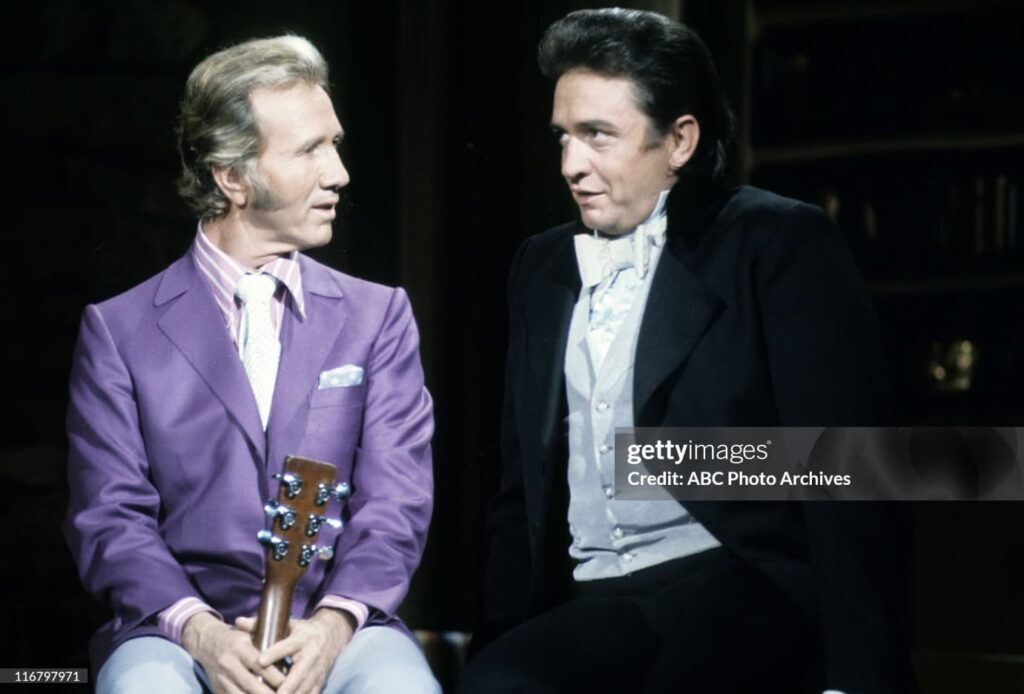
The Elegy of the American Drifter—Two Voices Weaving the West’s Final Lament
When Johnny Cash welcomed Marty Robbins to his stage on The Johnny Cash TV Show—episode 32, broadcast May 13, 1970—the moment felt less like a television performance and more like a communion of kindred spirits. Their duet on “Streets of Laredo”, that timeworn cowboy ballad passed through generations of American folklore, carried the weight of two storytellers who understood the mythic loneliness of the frontier. Though this rendition was not a charting single—it was a live collaboration rather than an official release—it remains one of those rare televised moments where authenticity eclipses commercial ambition. Two titans of country music, both steeped in Western balladry and moral reflection, stood before the nation to breathe life into a song older than either of them, yet somehow perfectly their own.
The origins of “Streets of Laredo” trace back through centuries, its melody and structure adapted from the Irish folk song “The Unfortunate Rake.” Over time it drifted westward, reshaped by the American plains into a cowboy’s lament for a dying man and his regrets beneath the wide desert sky. By 1970, both Cash and Robbins had already built careers on such narratives: songs of men haunted by conscience, driven by duty or desire into the margins of redemption. Cash’s gravel-edged baritone embodied judgment and grace in equal measure; Robbins’ supple tenor carried the romance and tragedy of the Western mythos. When their voices intertwined that night, it was as if two facets of the American spirit—the sinner and the dreamer—were finally singing to each other.
Musically, their rendition is austere yet resonant: acoustic guitars strum with a slow inevitability, while the voices trade verses like ritual confession. There are no grand orchestrations or studio polish—just two men standing in the stark light, allowing silence to frame every phrase. The restraint is its own kind of reverence. It reminds us that country music’s deepest power lies not in spectacle but in storytelling—the ability to turn mortality into melody, solitude into shared memory.
Lyrically, “Streets of Laredo” dwells on death without despair. The young cowboy’s farewell becomes a meditation on legacy—what remains when one’s story ends. In Cash’s phrasing, there is stern compassion; in Robbins’, mournful tenderness. Together they suggest that even in dying there is dignity, if one’s life has been sung truthfully. This duet thus transcends performance: it becomes ritualized remembrance.
Half a century later, that broadcast endures as a testament to how traditional songs survive—not as museum pieces but as living testimonies continually reborn through interpretation. On that May evening in 1970, Johnny Cash and Marty Robbins did not merely revisit “Streets of Laredo”; they sanctified it anew, turning an old cowboy ballad into an eternal dialogue between mortality and grace.
 Timeless Melodies