
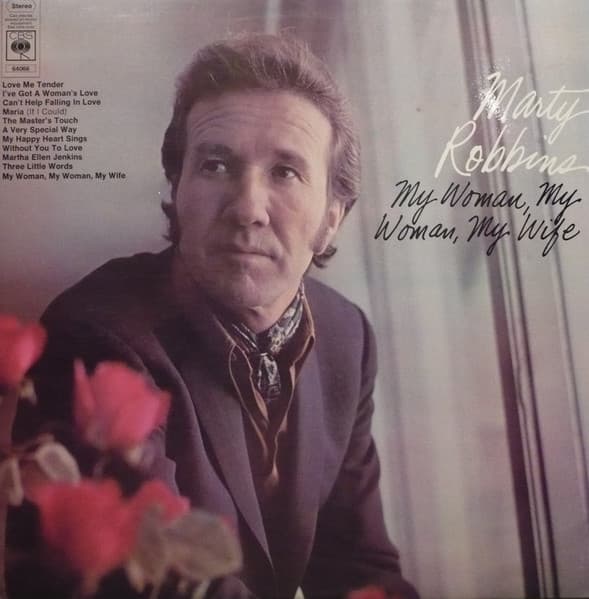
When a Familiar Promise Finds a New Voice: Tender Restraint and Mature Devotion in “Can’t Help Falling in Love”
When Marty Robbins recorded “Can’t Help Falling in Love,” he was stepping into sacred territory. By the time Robbins approached the song, it was already deeply etched into public memory through Elvis Presley, whose 1961 recording had transformed the piece into one of the most enduring love songs of the 20th century. Yet Robbins did not attempt to compete with Elvis’ legacy. Instead, he offered something quieter, older, and perhaps more contemplative a reading shaped by experience rather than infatuation.
The song “Can’t Help Falling in Love” was written by Hugo Peretti, Luigi Creatore, and George David Weiss, adapted from the 18th-century French melody “Plaisir d’amour.” Elvis Presley’s original version was released in 1961 on the album Blue Hawaii and reached No. 2 on the Billboard Hot 100, becoming one of his signature ballads. It was romantic, youthful, and filled with the promise of love as destiny.
Marty Robbins’ version came later, recorded during a period when he was already firmly established as a master storyteller and balladeer. His rendition did not chart on the Billboard singles lists, nor was it intended to. This was not a commercial move; it was an interpretive one. Robbins approached the song not as a declaration shouted from the rooftops, but as a truth spoken softly, almost privately.
From the opening lines, the difference is clear. Where Elvis’ version feels like a vow made at the beginning of love, Robbins’ interpretation sounds like a reflection made after years of living with love its joys, its costs, and its endurance. His voice, warm and steady, carries no urgency. There is acceptance instead of longing, certainty instead of wonder. Love, in this telling, is not a sudden fall. It is a gravity long understood.
Musically, Robbins keeps the arrangement restrained. The instrumentation is gentle, respectful of the melody’s classical roots. Nothing intrudes upon the vocal line. This simplicity allows the lyrics so familiar they risk becoming invisible to regain their weight. Phrases like “wise men say” and “only fools rush in” feel less like poetic flourishes and more like lived wisdom when delivered in Robbins’ calm baritone.
What makes Marty Robbins’ “Can’t Help Falling in Love” especially poignant is the way it reframes inevitability. In Elvis’ version, inevitability feels romantic, almost thrilling. In Robbins’ hands, it feels earned. The song becomes less about surrendering to love and more about recognizing it as something that has quietly shaped one’s life, regardless of resistance.
This perspective aligns perfectly with Robbins’ broader artistic identity. Throughout his career—whether singing Western ballads, tragic love stories, or gentle hymns Robbins excelled at emotional understatement. He trusted silence, pacing, and tone to do the work. In this song, he resists embellishment, letting familiarity do the heavy lifting. The listener is invited not to be impressed, but to remember.
There is also a subtle shift in emotional center. Elvis’ recording feels like a moment frozen in time, often associated with weddings and beginnings. Robbins’ version feels like something heard later, perhaps in the quiet of evening, when love is no longer theoretical. It speaks to devotion that has survived doubt, routine, and time itself. The line “take my hand, take my whole life too” sounds less like an offer and more like a confirmation of what has already happened.
Historically, Robbins’ decision to record such a well-known song reflects his confidence as an interpreter. He did not need to redefine it. He only needed to inhabit it honestly. In doing so, he demonstrated that great songs are not owned by a single voice or era. They evolve as singers bring their own lives into the melody.
Within Marty Robbins’ catalog, “Can’t Help Falling in Love” stands apart from his dramatic narratives. There are no characters, no fatal turns, no moral reckonings. Yet emotionally, it is just as profound. It reveals Robbins not as a storyteller looking outward, but as a man quietly acknowledging the power of attachment.
For listeners encountering this version later in life, the song often lands differently than it once did. It no longer feels like a promise waiting to be fulfilled. It feels like a truth already proven. Robbins’ voice carries the suggestion that love does not always arrive with fireworks but when it stays, it becomes unavoidable.
In the end, “Can’t Help Falling in Love” as sung by Marty Robbins is an act of reverence toward the song, toward love itself, and toward the idea that emotion does not need volume to be profound. It reminds us that some feelings grow stronger not through passion, but through patience. And when Robbins sings that he cannot help falling in love, it sounds less like surrender and more like gratitude.
 Oldies Songs