
Joy as Rebellion: Freedom, Fiddles, and Firelight in “Settin’ the Woods on Fire”
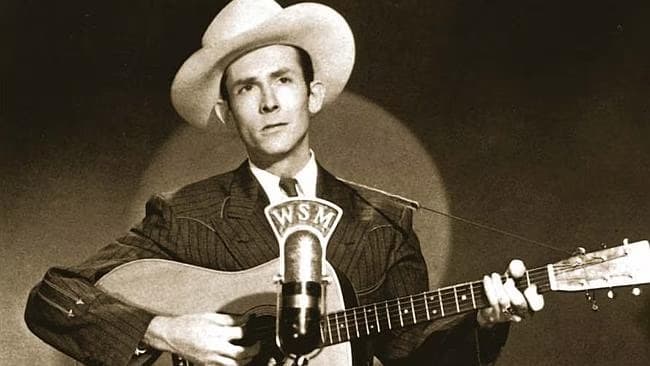
“Settin’ the Woods on Fire” captures Hank Williams at his most exuberant—a rare moment where joy, humor, and raw vitality push aside sorrow, if only for the length of a song. It is not a lament, not a confession, not a warning. Instead, it is a celebration of release, a declaration that sometimes the cure for life’s weight is noise, laughter, and motion. In the landscape of Williams’ deeply emotional catalog, this song burns brightly as a reminder that happiness, too, can be honest.
The song was written and recorded by Hank Williams in 1950, during the peak of his commercial success with MGM Records. Released as a single later that year, “Settin’ the Woods on Fire” reached No. 1 on the Billboard Country & Western Best Sellers chart, confirming Williams’ unmatched ability to connect with everyday listeners. At a time when postwar America was redefining leisure and freedom, the song arrived like a Saturday night breaking through a long workweek.
From the opening lines, the song announces its purpose without subtlety. This is music meant for dancing floors, crowded halls, and wide-open nights. Williams sings about fiddles playing, people gathering, and the collective act of letting go. There is no complex narrative to unravel. The meaning is direct: when the world grows heavy, you light it up with music and company.
Musically, “Settin’ the Woods on Fire” is built on classic honky-tonk energy. The rhythm is lively, the tempo brisk, and the melody instantly memorable. Fiddles and steel guitar drive the arrangement forward, creating a sense of motion that never lets the listener sit still for long. Everything about the song feels communal. It sounds like a room filling up, voices rising, worries dissolving.
What makes the song especially striking is its placement within Hank Williams’ career. By 1950, Williams was already known for deeply personal, often painful songs such as “I’m So Lonesome I Could Cry” and “Cold, Cold Heart.” Those songs exposed vulnerability in ways country music had rarely done before. “Settin’ the Woods on Fire,” by contrast, shows the other side of the same man the need to escape sadness through shared joy.
Yet even here, Williams’ voice carries complexity. There is excitement, yes, but also urgency. His high, slightly strained vocal delivery suggests that the celebration is not casual. It feels necessary. As if joy itself must be seized before it slips away. This emotional undercurrent gives the song depth beyond its party-ready surface.
Lyrically, the song reflects a world where entertainment is not passive. People do not sit back and listen they participate. They dance, sing, and gather. The phrase “set the woods on fire” is both literal and symbolic. It implies making noise, being seen, and refusing to fade quietly into routine. In this sense, the song becomes an anthem of presence of insisting on life, loudly.
Historically, the song also marks country music’s growing confidence. Williams was helping define a sound that belonged to working people but spoke with artistic authority. His songs did not require polish or sophistication to feel complete. They relied on truth, rhythm, and emotional clarity. “Settin’ the Woods on Fire” embodies that philosophy perfectly.
Within Williams’ recorded legacy, the song stands as proof that joy and pain are not opposites, but neighbors. The same man who could write devastating heartbreak could also write a song that turns sorrow into movement. This duality is essential to understanding Williams not just as a tragic figure, but as a fully human artist.
There is also a sense of nostalgia attached to the song that grows stronger with time. It evokes an era when music was an event, not a background. When a song could pull people out of their homes and into shared spaces. Hearing it now feels like stepping into a memory of togetherness one built on sound, sweat, and laughter.
For listeners later in life, “Settin’ the Woods on Fire” often carries a deeper resonance. It recalls nights when responsibilities were lighter, when joy did not require explanation. Yet it also reminds us that the need for release never truly disappears. It simply changes shape.
In the end, “Settin’ the Woods on Fire” is not about recklessness. It is about survival through celebration. Hank Williams understood that life’s burdens cannot always be reasoned away but sometimes they can be danced into silence, at least for a while. The song leaves behind the image of music spilling into the night, worries left at the door, and a fire of sound burning bright against the dark.
 Oldies Songs