
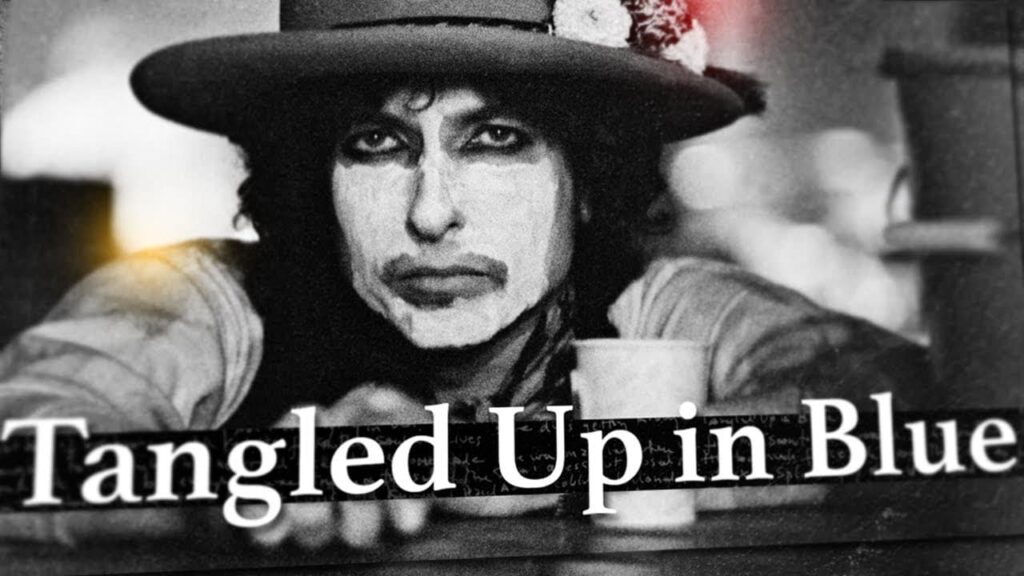
A restless journey through memory and time where love is never linear, and the past keeps changing shape.
When Bob Dylan released “Tangled Up in Blue” in September 1974, it stood immediately as something different — not just another song, but a reframing of how popular music could tell a story. Issued as the opening track and lead single from the album Blood on the Tracks (1975), the song reached No. 31 on the Billboard Hot 100. Commercially modest by Dylan’s standards, its true significance unfolded over time. Today, “Tangled Up in Blue” is widely regarded as one of the greatest songs in the history of modern music, frequently appearing near the top of critics’ lists, including Rolling Stone’s “Greatest Songs of All Time.”
By the mid-1970s, Bob Dylan had already lived several artistic lives — folk prophet, electric revolutionary, country troubadour. With Blood on the Tracks, he turned inward, crafting songs that felt intensely personal while remaining deliberately elusive. “Tangled Up in Blue” opens that album not with certainty, but with motion: “Early one mornin’, the sun was shinin’…” From the first line, the listener is already traveling — across roads, relationships, years, and emotional states.
The story behind the song is inseparable from the period in which it was written. Dylan was navigating the emotional fallout of his separation from Sara Dylan, and while he repeatedly denied that the album was autobiographical in a literal sense, he famously described the songs as “paintings.” “Tangled Up in Blue” feels exactly like that fragments of scenes, perspectives shifting mid-verse, time folding in on itself. The narrator moves between first person and third person, between past and present, as if memory itself refuses to stay still.
Musically, the song is built on a deceptively simple structure. Acoustic guitar drives the rhythm with steady forward momentum, supported by bass and drums that feel more like companions than anchors. There is a sense of constant movement trains leaving, highways stretching, rooms being entered and abandoned. The melody carries a conversational looseness, allowing Dylan’s phrasing to stretch and contract around the words. Nothing feels fixed, and that is precisely the point.
The meaning of “Tangled Up in Blue” lies in its refusal to explain itself. It is not a breakup song in the traditional sense. It is a meditation on how love, once experienced, becomes inseparable from identity. The lovers drift apart, reconnect briefly, miss each other, misunderstand each other — yet they remain bound, not by proximity, but by memory. The “blue” of the title suggests sadness, yes, but also depth — an emotional ocean where clarity is always just out of reach.
One of the song’s most striking qualities is its shifting point of view. In one verse, the narrator is inside the moment; in another, he watches it from a distance. This technique was groundbreaking in popular songwriting at the time. Dylan treats memory not as a straight line, but as something revised each time it is recalled. Events are the same, yet they feel different depending on where the narrator stands when remembering them.
Over the years, Bob Dylan has famously altered the lyrics of “Tangled Up in Blue” in live performances, reinforcing the idea that the song is alive, unfinished, and subject to change. This fluidity mirrors the song’s central theme: the past is never settled. It moves as we move. What once felt like freedom can later feel like loss. What once felt like heartbreak can later feel like gratitude.
Within Blood on the Tracks, the song serves as a thesis statement. While other tracks explore anger, resignation, tenderness, and regret, “Tangled Up in Blue” embraces contradiction. It does not choose sides between joy and pain. It allows both to coexist. That emotional honesty is why the album, initially met with some uncertainty, has since come to be regarded as Dylan’s masterpiece.
Culturally, the song marked a turning point in songwriting. It showed that narrative songs did not need clear resolutions or chronological order to feel truthful. Its influence can be traced through generations of writers who learned that ambiguity could be more powerful than explanation.
Today, “Tangled Up in Blue” endures not because it tells listeners what to feel, but because it recognizes how complicated feeling truly is. It understands that love stories rarely end cleanly, that memory reshapes itself with time, and that the self who remembers is never the same as the self who lived the moment.
In the vast and varied catalog of Bob Dylan, this song stands as a quiet summit. Not dramatic, not grandiose just deeply human. It reminds us that some stories are not meant to be untangled. They are meant to be carried, revisited, and lived with changing color as the light changes, forever moving, forever unresolved.