
A Sovereign Declaration of Independence: The Bittersweet Uncoupling of Two Folk Icons Beneath the Weight of Public Expectation
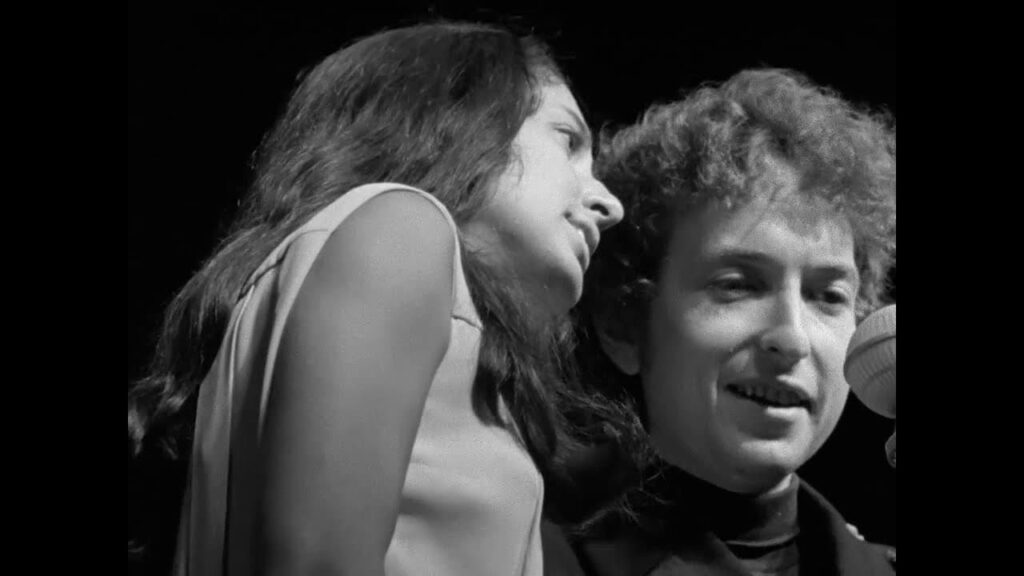
In the hallowed annals of the 1960s folk revival, few images are as evocative as Joan Baez and Bob Dylan standing together at a wooden microphone, their voices entwined in a stark, monochromatic harmony. Their collaborative performances of “It Ain’t Me Babe” most notably during the Rolling Thunder Revue in the mid-1970s and their earlier 1964-65 appearances represent a definitive moment in cultural history. While the song first appeared on Dylan’s 1964 album Another Side of Bob Dylan, peaking in various forms on international charts and becoming a top 10 hit for The Turtles, it was the version shared with Baez that transformed it into a poignant dialogue. It became an anthem of refusal, a sophisticated rejection of the “protest singer” mantle and the suffocating demands of a lover or a public seeking a savior rather than a man.
The story behind this song is steeped in the complex, often turbulent “Real Love” (to borrow a phrase from our previous discussions) shared between Dylan and Baez. By 1964, Joan Baez was already the “Queen of Folk,” a figure of immense grace and political conviction who had helped introduce a scruffy, enigmatic Bob Dylan to the world. However, as Dylan began to pivot away from topical “finger-pointing” songs toward a more surrealist, internal landscape, “It Ain’t Me Babe” served as his manifesto of departure. When they sang it together, the subtext was electric. Baez, with her crystalline, operatic soprano, and Dylan, with his dry, rhythmic rasp, created a tension that mirrored their own relationship. It was as if they were publicly negotiating the terms of their own fading romance and their differing paths toward artistic truth.
Musically and lyrically, “It Ain’t Me Babe” is a masterclass in the art of the “anti-love” song. It subverts the traditional romantic tropes of the era; instead of promising eternal devotion, the narrator explicitly warns the listener that he is not the one to “protect you from yourself” or “be there every time you fall.” For the discerning listener who has navigated the complexities of long-term relationships, the lyrics resonate with a profound, perhaps even painful, honesty. It speaks to the realization that we cannot be everything to everyone. The repetitive refrain “No, no, no, it ain’t me, babe” is a rhythmic slamming of a door, yet when Baez joins in, it takes on a haunting, almost mournful quality, suggesting that saying goodbye is often an act of mercy for both parties.
To revisit this song today is to return to a time when music was the primary vehicle for social and personal revolution. It evokes memories of coffeehouses filled with the scent of tobacco and the earnest strumming of acoustic guitars a period when a single lyric could feel like a tectonic shift in the cultural landscape. For those who came of age during the “Greenwich Village” era, “It Ain’t Me Babe” is more than just a track on an album like The Boots of Spanish Leather collections or Vanguard recordings; it is a souvenir of a time when we were all trying to find our own identities amidst the noise of a world in flux. The song reminds us of the dignity found in setting boundaries and the courage required to walk away from a life or a role that no longer fits.
Ultimately, the collaboration between Joan Baez and Bob Dylan on this track remains a cornerstone of the Rock and Roll Hall of Fame narrative. It captures two geniuses at a crossroads, using their art to navigate the messy reality of human connection. To listen to their harmonies now is to hear the echo of a generation’s lost innocence, but also the birth of a new kind of individualistic strength. It is a song for the quiet hours of the soul, inviting us to look back with a sense of peace, acknowledging that while we may not have been the “someone” others wanted us to be, we were, at the very least, true to ourselves.