
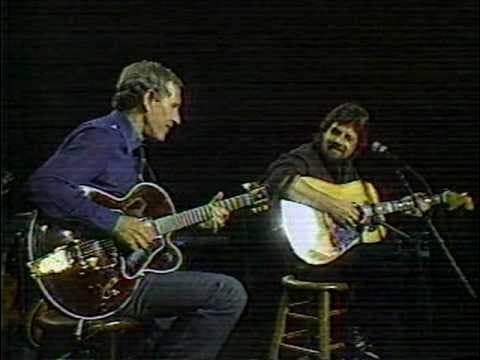
A rhythmic masterpiece of Appalachian resilience, where the heavy toil of the coal mines is transformed into a sophisticated dance of silver and steel.
When Chet Atkins—the undisputed “Country Gentleman”—placed his thumb on the bass strings to perform “Nine Pound Hammer,” he wasn’t just playing a folk song; he was channeling the very heartbeat of the American working class. Originally a traditional labor holler rooted in the coal mines of Kentucky and popularized by the legendary Merle Travis, the song is a gritty narrative of manual labor, sweat, and the yearning for the end of a long, hard road. While many versions lean into the raw, unpolished blues of the mountains, Chet Atkins brought to it a level of suburban sophistication and technical wizardry that redefined the “Nashville Sound.” His rendition, particularly the iconic versions found on his early RCA Victor recordings like Gallopin’ Guitar (1953), remains a gold standard for fingerstyle guitarists worldwide. For those who remember the 1950s as a time of building—of laying tracks and carving out lives—this melody serves as a polished mirror to a more rugged past.
On the charts, “Nine Pound Hammer” acted less as a pop phenomenon and more as a foundational pillar of the country music canon. While Chet’s version didn’t chase the fleeting heights of the Billboard Hot 100, it achieved something far more permanent: it became a mandatory rite of passage for every aspiring guitarist in the United States and beyond. It helped Chet Atkins secure his legacy as the most recorded solo instrumentalist in history, earning him a staggering 14 Grammy Awards over his lifetime. To hear Chet play it is to hear the evolution of an instrument; he took the “boom-chicka-boom” rhythm of his mentor Merle Travis and added a melodic complexity that made the guitar sound like a self-contained orchestra. It is the sound of a man who conquered the instrument so completely that he could make a song about back-breaking labor feel as light as a summer breeze.
The story behind the song is one of deep-seated heritage and artistic lineage. “Nine Pound Hammer” belongs to the “John Henry” cycle of folk songs—tales of men pitted against machines and the sheer physical toll of the industrial age. For Chet, who grew up in the impoverished hills of Luttrell, Tennessee, during the Great Depression, these weren’t just lyrics; they were the echoes of his childhood. He took a song about a heavy, nine-pound tool and played it with a touch as delicate as lace. This juxtaposition is the hallmark of the Atkins style. He understood that to honor the working man, one didn’t have to be loud; one had to be precise. By the time he was performing this for international audiences and on television programs like The Jimmy Dean Show, he was representing an entire culture that had moved from the coal mines to the recording studios, carrying their stories with them.
Meaningfully, “Nine Pound Hammer” explores the dignity of the grind and the quiet desire for escape. When the lyrics mention “Roll on buddy, don’t you roll so slow,” they capture that universal human feeling of watching the clock, waiting for the whistle to blow so one can return to the warmth of home. For the mature listener, this track is a powerful reminder of the work ethic that defined a generation. It speaks to a time when things were built to last, and music was played by hand, without the safety net of digital trickery. As Chet’s fingers fly across the fretboard, mimicking the steady strike of the hammer, there is a sense of profound order and discipline. It is a meditation on the idea that even the hardest tasks can be performed with grace if one has the right rhythm.
There is a bittersweet nostalgia in the tone of Chet’s hollow-body Gretsch guitar—a warmth that modern instruments struggle to replicate. Listening to it now, one can almost see the dust motes dancing in the light of an old living room, the smell of woodsmoke in the air, and the steady, reassuring presence of a master at work. Chet Atkins didn’t just play “Nine Pound Hammer”; he elevated it to an art form, proving that the simplest folk tunes contain the complexities of the human spirit. For those of us looking back through the lens of a long life, this performance is a comforting echo of our own journeys—reminding us that while the work was often heavy, the music we made along the way made the load a little easier to carry.