
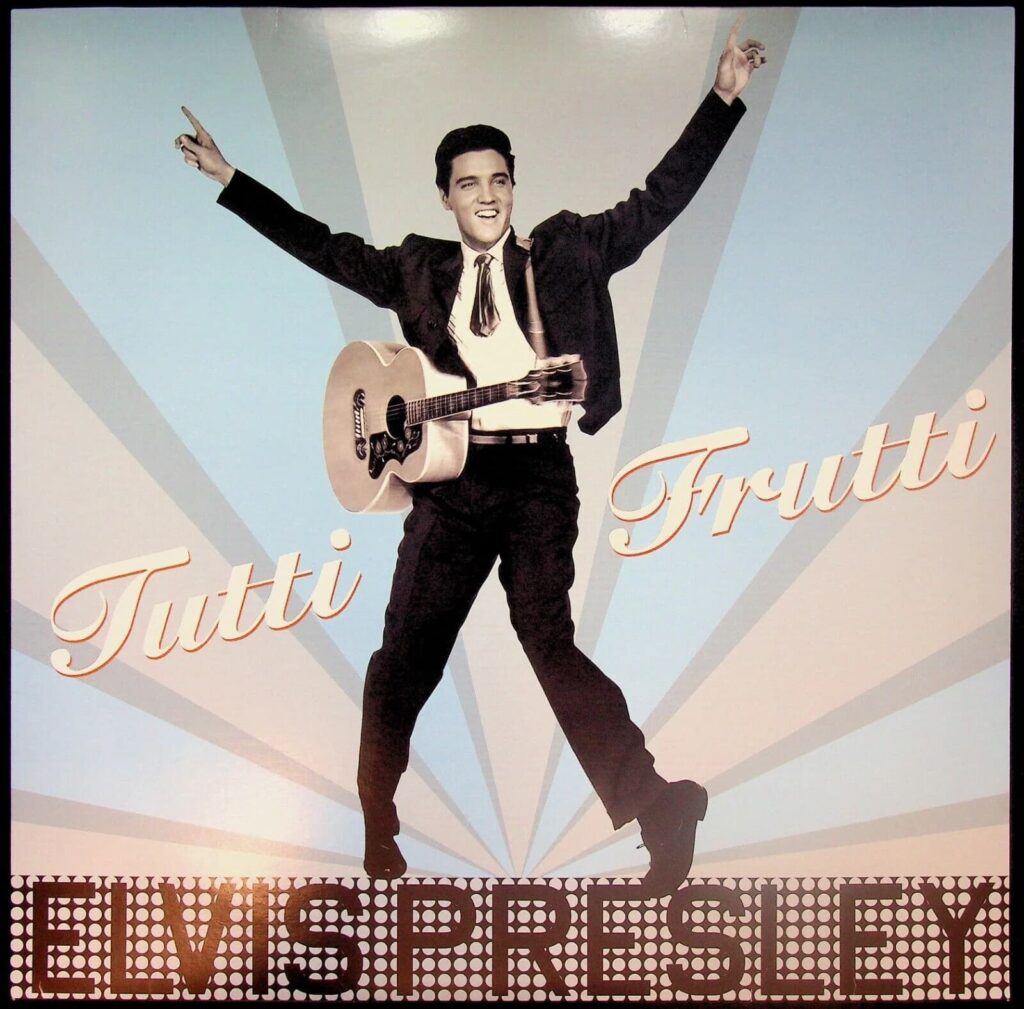
A raw, energetic re-birth of rock ’n’ roll Elvis Presley rides the wave with “Tutti Frutti”
When Elvis Presley recorded Tutti Frutti on January 31, 1956, for his debut RCA album Elvis Presley (released March 23, 1956), he was staking a claim in a musical revolution already in motion but through his own voice, guitar, and a swagger uniquely his own. While Elvis’s version of Tutti Frutti was released as the B-side to Blue Suede Shoes (August 31, 1956) and didn’t chart on its own, its presence on that groundbreaking album helped shape his early identity and signaled that rock ’n’ roll’s wild energy had found a new ambassador.
Originally written by Richard Penniman (Little Richard) and Dorothy LaBostrie, Tutti Frutti exploded from Little Richard’s 1955 original a song that would later be hailed as one of the cornerstones of rock music. Its ecstatic “A-wop-bop-a-loo-mop-a-lop-bam-boom!” chorus, pounding beat and frenetic energy embodied a youthful rebellion and raw excitement. Elvis took that same spirit, stripped away excess, and reinterpreted it through his rockabilly-tinged style smooth, driven, and full of bravado.
On Elvis’s version, the familiar refrain returns at the start of each verse, ending with “bam-boom,” giving the song its signature punch. Backed by Scotty Moore on guitar, Bill Black on bass, D.J. Fontana on drums, and Shorty Long on piano, the track surges forward with a lively rhythm: every instrument tight, every beat punctuated like a heartbeat racing with excitement. Listening to it now is like hearing a lightning bolt slice through a quiet sky unexpected, thrilling, alive.
There is significance not only in the energy of the song, but in what it represented at the time: a young white singer from the South embracing and amplifying a sound rooted in the rhythm & blues tradition. Tutti Frutti had already broken ground under Little Richard, reaching No. 2 on the R&B chart in early 1956 and crossing over into pop charts. By covering it, Elvis helped carry that energy into wider acceptance and introduced rock ’n’ roll to audiences who might not otherwise have heard it.
Even though Elvis’s version wasn’t a chart-topping single, the album Elvis Presley itself had seismic impact it’s often looked back on as the moment when rock ’n’ roll, rockabilly, country and rhythm & blues merged under one restless, youthful voice. Tutti Frutti contributed to that shockwave. Over time, many fans began to appreciate Elvis’s take for what it was: not a pale imitation, but a confident reinterpretation laced with swagger, charm, and a raw sense of freedom.
For older listeners, recalling Tutti Frutti may bring back memories of jukeboxes in smoky diners, of drive-in theaters pulsing with rockabilly rhythms, of dance floors trembling under teenage feet. The song captures that restless energy of youth impatience, exhilaration, possibility. Elvis’s voice, though smooth, carries the spark of someone pushing at boundaries, someone ready to break away and reshape the world with a guitar and a shout.
Listening today, Tutti Frutti still resonates not just as a historic track, but as a reminder that music can be electric, unpredictable, and deeply human. In Elvis’s rendition, it becomes a kind of invitation: to move, to feel, to remember what it is to be alive in a moment when the world felt new, dangerous, and full of thrilling promise.