
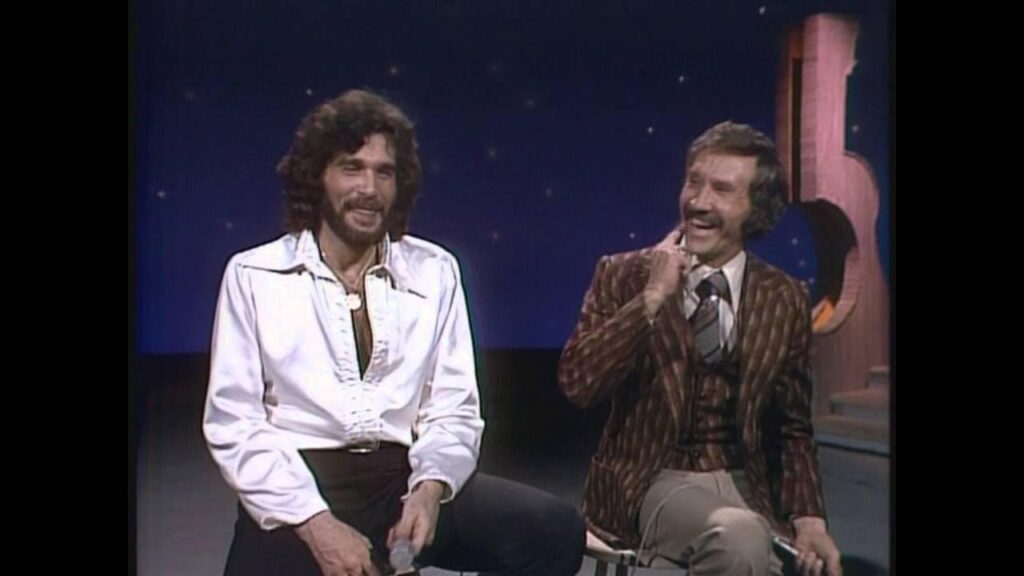
A meeting of two voices from different eras, joined by shared stories, shared roads, and shared truths
The Eddie Rabbitt & Marty Robbins – Medley is not a conventional hit single, nor a chart-driven release designed for radio dominance. Instead, it stands as something far more meaningful: a televised performance medley that brought together two generations of country music storytelling—Marty Robbins, the seasoned master whose voice had already become part of American musical folklore, and Eddie Rabbitt, the bridge between traditional country and a more contemporary, pop-leaning sound of the late 1970s and early 1980s.
Because this medley was performed for television rather than released as a standalone commercial single, it did not appear on Billboard singles charts at the time of its airing. Yet its absence from chart listings only underscores an important truth: some musical moments are not measured by rankings, but by resonance. This collaboration belongs firmly in that category.
By the time this medley took place, Marty Robbins was already a towering figure. With classics such as “El Paso,” “Big Iron,” and “Devil Woman,” Robbins had long established himself as a master narrator—an artist who could turn three minutes into a fully formed novel. His smooth baritone carried the authority of lived experience, and even in later performances, his voice retained a quiet dignity shaped by decades of songs about love, loss, faith, and moral consequence.
Eddie Rabbitt, on the other hand, represented a different path through country music. Known for crossover hits like “I Love a Rainy Night,” “Drivin’ My Life Away,” and “Every Which Way but Loose,” Rabbitt brought a brighter, more rhythmic sensibility. Yet beneath the polished sound was a deep respect for tradition. He often spoke of the artists who shaped him—and Robbins was clearly among them.
The medley itself unfolds like a conversation across time. Rather than competing for attention, the two singers complement each other, moving seamlessly from one familiar melody to the next. Robbins’ voice anchors the performance with calm assurance, while Rabbitt adds warmth and energy, never overstepping, never overshadowing. There is a sense of mutual respect that cannot be rehearsed—it can only come from genuine admiration.
What gives this medley its emotional weight is not virtuosity, but recognition. Recognition of shared themes that have always defined country music: longing, responsibility, pride, regret, and the quiet endurance of ordinary lives. Each song fragment feels like a memory briefly revisited, then gently set aside.
From a historical perspective, this performance also captures a moment when country music still valued continuity—when newer voices acknowledged their roots not with imitation, but with gratitude. Rabbitt does not attempt to sound like Robbins, and Robbins does not attempt to modernize. Instead, they meet where their values overlap: clarity of storytelling and emotional honesty.
Listening now, the medley feels almost reflective, as if both artists understood—consciously or not—that music outlives its moment. Robbins would pass away only a few years later, in 1982, and this performance now carries the weight of farewell without ever announcing itself as such. Rabbitt’s presence adds another layer of poignancy, knowing his own life would be cut short in the late 1990s.
In the end, the Eddie Rabbitt & Marty Robbins – Medley is less about individual songs and more about legacy. It reminds us that country music, at its best, is a long conversation—one voice answering another across decades. No chart position could ever capture that.
 Oldies Songs