
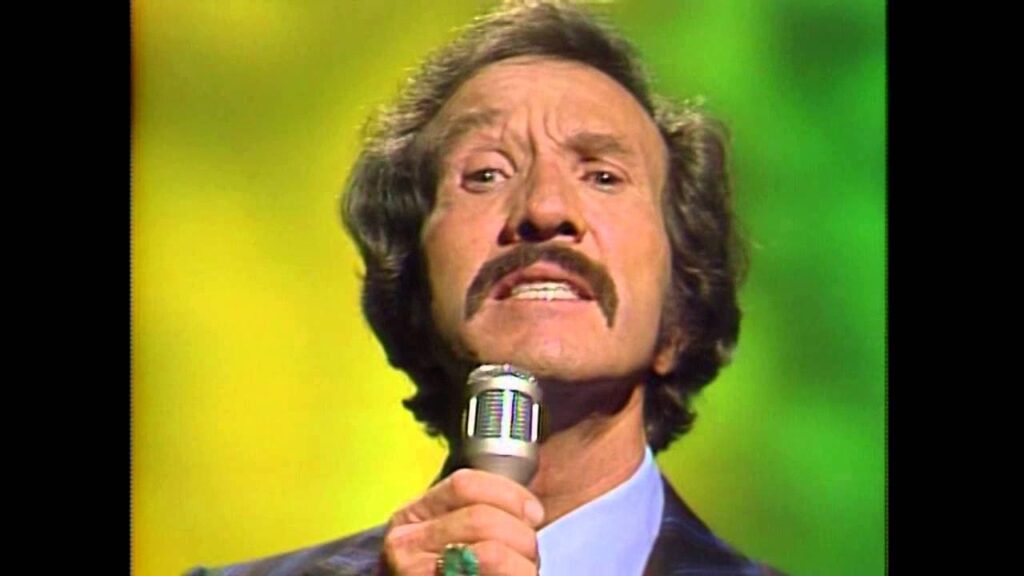
A gentle confession of longing, where patience and devotion speak louder than certainty
Released in 1956, “I’m Wanting To” by Marty Robbins captures a moment of emotional restraint that feels almost rare in popular music. At a time when country songs often leaned toward clear declarations of love or sorrow, this recording chose a quieter path one defined by hesitation, hope, and unspoken desire. Upon its release, the song became an early success for Robbins, reaching the Top 10 on the Billboard Hot Country Singles chart, peaking at No. 8. Though modest by later standards, that chart position marked an important step in the rise of a voice that would soon become one of the most respected in country music.
In the mid-1950s, Marty Robbins was still shaping his artistic identity. He had not yet delivered the sweeping narratives of “El Paso” or the polished confidence of his 1960s hits. Instead, he was refining a style rooted in emotional clarity and vocal control. “I’m Wanting To” belongs firmly to this formative period, when Robbins’ strength lay in his ability to sound sincere without excess. His voice here is youthful, warm, and carefully measured, revealing a singer who understood that understatement could be deeply persuasive.
The song was written by Marty Robbins himself, a fact that adds another layer of intimacy to the recording. As a songwriter, Robbins had a keen sense of emotional pacing. He knew how to let a feeling unfold slowly, without forcing resolution. In “I’m Wanting To,” the narrator does not demand love, nor does he assume it will come easily. He simply admits his desire and waits openly, patiently, and with dignity.
Lyrically, the song is built around uncertainty. The phrase “I’m wanting to” suggests intention without action, emotion without expectation. It is the language of someone who understands that love cannot be rushed or claimed. There is vulnerability in that admission, but also quiet strength. The narrator knows what he feels, yet respects the freedom of the other person to respond or not. This emotional balance gives the song its enduring appeal.
Musically, the arrangement is sparse and elegant, typical of mid-1950s country recordings. Gentle guitar lines, a steady rhythm, and subtle background harmonies frame Robbins’ vocal without overwhelming it. Everything is designed to support the emotion at the center of the song. There are no dramatic flourishes, no instrumental breaks that distract from the message. The focus remains firmly on the voice and the feeling behind it.
What makes “I’m Wanting To” particularly meaningful within Robbins’ catalog is how clearly it foreshadows his later work. Even at this early stage, his gift for emotional storytelling is evident. He understood that the most powerful moments often live in uncertainty, in the space between desire and fulfillment. That understanding would later allow him to inhabit characters and narratives with remarkable authenticity.
The song’s success on the country charts helped establish Marty Robbins as more than just another promising newcomer. It showed that audiences responded to his sincerity, his restraint, and his ability to articulate complex emotions in simple language. While the song did not cross over into the pop charts, its impact within the country genre was significant, laying the groundwork for the remarkable career that followed.
Over time, “I’m Wanting To” has come to be appreciated as a quiet classic less celebrated than Robbins’ later hits, but deeply revealing. It captures a moment before certainty, before triumph, when emotion is still tentative and hope has not yet hardened into expectation. That emotional honesty is what gives the song its lasting resonance.
In the broader context of 1950s country music, the song reflects a genre grounded in sincerity rather than spectacle. It reminds us of an era when a single voice, a simple melody, and an honest feeling were enough. Through Marty Robbins’ gentle delivery, “I’m Wanting To” becomes more than a love song it becomes a reflection on patience, respect, and the courage it takes to admit longing without guarantees.
Decades later, the song still feels quietly relevant. Its message has not aged, because the emotions it expresses are timeless. Wanting, waiting, and hoping these are feelings that never leave us. And in “I’m Wanting To,” Marty Robbins gave them a voice that remains soft, sincere, and enduring.
 Oldies Songs