
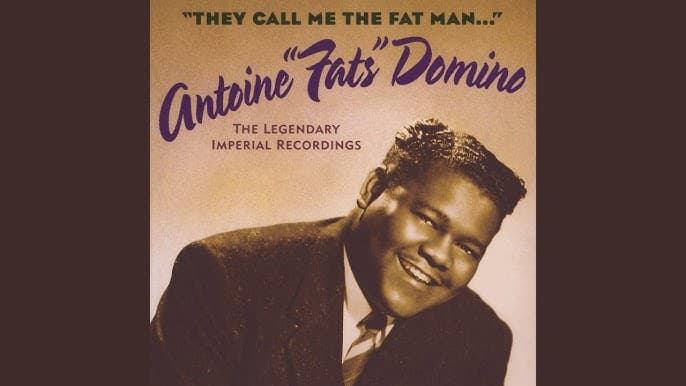
A playful slice of Southern folklore, where rhythm turns hardship into joy and resilience
When Fats Domino released “Bo Weevil” in 1960, he once again demonstrated a rare gift: the ability to transform everyday struggle into music that smiles rather than complains. At a time when his place in American popular music was already firmly established, this song arrived not as a grand statement, but as a reminder of where his music came from the soil, the stories, and the humor of the Deep South.
“Bo Weevil” was issued as a single on Imperial Records, produced by Dave Bartholomew, the longtime collaborator who helped shape Domino’s unmistakable sound. Upon its release, the song performed strongly on the charts, reaching No. 2 on the Billboard R&B Singles chart and crossing over to the Billboard Hot 100, where it peaked around the mid-30s. While it did not rival the massive crossover success of songs like “Blueberry Hill”, its chart performance confirmed Domino’s continued relevance at the dawn of a new decade.
The song’s title refers to the boll weevil, an insect that devastated cotton crops across the American South in the late 19th and early 20th centuries. For generations, the boll weevil symbolized hardship, lost livelihoods, and economic uncertainty. It appeared frequently in Southern folk songs and blues traditions, often portrayed as an almost mythical figure a small creature capable of enormous destruction. What makes Fats Domino’s “Bo Weevil” distinctive is how lightly he carries this heavy history.
Rather than framing the subject with bitterness or anger, Domino approaches it with warmth and humor. The lyrics describe the weevil’s arrival and its appetite, but the tone is playful, almost affectionate. This choice reflects Domino’s broader artistic philosophy: acknowledging life’s difficulties without letting them harden the heart. He does not deny hardship he simply refuses to be overwhelmed by it.
Musically, “Bo Weevil” is rooted firmly in the New Orleans rhythm-and-blues tradition. Domino’s rolling piano anchors the song, supported by a relaxed shuffle rhythm and subtle horn accents. The tempo is steady but unhurried, creating a groove that feels conversational rather than forceful. There is an ease to the performance, as if the song were being shared on a front porch rather than delivered from a stage.
Domino’s vocal performance is central to the song’s charm. His voice warm, rounded, and unmistakably human never strains for effect. He sings with a smile audible in every phrase, turning what could have been a tale of loss into one of shared understanding. The delivery suggests not ignorance of hardship, but familiarity with it. He has seen worse, and he knows life continues.
Behind the scenes, Dave Bartholomew’s production plays a crucial role in maintaining this balance. The arrangement is economical and uncluttered, leaving room for rhythm and melody to breathe. Nothing distracts from the song’s core feeling. This simplicity was one of the hallmarks of Domino’s recordings and a key reason they aged so gracefully.
In the context of Domino’s career, “Bo Weevil” represents his deep connection to folk tradition filtered through a modern rhythm-and-blues lens. While many artists of the era were chasing novelty or intensity, Domino remained rooted in storytelling. His songs often reflected working-class experiences, regional history, and emotional resilience, presented without sermon or spectacle.
The song also illustrates why Domino appealed across cultural and generational boundaries. Even listeners unfamiliar with the boll weevil’s historical significance could feel the song’s spirit. The rhythm invited movement, the melody lingered, and the tone reassured. Domino did not demand understanding; he offered companionship.
As the 1960s approached, popular music was beginning to shift toward sharper edges and louder statements. “Bo Weevil”, by contrast, feels grounded and timeless. It belongs as much to earlier blues traditions as it does to the emerging rock-and-roll landscape. That dual identity traditional yet contemporary was one of Domino’s greatest strengths.
Today, “Bo Weevil” may not be the first song mentioned when discussing Fats Domino’s legacy, but it remains an essential piece of it. It captures his ability to humanize history, to soften hardship with rhythm, and to remind listeners that joy and struggle often share the same space.
Listening now, the song still feels alive. Its humor has not faded, its groove remains inviting, and its message that resilience can be expressed with warmth rather than defiance feels as relevant as ever. In “Bo Weevil,” Fats Domino once again proves that great music does not always confront life head-on. Sometimes, it sidesteps, smiles, and keeps moving forward one easy rhythm at a time.