
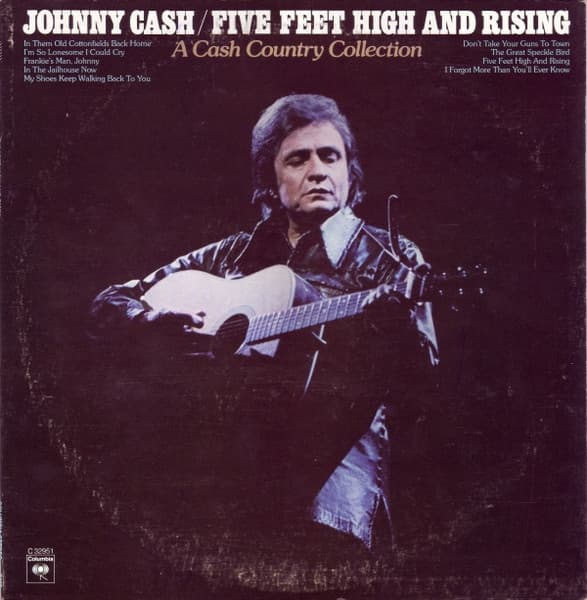
When the River Became a Memory: Hardship, Humor, and Survival in “Five Feet High and Rising”
“Five Feet High and Rising” is one of the most vivid and enduring songs in Johnny Cash’s catalog a rare piece of storytelling that turns personal hardship into living folklore. Rooted in memory rather than metaphor, the song captures a childhood experience of natural disaster and transforms it into something larger: a reflection on resilience, family, and the quiet strength required to endure forces beyond human control.
Written by Johnny Cash himself, “Five Feet High and Rising” was recorded in 1959 and released by Columbia Records as a single. Upon its release, the song reached No. 5 on the Billboard Hot Country Singles chart, reaffirming Cash’s standing not just as a singer, but as one of country music’s most compelling storytellers. It was later included on the album Hymns by Johnny Cash (1959), a record that blended spiritual reflection with deeply personal themes.
The song is autobiographical, drawn from Cash’s childhood in Dyess, Arkansas, where his family struggled through the Great Depression as sharecroppers. Seasonal flooding of the Mississippi River and its tributaries was a constant threat, and in one particularly severe year, rising waters forced families from their homes. “Five Feet High and Rising” recounts that experience from a child’s perspective observant, slightly bewildered, and quietly afraid, yet surrounded by family and faith.
Musically, the song is deceptively light. Driven by acoustic guitar, a steady rhythm, and Cash’s unmistakable baritone, it carries a near-spoken cadence. There is no dramatic orchestration, no attempt to mimic the violence of the flood itself. Instead, the calm delivery mirrors the way memory often works facts recalled plainly, emotions implied rather than declared. This restraint allows the story to speak with greater authenticity.
Johnny Cash’s vocal performance is central to the song’s power. He sings with an even tone, almost conversational, as though recounting the story across a kitchen table. There is no panic in his voice, only observation and acceptance. That emotional control makes the moments of danger feel more real, not less. The listener senses fear not because it is shouted, but because it is understated.
Lyrically, “Five Feet High and Rising” is rich with detail. The rising water is measured inch by inch, foot by foot, grounding the story in physical reality. Biblical imagery appears naturally, not as symbolism, but as a reflection of how a rural Southern family might understand catastrophe through faith, reference, and shared language. The comparison to Noah’s flood is both humble and profound, placing personal suffering within a timeless human narrative.
What sets the song apart is its balance of gravity and subtle humor. There is an almost wry tone beneath the seriousness, suggesting that survival often depends on perspective. Cash does not present his family as heroic figures, nor does he dwell on despair. Instead, he honors endurance the act of holding on, waiting it out, and trusting that the water will eventually recede.
Within Johnny Cash’s broader body of work, “Five Feet High and Rising” stands as an early example of what would become his signature approach: songs rooted in truth, dignity, and lived experience. Long before he became the voice of prisoners, prophets, and outsiders, Cash was singing about ordinary people facing extraordinary circumstances.
Over time, the song has grown in resonance. As floods, displacement, and environmental uncertainty continue to shape lives, its themes remain painfully relevant. Yet the song does not preach or warn. It remembers. And in remembering, it preserves a form of quiet wisdom passed down through generations.
Ultimately, “Five Feet High and Rising” endures because it captures something deeply human: the way families face disaster together, the way memory softens fear, and the way stories survive long after the water has gone. In Johnny Cash’s steady voice, a childhood flood becomes a timeless testament to endurance measured not in feet, but in faith.
 Oldies Songs