
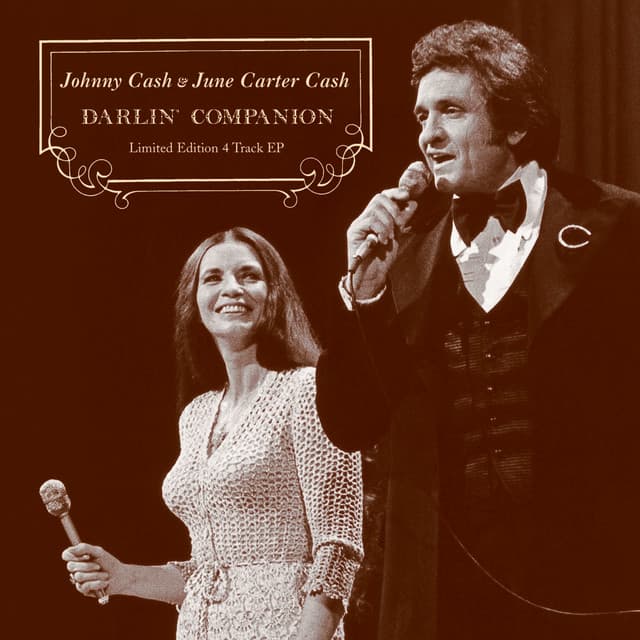
A Love Song Turned into a Living Promise, Where Two Voices Became One Heart on Stage
When Johnny Cash and June Carter Cash stepped onto the stage in Denmark to perform “If I Were a Carpenter,” the song ceased to be merely a folk ballad. In that moment, it became something far rarer: a living testament to love tested, earned, and finally shared in full view of the world. This live performance, recorded during their European appearances in the early 1970s, stands as one of the most emotionally resonant interpretations of the song ever captured.
Originally written by Tim Hardin in 1966, “If I Were a Carpenter” had already enjoyed chart success before Johnny and June made it their own. Hardin’s original version reached the Top 10 on the Billboard Hot 100, while covers by Bobby Darin and The Four Tops also performed strongly. However, it was the 1970 studio duet by Johnny Cash & June Carter, released on the album Hello, I’m Johnny Cash, that gave the song its most enduring identity. That studio version climbed to No. 2 on the Billboard Hot Country Singles chart and went on to win the Grammy Award for Best Country Performance by a Duo or Group with Vocal in 1971.
Yet the live performance in Denmark tells a deeper story than any chart position ever could.
By the time of this performance, Johnny and June were no longer a promise waiting to be fulfilled—they were married, seasoned by years of personal struggle, separation, reconciliation, and survival. Their love story was well known, but what makes this rendition extraordinary is how little they rely on theatrics. There is no grand declaration, no exaggerated emotion. Instead, there is trust. There is history. There is an unspoken understanding that flows between them with every exchanged glance.
Musically, the arrangement remains spare. The tempo is gentle, almost fragile, allowing space for the words to breathe. Johnny Cash, with his deep, weathered baritone, delivers his lines with humility rather than dominance. His voice carries the weight of a man who has known both success and failure, asking not as a fantasy but as a sincere question: Would you still love me if I were nothing more than a working man?
When June Carter Cash answers, her voice is warm, steady, and quietly radiant. She does not sing as a character; she sings as herself. Her reply feels less like lyrics and more like reassurance. In this live setting, the call-and-response structure becomes profoundly intimate, transforming the song into a dialogue between two people who have already lived the question and arrived at the answer.
The meaning of “If I Were a Carpenter” lies in its rejection of status, wealth, and public image. It asks whether love can survive when stripped of titles and applause. In the hands of Johnny and June, that question carries extraordinary weight. Johnny Cash was one of the most recognizable figures in American music, yet here he stands, offering vulnerability instead of authority. June, long underestimated despite her deep musical heritage with the Carter Family, answers not with submission, but with certainty.
The Danish audience, though thousands of miles from Nashville, sensed the authenticity of the moment. This was not an act rehearsed for effect. It was a couple sharing something deeply personal, allowing strangers to witness a bond forged over years of hardship and devotion. The applause that follows feels less like celebration and more like gratitude.
In the broader legacy of Johnny Cash & June Carter Cash, this performance occupies a special place. It represents the rare instance where biography and song align perfectly. Every word feels earned. Every note feels true. Long after the lights fade and the stage empties, what remains is the image of two voices meeting in harmony not just musically, but spiritually.
“If I Were a Carpenter (Live in Denmark)” endures because it reminds us that the greatest love songs are not about perfection, but about commitment. Not about fantasy, but about choosing one another again and again, even when the music stops.
 Oldies Songs