
The Quiet Bloom of Devotion in a World Gone Restless
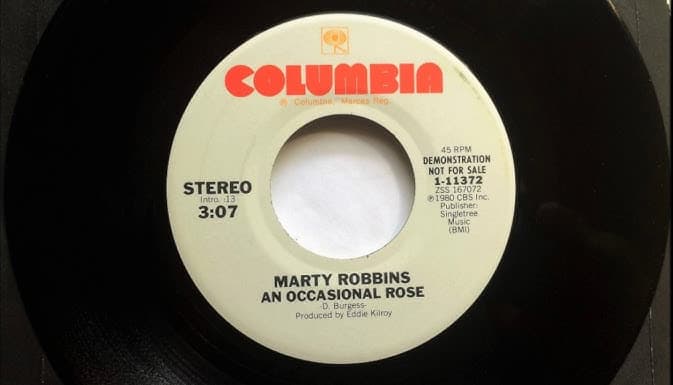
When Marty Robbins released “An Occasional Rose” on his 1971 album Today, the song did not climb high on the charts, overshadowed by more radio-friendly singles of the era. Yet, within the grooves of that record lies one of Robbins’ most tender and contemplative performances—a composition that distills his gift for storytelling into something hushed, intimate, and profoundly human. Known primarily for his sweeping western ballads and crossover hits like “El Paso,” Robbins here turns inward, away from gunfights and dusty trails, toward the quiet domestic terrain of love’s endurance.
“An Occasional Rose” is less a narrative than a meditation, a reflection on affection as something sustained not by grand gestures but by small, recurring acts of tenderness. Where so many country songs of its time sought drama—betrayal, heartbreak, or honky-tonk redemption—this track lingers instead in the stillness between lovers who have long since passed the feverish stage of romance. Robbins’ voice, worn yet steady, carries the weary grace of a man who has seen passion’s blaze and now finds solace in its embers.
Musically, the song is quintessential early-’70s Nashville craftsmanship: gentle acoustic guitar lines intertwined with restrained strings and a rhythm section that moves like a heartbeat at rest. The arrangement allows space for Robbins’ vocal phrasing to breathe—to lean into certain syllables with wistful emphasis, to soften others into near-whispered confessions. The production reflects the sensibility that guided much of his later work: an interest in emotional texture over commercial flourish.
Lyrically, Robbins employs a metaphor that is both simple and timeless—the image of a rose offered occasionally as a token of love’s continuity. It is not about extravagance or frequency; it is about meaning. The “occasional rose” becomes emblematic of appreciation renewed, proof that affection can survive the erosion of routine if nurtured by remembrance. In this way, the song speaks to a mature love—the kind that no longer needs to announce itself loudly but thrives in quiet acknowledgment.
Within Robbins’ broader catalog, “An Occasional Rose” occupies a subtle yet significant place. It reveals the artist as philosopher as much as balladeer—a man who could translate life’s simplest gestures into enduring poetry. Listening today, one hears more than nostalgia; one hears wisdom blooming softly through time’s passage. In an age obsessed with immediacy, Robbins reminds us that beauty often lives in what is occasional—in those fleeting moments when love still chooses to show itself amid life’s ordinary days.
 Timeless Melodies
  Oldies Songs