
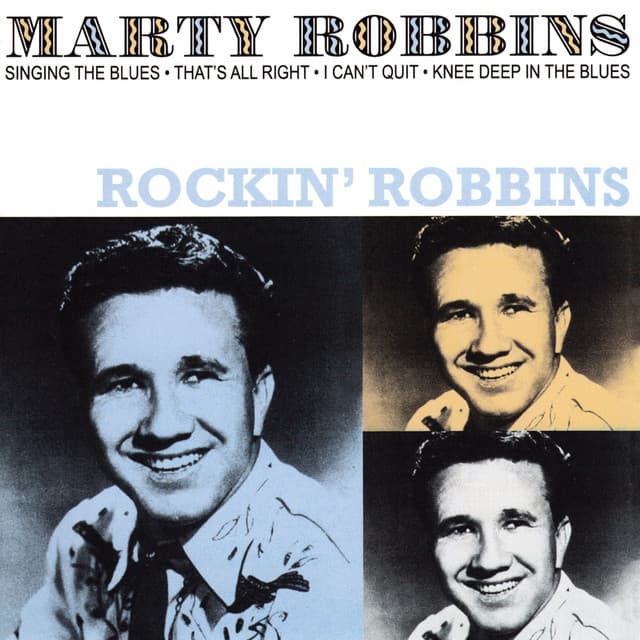
When Love Becomes a Habit: Emotional Surrender and Inner Conflict in “I Can’t Quit”
“I Can’t Quit” is one of Marty Robbins’ most quietly devastating recordings a song that explores love not as romance or heartbreak alone, but as dependence. Released in 1961, at the height of Robbins’ creative maturity, the song reveals an emotional truth that feels uncomfortable precisely because it is so familiar: knowing something is wrong, yet being unable to walk away.
Often known by its full title, “I Can’t Quit (I’ve Gone Too Far)”, the song became a Top 10 hit on the Billboard Hot Country Singles chart, further establishing Robbins as one of country music’s most emotionally articulate voices. By this point in his career, Robbins had already proven himself as a master storyteller through grand ballads and Western epics. But here, he turned inward away from legends and landscapes, and toward psychological realism.
Written by Marty Robbins himself, the song carries the unmistakable weight of personal understanding. The lyrics do not dramatize addiction to love; they confess it. The narrator does not blame the other person, nor does he claim innocence. Instead, he admits complicity. He knows the relationship is destructive, but awareness alone is not enough to free him. That honesty gives the song its enduring power.
Musically, “I Can’t Quit” is restrained and deliberate. The arrangement moves slowly, guided by gentle guitar lines and subtle rhythm, creating a sense of emotional confinement. There is no urgency in the music only inevitability. The song does not push toward resolution; it circles the same emotional truth, just as the narrator circles his inability to leave.
Marty Robbins’ vocal performance is central to the song’s impact. His voice is calm, controlled, and almost weary. There is no dramatic breaking point, no raised volume meant to signal pain. Instead, Robbins sings as someone who has already accepted the situation, even while recognizing its cost. That resignation delivered without bitterness feels painfully authentic.
Lyrically, “I Can’t Quit” explores a rarely acknowledged aspect of love: the loss of agency. The narrator is not confused about what should be done; he is simply unable to do it. Lines unfold with clarity and self-awareness, yet every admission reinforces the same conclusion he has gone too far to turn back. The song captures the moment when love stops being a choice and becomes a condition.
This emotional framing was especially striking in early 1960s country music, which often favored clear moral lines and decisive endings. Robbins, however, understood that real emotional lives are rarely so clean. By allowing the song to exist without redemption or escape, he honored the complexity of human attachment.
Within Marty Robbins’ broader catalog, “I Can’t Quit” stands as one of his most psychologically nuanced works. While he is often remembered for songs filled with action, movement, and narrative resolution, this song refuses motion. Everything happens internally. The drama lies not in events, but in awareness and the inability to act on it.
The early 1960s marked a period where Robbins increasingly trusted subtlety. He no longer needed elaborate stories to hold attention. Songs like “I Can’t Quit” demonstrated that emotional truth, expressed plainly, could be just as compelling as any epic ballad.
Today, “I Can’t Quit” remains deeply resonant because its message does not belong to any one era. Many listeners recognize the experience it describes not only in romantic relationships, but in habits, attachments, and patterns that persist despite better judgment. The song speaks to the quiet struggle between knowing and doing.
In the end, “I Can’t Quit” offers no solution and that is its strength. It does not promise healing, nor does it pretend that awareness guarantees freedom. Instead, it bears witness to a difficult truth: sometimes the hardest battles are not fought against others, but within oneself. Marty Robbins understood that tension intimately, and in this song, he captured it with rare honesty, restraint, and grace.
 Oldies Songs