
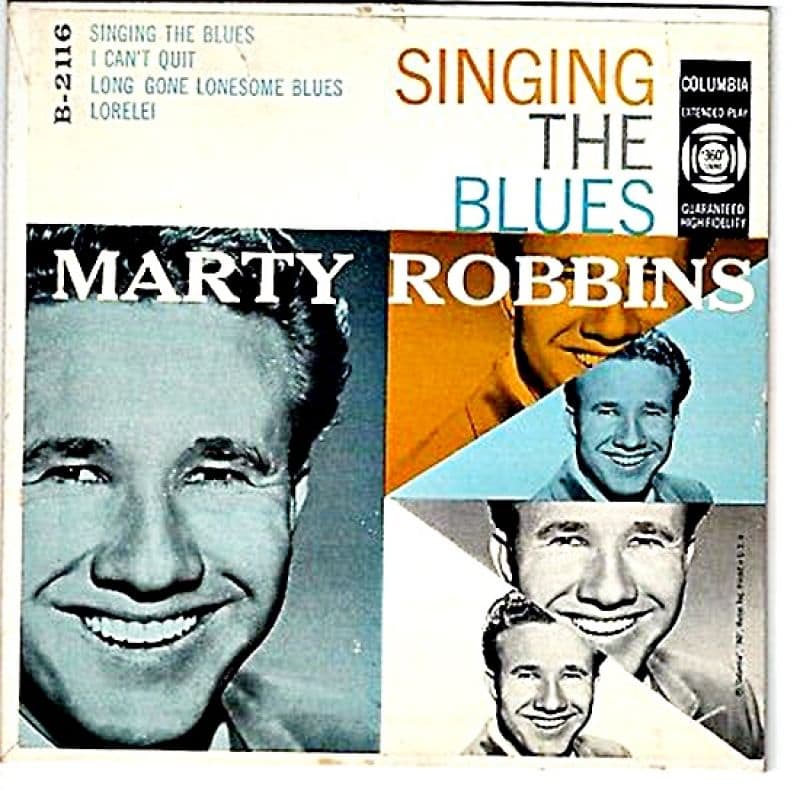
“Singing the Blues” a melancholy country-ballad that carved a breakthrough for Marty Robbins
In the wistful twang of a guitar and a voice full of longing, “Singing the Blues” captures the ache of lost love and quiet resignation, offering a fragile solace to anyone who has ever felt the sting of heartbreak.
Back in 1956, when Marty Robbins released his rendition of Singing the Blues, it changed everything for him. His version climbed to No. 1 on the U.S. Country charts, where it stayed for a remarkable 13 weeks, establishing him as a major force in country music. At the same time, it crossed over into the pop world, reaching No. 17 on the U.S. pop chart — a rare feat for a country ballad in that era.
The backstory of the song is as evocative as the song itself. Written by the young Nashville songwriter Melvin Endsley, “Singing the Blues” carried the weight of personal sorrow and stark honesty. Endsley, who endured polio and spent much of his life in a wheelchair, poured his hardships into the melody and lyrics the song became a plaintive confession, almost a diary entry set to music. Robbins heard in it a rare sincerity and, during a late-night session at Bradley Studios in Nashville, recorded his version accompanied by fiddle, steel guitar and piano instruments that underscored the song’s country roots and emotional depth.
When “Singing the Blues” finally reached the public in August 1956, it resonated immediately. Radio DJs began spinning it, and soon listeners across America from dusty small towns to neon-lit city bars recognized a familiar ache in Robbins’s voice: the pain of love lost, the heaviness of loneliness, the silent nights when memories flood back. Its success was not just commercial: it marked a turning point for Robbins, who until then had enjoyed modest success in rockabilly and country, but had not yet broken into the mainstream. With this song, he stepped into the spotlight for good.
But the journey of the song did not end with Robbins. Almost simultaneously, a more pop-oriented version by Guy Mitchell was released in October 1956, produced with orchestral backing and radio-friendly sheen. Mitchell’s version soared even higher — hitting No. 1 on the U.S. pop charts and dominating airwaves into early 1957. Across the Atlantic, an alternate version by Tommy Steele & the Steelmen also captured the top spot in the UK Singles Chart in early 1957. This unexpected “chart-battle” with country, pop, and rock-oriented versions of the same song competing underscored the song’s universal appeal across audiences and genres.
Yet, despite the competition, Robbins’s version remains special. It wasn’t glossy or orchestrated it was raw, honest, and steeped in country authenticity. Its simple instrumentation and heartfelt vocal created something deeply intimate, as if the singer were confessing his pain directly to you in a dimly lit room. For many listeners, that version became not just a hit, but a companion a reflection of their own sorrows and silent nights.
Over the decades, “Singing the Blues” continued to echo across generations. It was covered by dozens of artists spanning rock, pop, and country from Dean Martin to Jerry Lee Lewis, and even later by artists such as Dave Edmunds (whose 1980 version reached No. 28 in the UK) and Daniel O’Donnell (UK No. 23 in 1994). Yet for all its many incarnations, the soul of the song the sorrow, the longing, the bare confession is often felt strongest in that 1956 recording by Marty Robbins.
What gives “Singing the Blues” its enduring power is not just melody or success it is honesty. In a world that often demands strength and gloss, the song dared to feel broken, to admit loss, to allow trembling vulnerability. Listening now, the crackle of old vinyl and the warm echo of Robbins’s baritone can pull memories forward: perhaps of someone long gone, perhaps of a younger self bruised by love or loneliness. It reminds us that sorrow can be beautiful, that pain can shape art, and that sometimes a simple country song just two minutes and twenty-four seconds can hold more heartache and hope than an entire lifetime.
“Singing the Blues” is more than a milestone in country music. It is a bridge between sorrow and solace, between the past and the present, between one lonely heart and another, across decades.
 Oldies Songs