
A high-octane collision of rock-and-roll nostalgia and boogie-woogie brilliance, celebrating the primal, timeless joy of a musical legend’s youthful spirit.
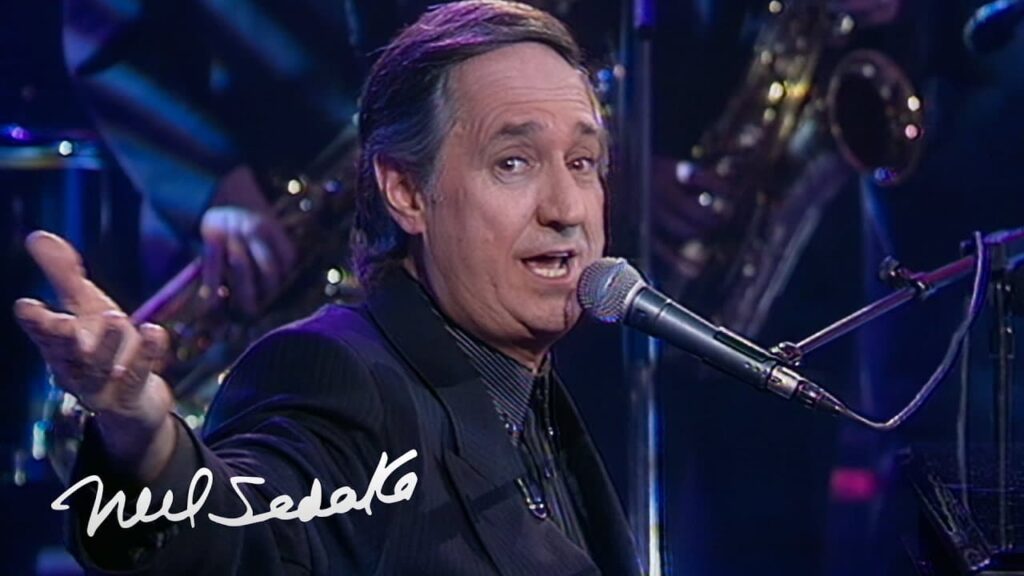
There are moments in musical history where the past and the present don’t just meet; they ignite. One such electric instance occurred on April 16, 1994, on the cult-classic British television show Don’t Forget Your Toothbrush. When the legendary Neil Sedaka sat down across from the incomparable Jools Holland, the atmosphere shifted from mere television entertainment to a masterclass in pure, unadulterated showmanship. Their performance of “I Go Ape” was not simply a trip down memory lane; it was a defiant, roaring statement that the fire of 1950s rock-and-roll never truly goes out—it just waits for the right hands to fan the flames. For those of us who remember the crackle of a transistor radio and the kinetic energy of a jukebox, watching these two virtuosos trade piano licks felt like witnessing a joyous reunion of old friends.
Originally released in 1959 as a follow-up to his breakout hits, “I Go Ape” reached No. 42 on the Billboard Hot 100 and found even greater success in the UK, climbing to No. 9. While it was often dismissed by critics of the era as a “novelty song,” the 1994 performance with Jools Holland stripped away any such labels, revealing the sophisticated rhythmic backbone of the composition. Sedaka, then in his mid-50s, performed with a frantic, boyish exuberance that belied his years, proving that the “Ape” persona was less about a gimmick and more about the visceral, rhythmic pulse that defined an entire generation. This specific live rendition remains a gold standard for musical synergy, showcasing two different generations of ivory-tinklers finding common ground in the language of the blues and the shuffle.
The story behind “I Go Ape” is one of calculated rebellion and Brill Building precision. Written by the powerhouse duo of Neil Sedaka and Howard Greenfield, the song was born from a need to capture the wild, untamed energy of the burgeoning teenage culture. In the late 50s, rock-and-roll was viewed by the establishment as something primitive—almost simian. Sedaka, ever the clever strategist, leaned into this critique with a wink and a smile. He took the “primitive” accusations and turned them into a chart-topping anthem of liberation. By the time he performed it on Don’t Forget Your Toothbrush decades later, the song had evolved into a badge of honor. It represented a time when life felt simpler, louder, and infinitely more exciting.
Meaningfully, this performance serves as a profound meditation on the concept of “staying young.” As we navigate the quieter chapters of our lives, there is a tendency to look back at our youthful outbursts with a sense of distant detachment. However, watching Sedaka hurl himself into the lyrics—”I’m a monkey, a chimpanzee!”—reminds us that the spirit of play is a vital part of the human experience. The song isn’t just about a dance or a crush; it is about the “madness” of joy. It reflects a period in history where music was the primary outlet for a world trying to shake off the greyscale shadows of the post-war era. The Jools Holland collaboration added a layer of sophisticated British boogie-woogie to the mix, creating a bridge between the American sock-hop and the London pub scene.
There is something deeply moving about seeing a man of Sedaka’s stature return to a song he wrote as a teenager and perform it with even more conviction than he did the first time. It suggests that while our bodies may grow frail and our memories may soften, the rhythm of our hearts remains unchanged. For the viewer who has lived through the seismic shifts of the last sixty years, this performance is a tonic. It is a reminder that we are allowed to “go ape,” to lose ourselves in the melody, and to remember exactly who we were before the world told us to grow up. It is a celebratory, loud, and brilliantly messy piece of art that honors the legacy of a man who helped build the very foundations of modern pop music.