
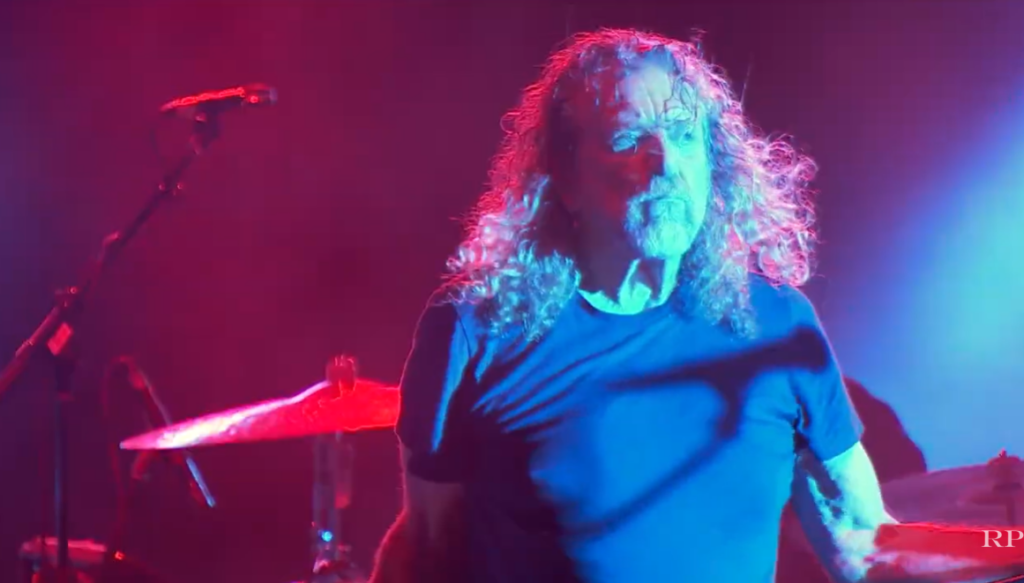
A Voice Transformed: Robert Plant Reimagines Blues at Bonnaroo 2015
At the 2015 Bonnaroo Music and Arts Festival, Robert Plant delivered a performance that stood apart from expectations tied to his legacy. Performing Fixin’ to Die Blues with Sensational Space Shifters, Plant offered not a return to the past, but a reinterpretation shaped by time, experience, and artistic evolution.
The song itself, originally written and recorded by blues musician Bukka White, carries themes of mortality and reflection. In this live setting, those themes took on a deeper resonance. Plant, now decades removed from his years with Led Zeppelin, approached the material with restraint rather than intensity. His voice, no longer defined by the high range of his early career, instead conveyed weight and texture, allowing the lyrics to settle with greater emotional impact.
From the opening moments, the performance established a distinct atmosphere. There was no elaborate introduction or attempt to recreate the scale of stadium rock. Instead, the arrangement leaned into rhythm and repetition, drawing from traditional blues structures while incorporating global musical influences that have defined Plant’s later work. The Sensational Space Shifters functioned as a cohesive unit, emphasizing groove and continuity over individual display.
This approach reflects a deliberate artistic direction. Since the end of Led Zeppelin following the death of John Bonham in 1980, Plant has consistently avoided revisiting his past in a conventional sense. Rather than relying on nostalgia, he has pursued projects that expand his musical identity. The Bonnaroo performance is a clear example of this philosophy in practice.
There is also a personal dimension that informs the interpretation. Over the years, Plant has experienced significant loss, including the death of his young son in 1977. While not explicitly referenced on stage, such experiences inevitably shape the emotional depth of a performance centered on themes of life and mortality. In this context, Fixin to Die Blues becomes less a traditional blues standard and more a reflective statement delivered by an artist who has lived through profound change.
Audience response at Bonnaroo suggested an appreciation for this evolution. Rather than seeking a recreation of past glories, listeners were presented with a performance grounded in authenticity. The absence of spectacle allowed the focus to remain on the music itself and on the subtle dynamics between voice and instrumentation.
This performance ultimately highlights a broader truth about longevity in music. Artistic relevance is not maintained through repetition, but through reinvention. Robert Plant’s interpretation of Fixin to Die Blues demonstrates how a familiar song can acquire new meaning when filtered through decades of experience.
In doing so, it affirms his position not only as a former icon of rock history, but as an artist still actively shaping his legacy.