
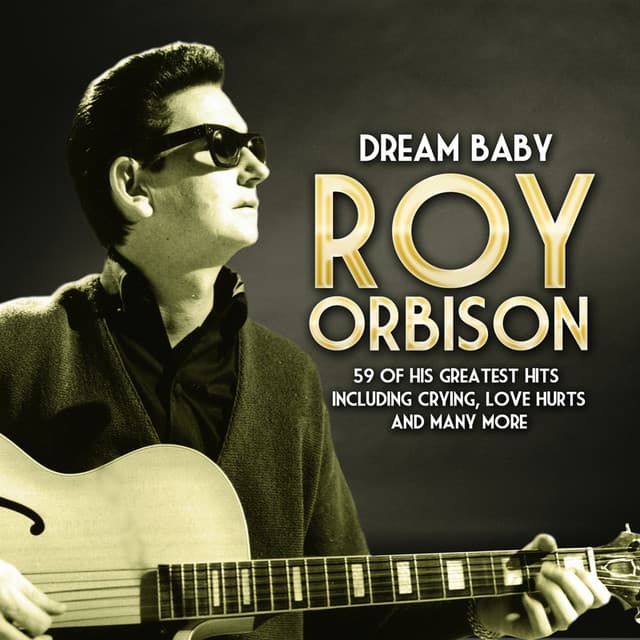
A gentle plea of love and longing set to the soaring voice of Roy Orbison
When Roy Orbison released “Dream Baby (How Long Must I Dream)” in September 1962, the song carried the yearning of unfulfilled love a melody of hope trembling on the edge of despair. The single climbed to No. 4 on the Billboard Hot 100, marking one of the highest-charting hits of Orbison’s early 1960s period and reaffirming his stature as a voice capable of capturing raw emotion and longing.
From the first notes the plaintive guitar, the soft rhythm, and Orbison’s soaring tenor “Dream Baby” evokes a world of distance and yearning. Its narrator sings not with anger or bitterness, but with a quiet desperation, longing for a return of love and a reunion in dreams: “Dream, baby, dream / Let the old love come through”. That subtle hope fragile, aching, human becomes the heart of the song, and Orbison’s vocal performance invests every syllable with tenderness, vulnerability, and longing.
The song was penned by Cindy Walker, a celebrated country songwriter known for her lyrical sensitivity and melodic clarity. Her composition provided the emotional foundation that Orbison would build upon: simple but effective lyrics, reminiscent of country-blues heartbreak, paired with a melody that lifts like a sigh toward the moonlit sky. When Orbison recorded it, he took that foundation and transformed it with his own signature style crystalline vocals, emotional depth, and a sense of distance both physical and spiritual.
Musically, “Dream Baby” stands at the crossroads of early ’60s pop and country soul. The arrangement is understated rhythmic guitar, soft bass, restrained drums giving Orbison’s voice space to soar and fall with the tides of longing. There are no showy flourishes, no dramatic overproduction. Instead, there is room: room for emotion to settle, for memories to surface, for heartbreak to echo. The restraint makes the song feel more intimate, more personal like a letter sung out loud to someone far away.
Lyrically and thematically, the song resonates deeply with anyone who has known separation, longing, or unfulfilled promises. It doesn’t rail against loss or bitterness; instead, it holds on to memory, to hope, to the idea that love even distant can remain alive in dreams and in the heart. That emotional subtlety is part of what makes it endure: not every love story ends with closure, but some continue quietly, in memory and longing, and this song gives voice to that soft ache.
For a generation that lived through long separations loved ones called away, promises delayed, goodbyes whispered with no clear return “Dream Baby” became a companion: a song for letters never sent, for nights spent staring at the ceiling, for hearts holding on to hope. Its popularity at the time of its release showed that many felt the same way: the emotional honesty cut through pop’s more superficial charms and struck a chord deeper than melody alone.
In the arc of Roy Orbison’s career, “Dream Baby (How Long Must I Dream)” stands as one of his purer expressions of youthful heartbreak a moment before fame’s glitz, before drama, before reinvention. It captures him at a point where his voice was still young, but already capable of longing that felt wise beyond years. For later listeners, especially, the song becomes a time capsule: echoing youth, heartbreak, unfulfilled love, and the gentle hope that dreams might one day become real.
Ultimately, “Dream Baby” endures because it holds space for what many hearts carry quietly: love that waits, memories that linger, and hope that refuses to die. Through Orbison’s voice, the song becomes not just a track on the radio, but a mirror for longing souls, a lullaby for the lonely, and a promise whispered in the darkness that love can be held even if only in dreams.