
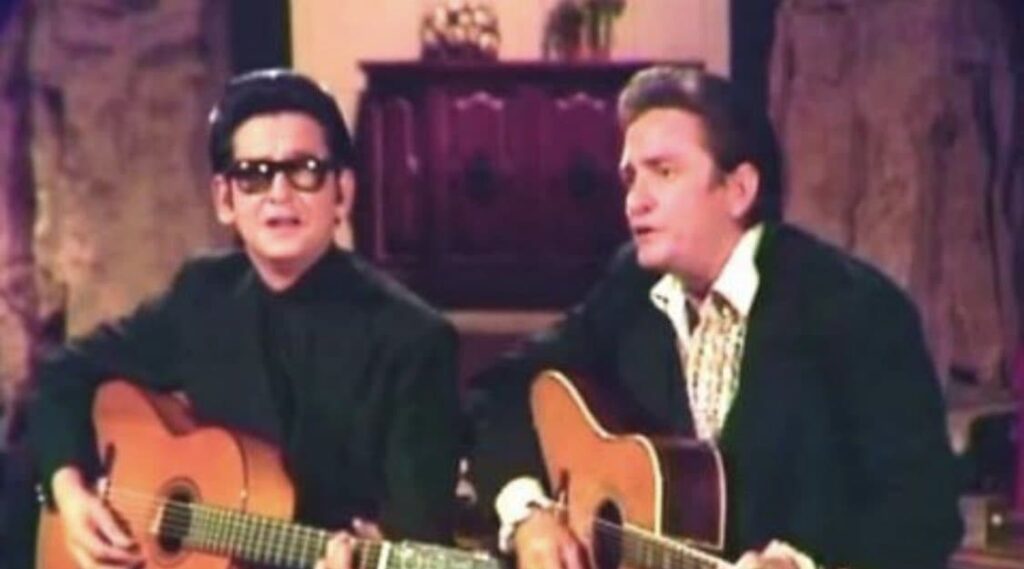
A rare meeting of two legends, where friendship, respect, and pure musical joy lit up the stage.
When Roy Orbison joined Johnny Cash on The Johnny Cash Show in 1969 to perform “Oh, Pretty Woman,” it was more than a hit song revisited. It was a moment of shared history, mutual admiration, and the quiet magic that only true artists can create when they stand together without competition or ego. The performance remains one of the most cherished live moments in American music television, not because it was polished, but because it was real.
By 1969, Roy Orbison was already a towering figure in popular music. Oh, Pretty Woman, released in 1964, had reached number one on the Billboard Hot 100, becoming his most recognizable and commercially successful song. Its instantly recognizable opening riff, dramatic pauses, and emotional tension marked Orbison as a songwriter unlike any other. He was not a swaggering rock star. He was a storyteller, singing operatic heartbreak behind dark glasses, letting his voice do all the talking.
Johnny Cash, meanwhile, was entering a new and powerful phase of his career. The Johnny Cash Show had become a cultural crossroads, bringing together country, rock, folk, and gospel artists at a time when musical lines were still sharply drawn. Cash’s decision to invite Orbison was no accident. The two men shared a deep respect, forged through years of touring, personal struggle, and an understanding of music as something sacred rather than disposable.
On stage, the performance feels effortless. Cash does not attempt to dominate or reinterpret the song. Instead, he steps slightly aside, smiling, clapping, and allowing Orbison to shine. This generosity speaks volumes. Cash understood that Oh, Pretty Woman belonged to Orbison’s world, and his role was simply to welcome it into his own. That quiet humility is part of what makes the moment so enduring.
Orbison’s voice that night is confident yet playful. Unlike the carefully controlled studio version, this live performance carries warmth and spontaneity. He smiles more, leans into the rhythm, and seems genuinely delighted by the crowd’s reaction. The famous pauses in the song feel less dramatic and more conversational, as if Orbison is sharing an inside joke with the audience. It is joy, not heartbreak, that defines this version.
The chemistry between the two men is subtle but unmistakable. There is no need for grand gestures. A glance, a grin, a shared laugh is enough. It reflects a time when artists lifted one another up rather than competed for attention. Watching them together feels like witnessing a private reunion made public, a reminder that great music often grows out of friendship and trust.
Culturally, this performance stands as a snapshot of a transitional era. The late 1960s were turbulent, and music was changing rapidly. Yet here were two artists from different backgrounds and styles, proving that a great song could still bring people together across genres and generations. There is something reassuring in that simplicity.
Today, Roy Orbison and Johnny Cash’s performance of “Oh, Pretty Woman” endures because it captures what audiences rarely see anymore, artists enjoying each other’s presence, honoring the song, and trusting the moment. It is not just nostalgia. It is a reminder of a time when music felt personal, human, and timeless.