
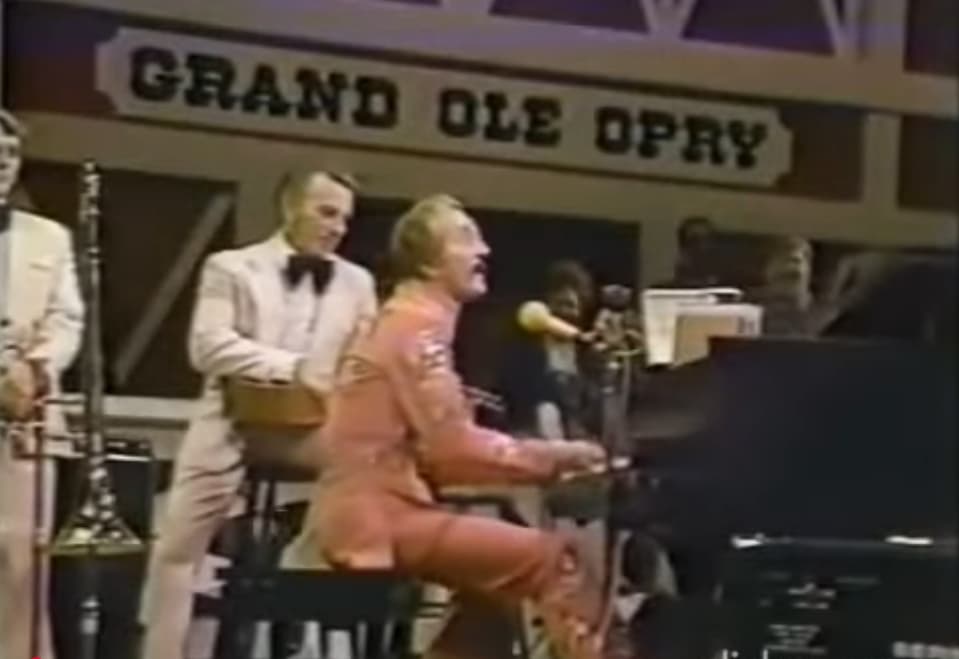
A legend meets his own mythology as a timeless ballad is sung one final time beneath the Opry lights
When Marty Robbins stood on the Grand Ole Opry stage in 1982 and performed El Paso for the final time, he revisited the song that had carried him to the top of the Billboard Hot 100 in 1960 and anchored his landmark album Gunfighter Ballads and Trail Songs. More than two decades after its release, El Paso remained inseparable from Robbins’s public identity, a ballad so deeply woven into the fabric of American music that each new performance felt less like a repetition and more like a ritual.
By 1982, Robbins was in the twilight of his career, yet his voice still carried the authority of the man who had once stunned the industry with a six minute Western epic that defied genre boundaries and chart expectations. On that night at the Opry, the song’s journey reached a poignant summit, not through reinvention, but through the quiet gravity of a storyteller confronting the end of his trail.
What makes this final rendition so arresting is the way Robbins’s seasoned voice reshapes the emotional topography of El Paso. The ballad’s narrative of forbidden love, jealousy, flight, and fatal return had always been delivered with cinematic sweep. Robbins’s youthful recordings bristled with urgency, as though the story were unfolding in real time. But in 1982, something changed. The pacing softened, the phrasing took on a reflective warmth, and the spaces between lines grew charged with a lifetime of performance. Robbins no longer sounded like a cowboy outrunning destiny. He sounded like a man revisiting a chapter of his life that had defined him, carrying its weight gently but knowingly.
The brilliance of El Paso lies in how Robbins built a complete tragic arc inside the frame of a country ballad. The doomed cowboy’s return to Rosa’s Cantina is one of the most iconic moments in American songwriting, and on the Opry stage, Robbins delivered it not as melodrama but as a memory. The tension of the gunfight, the burst of emotion as the cowboy sees Felina one last time, the collapse into her arms all of it became less about narrative climax and more about emotional resonance. It felt as though Robbins were acknowledging, with artistic clarity, the inevitability that had always haunted the song’s protagonist.
In that sense, the 1982 performance becomes more than a final reading of a classic. It becomes a meditation on legacy itself. Robbins gave the Opry audience not merely the song they cherished, but the culmination of a lifetime spent perfecting the art of narrative singing. El Paso had turned him into a legend. And on that last night, he returned the favor, offering a farewell so intimate that it now stands as one of the most enduring moments of his storied career.
 Timeless Melodies
  Oldies Songs