
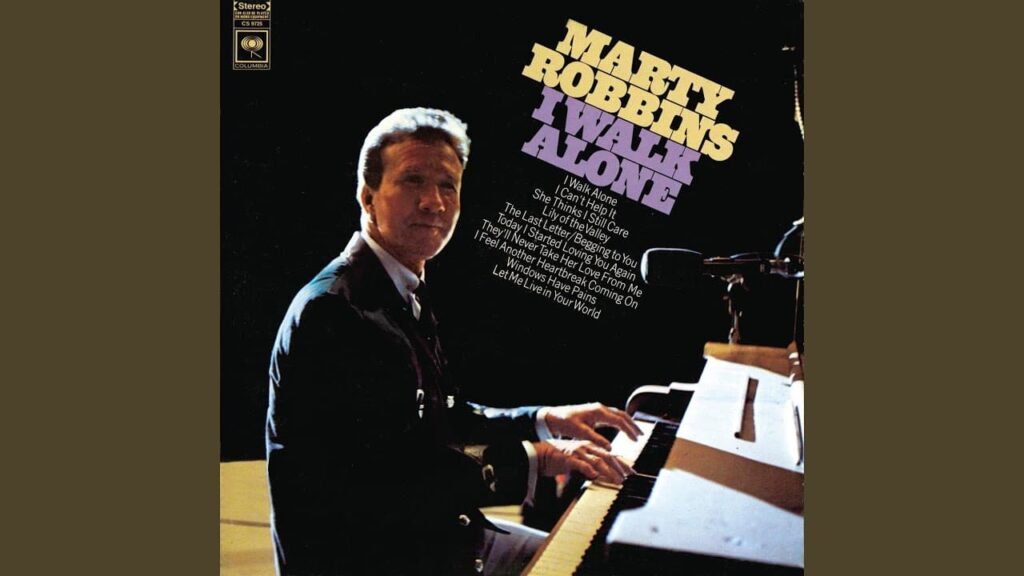
A tender confession of longing, “Begging to You” captures the quiet ache of love returning to the doorstep of the heart.
“Begging to You” stands among the most delicately emotional works of Marty Robbins, released in late 1963 and rising quickly to No. 2 on the Billboard Hot Country Singles chart. At a time when country music was filled with grand narratives, gunfighter ballads, and dramatic storytelling, this song arrived as something far more intimate a gentle surrender, sung in a voice that seemed to come not from a stage, but from the quiet corner of a dimly lit room. Written by Robbins himself, it showed another side of the artist who had become famous for the sweeping Western epics of Gunfighter Ballads and Trail Songs. Here, he traded wide-open deserts for the small, trembling space inside a wounded heart.
The story behind the song reflects Robbins’ natural gift for emotional clarity. Unlike many of his hits rooted in narrative tradition, “Begging to You” was said to be inspired by the everyday vulnerability people rarely admit aloud the moment when pride dissolves, when love outweighs ego, and when someone returns to the person they once hurt, asking to be let back in. Robbins had a deep intuition for human frailty, and in this composition he allowed himself to speak plainly, without symbols or allegories. It’s a rare instance where one of country music’s great storytellers chose a quiet truth over dramatic myth, and it remains one of his most heartfelt recordings because of that choice.
Musically, the track belongs to an era when country arrangements were beginning to soften under the influence of the Nashville Sound. Yet Robbins resisted over-polishing. The production is clean, but the emotion is unfiltered. His warm, unmistakable voice moves with a gentleness that feels almost fragile at times as though he were singing not for a crowd, but for one person who mattered more than all the audiences in the world. The restrained instrumentation, built around subtle guitar lines and steady rhythm, leaves space for the vulnerability in his delivery. Every word sounds like it comes from a man standing at the edge of hope, waiting for an answer he isn’t sure he deserves.
Lyrically, the song touches a universal experience: that journey back to someone whose forgiveness you desperately need. Robbins captures that moment with stunning simplicity. There is no dramatic plea, no theatrical regret. Instead, there is honesty almost painful in its purity. The narrator admits fault, admits longing, and admits that the door he once walked away from is the same door he now wishes to walk through again. It is a theme as old as love itself, yet Robbins gives it freshness through sincerity rather than novelty. His choice to keep the writing plain, even humble, is precisely what gives it its emotional power.
While “Begging to You” didn’t reach No. 1, its staying power has long surpassed many chart-toppers. The song remains cherished because it feels lived-in. It carries the weight of life’s quieter truths the ones discovered not in moments of triumph, but in the private reckonings of the heart. Over the decades, listeners have returned to it not just for its melody, but for the recognition it offers: that love often asks us to bend, to admit our flaws, and to speak words we might wish someone else would say first.
In the vast and varied legacy of Marty Robbins, “Begging to You” stands as a quiet masterpiece a reminder that beneath the legends, the Western heroes, and the stories of distant horizons, Robbins was, above all, a singer who understood the fragile, yearning corners of the human spirit. It is a song that doesn’t shout to be remembered; it simply lingers, like an unspoken apology finally finding its voice.
 Oldies Songs