
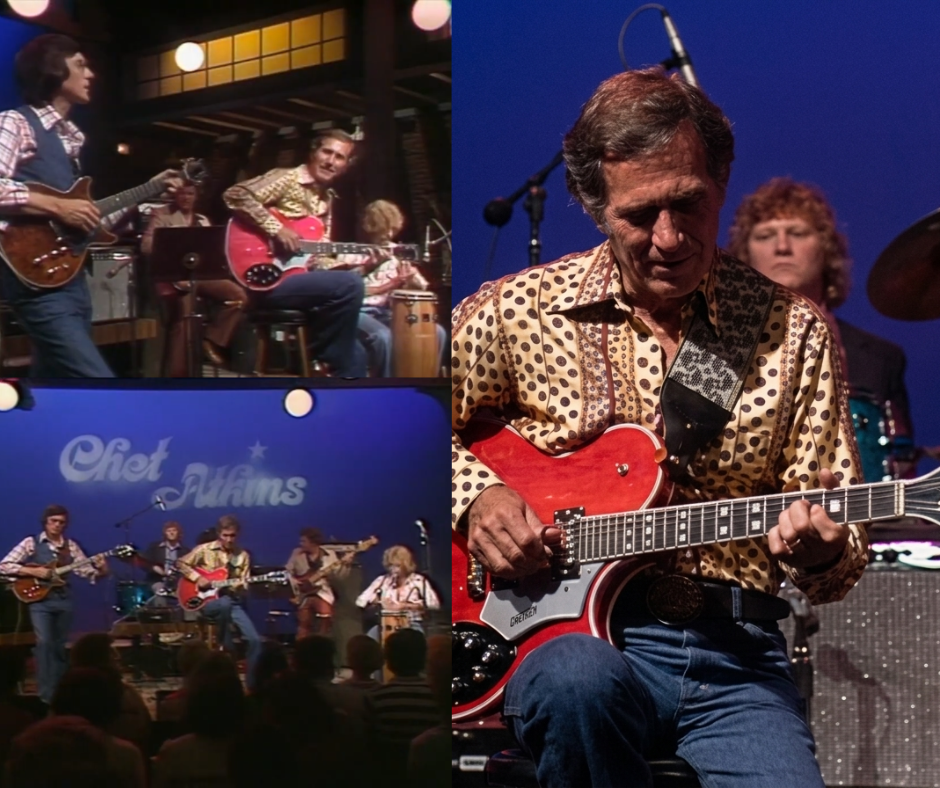
A Fretboard Fireworks Display: Chet Atkins and the Absolute High-Fidelity Wizardry of “Stars and Stripes Forever”
When exploring the expansive, deeply treasured archive of twentieth-century American guitar music, certain instrumental arrangements emerge as absolute, towering monuments to human ingenuity and mechanical perfection. A definitive peak in fingerstyle history was achieved when the legendary “Mr. Guitar,” Chet Atkins, integrated John Philip Sousa’s patriotic masterpiece, “Stars and Stripes Forever,” into his live repertoire. Originally written by Sousa in 1896 as a sweeping, multi-layered military brass march, the piece seems mathematically impossible to replicate on a single wooden instrument. Yet, utilizing a revolutionary fingerstyle architecture originally developed by Boston-based guitar virtuoso Guy Van Duser, Chet turned his fretboard into a self-contained marching band—leaving the international listening community with a magnificent, high-fidelity testament to the staggering possibilities of six strings.
The unique historical and technical weight surrounding this specific arrangement highlights Chet’s deep admiration for absolute fretboard independence. To translate a massive Sousa march to a solo guitar, Chet had to simultaneously handle the driving bass drum cadence, the intricate middle-tier brass harmonies, and the legendary, lightning-fast piccolo flute solo over the top. When Chet delivered this arrangement live—most famously captured during his historic 1982 performance on Austin City Limits and preserved across vintage archival channels like rarestuff87—the live television audio mix represented a spectacular victory of classic analog sound engineering. Free from any sterile digital cosmetics, over-dubbing, or pre-recorded backing tracks, the microphone layout perfectly isolates the immediate, clean bite of his signature thumbpick and the warm, woody resonance of his custom nylon-string guitar with breathtaking clarity.
The behind-the-scenes allure of this specific tracking centers on the dizzying, episodic layout of the composition itself, which completely shatters the boundaries of standard fingerstyle music. The performance opens with immediate, commanding authority, as Chet establishes the robust, driving rhythm bed of the march using his right thumb to thump out a steady alternating bassline. Rather than keeping the arrangement simple, the layout introduces rapid chord modulations and cascading syncopations that fly up and down the neck of the guitar. The true peak of the showpiece arrives during the famous trio section, where Chet’s index and middle fingers miraculously replicate the fluttering, high-pitched piccolo counter-melody while his thumb stubbornly maintains the heavy, stomping military rhythm beneath—an absolute display of mental and physical separation that leaves even advanced musicians completely spellbound.
For the serious guitarist who treasures the deep technical nuances of classic fingerstyle mechanics, Atkins’ live execution on “Stars and Stripes Forever” remains an absolute revelation. Navigating such a relentless, note-dense arrangement under warm stage spotlights requires exceptional focus, absolute muscle memory, and an innate, pocket-perfect sense of timing—demands that the native Tennessean met with his trademark, effortless poise and a warm, self-deprecating smile. The unvarnished honesty of the performance, where you can hear the physical slide of fingers across frets and see the sheer joy flashing in his eyes, creates an authentic intimacy that modern, computer-sequenced musical tracking simply cannot duplicate.
To turn the volume all the way up and re-engage with the archival treasures of Chet Atkins’ magnificent 1982 Austin City Limits delivery today is to be swept away by a powerful, deeply comforting wave of sweet nostalgia and profound gratitude. Watching and listening to our hero effortlessly ignite a fireworks display across his frets transports the educated viewer back to a highly sophisticated era of entertainment history—a time when true, enduring stardom required no artificial enhancements to command our deepest admiration. For the dedicated scholars and fans who spend decades searching the broadcast archives to preserve these priceless musical footprints, this performance remains a permanent, highly reflective blessing. It leaves the global listening community with a timeless reminder that when a beautiful melody is delivered straight from the passionate, resilient soul of a true legend, its magic possesses an immortal strength that will continue to cross generations, warm our hearts, and shine forever.