
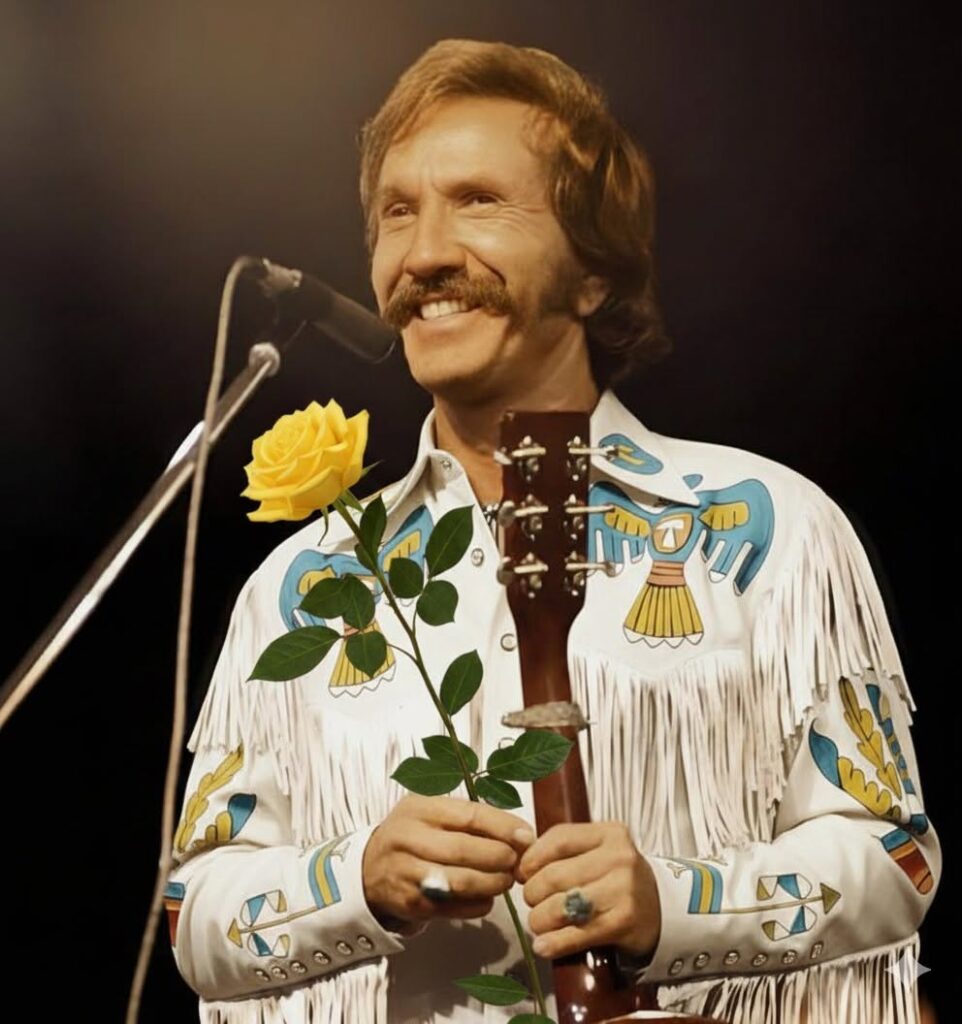
A father’s silent blessing wrapped in golden petals, where a quiet sacrifice speaks far louder than words.
The beauty of a truly great story song often lies in the shadows cast by its own restraint. While the legendary Marty Robbins built an immortal legacy around dramatic, high-stakes western ballads from the gunsmoke-chilled streets of “El Paso” to the legendary quick-draw tension of “Big Iron” there is a quieter, remarkably intimate gem in his vast catalog that hits a very different emotional nerve. When listening to “18 Yellow Roses,” one is immediately drawn into a gentle, cinematic world that feels less like a theatrical performance and more like a deeply personal story shared across a porch table. Though the song itself has a rich pop-country heritage (originally penned and recorded as a Top 10 pop smash by Bobby Darin in 1963 before being embraced and performed live by Marty Robbins throughout the 1970s), its enduring magic comes from the quiet, unvarnished way Robbins delivered it. He didn’t need grand orchestrations or weeping steel guitars; he simply let the narrative breathe.
What makes “18 Yellow Roses” so hauntingly effective especially to those who have navigated the long, winding road of raising children is the profound twist embedded at the heart of its lyrics. Throughout the first half of the song, the listener assumes they are hearing a simple, jealous reflection from a man whose lover has just received a grand romantic gesture from another suitor. A box arrives containing eighteen yellow roses, complete with a card declaring an unwavering love. Yet, as the story unfolds, the emotional lens shifts entirely. The narrator isn’t a rejected lover; he is a father watching a delivery boy hand a bouquet to his eighteen-year-old daughter a young woman who is stepping out of childhood and into a life of her own.
There is an exceptional, tender dignity in the way the song handles the passage of time. In traditional pop and country music, a moment like this might be framed around explosive family drama, bitter tears, or overt conflict. Here, however, there are no villains, no harsh words, and no dramatic confrontations. The father acknowledges his own sudden irrelevance in his daughter’s romantic world not with anger, but with a quiet, protective grace. He sees the golden roses for what they are: a symbolic rite of passage. He recognizes that while the flowers will eventually wither, his devotion remains an unshakeable, silent anchor beneath her feet.
To listen to Marty Robbins perform “18 Yellow Roses” today is to experience a gentle, reflective mirror held up to the human heart. It speaks directly to the delicate art of letting go a feeling every parent eventually comes to understand. It carries the distinct warmth of old vinyl, the soft amber glow of late-afternoon sun filtering through living room curtains, and the bittersweet realization that our children never truly leave our hearts, no matter how far they walk. Through Robbins’ calm, effortless storytelling, the song stands as a timeless sanctuary for anyone who understands that the deepest, most enduring loves in life are often the ones expressed in absolute silence.
 Oldies Songs