
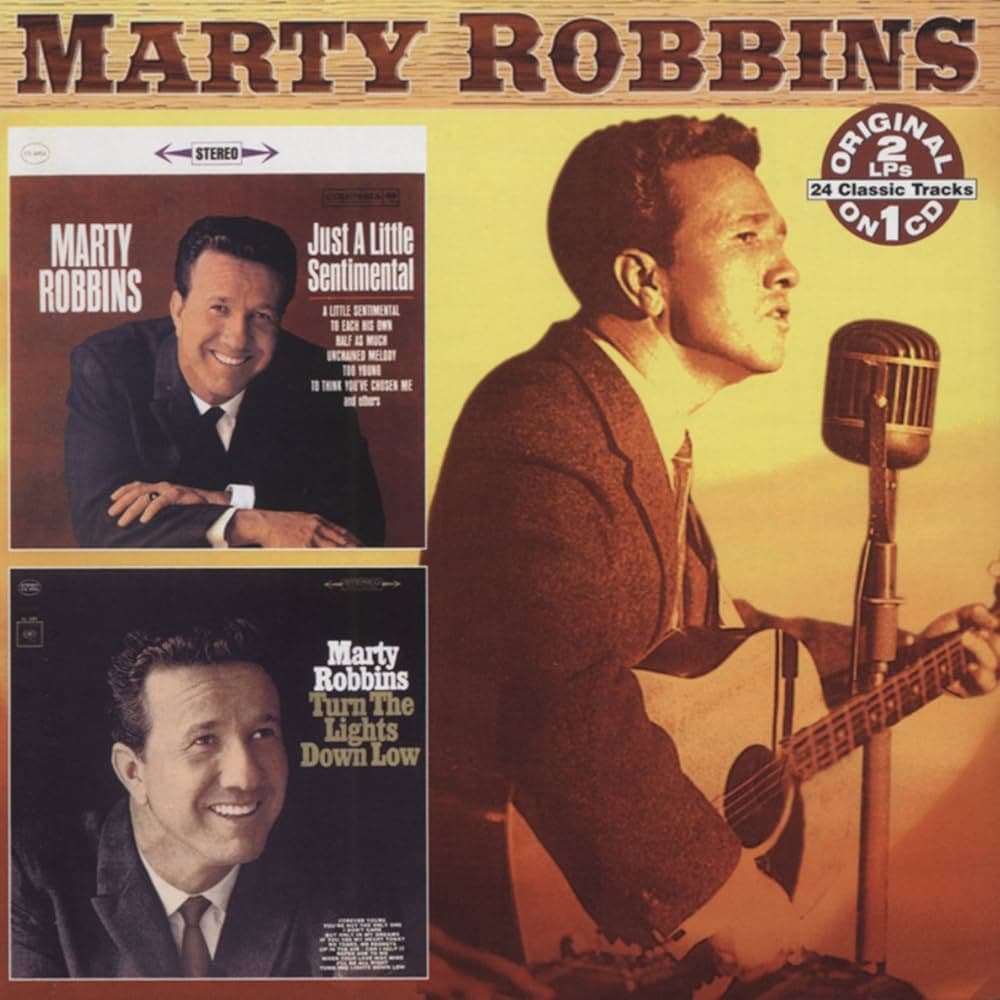
A Voice Wrapped in Longing, Where Love Waits Across Time and Distance
“Unchained Melody” is one of the most enduring love songs of the twentieth century, and when Marty Robbins recorded his version in the mid-1950s, he approached it not as a pop spectacle, but as a quiet confession. Long before the song became inseparable from later cinematic moments and soaring pop arrangements, Robbins treated it as something intimate, restrained, and deeply human a song about waiting, memory, and love that refuses to fade.
The song itself was written in 1955 by Alex North (music) and Hy Zaret (lyrics) for the prison film Unchained. Its original context already carried themes of separation and emotional captivity, but it was the universal language of longing that allowed “Unchained Melody” to transcend its origins. While many artists recorded the song almost immediately, Marty Robbins was among the earliest major American vocalists to give it a definitive interpretation rooted in country and traditional pop.
Released by Columbia Records, Marty Robbins’ “Unchained Melody” did not dominate the pop charts the way later versions would, nor was it designed to. It achieved modest recognition within the country and adult-oriented listening audience of the time, serving more as a statement of artistic sensitivity than a commercial breakthrough. Robbins, already respected for his smooth baritone and emotional control, used the song to demonstrate that country music could speak fluently in the language of universal romance.
What sets Robbins’ rendition apart is its emotional posture. Where later interpretations would lean toward dramatic crescendos and near-operatic intensity, Robbins chose restraint. His voice is steady, almost conversational, yet filled with quiet ache. Each line feels carefully weighed, as though spoken rather than sung. There is no urgency in his delivery only patience. And that patience becomes the emotional core of the performance.
The lyrics of “Unchained Melody” are simple but profound: a voice reaching across distance, time, and uncertainty. “Time goes by so slowly, and time can do so much.” In Robbins’ hands, these words sound less like poetic exaggeration and more like lived experience. His phrasing suggests someone who understands waiting not as a momentary inconvenience, but as a condition of life.
At this point in his career, Marty Robbins was still shaping the identity that would later bring cinematic western ballads and dramatic storytelling. Here, however, he reveals another dimension: vulnerability. His interpretation avoids melodrama, allowing silence and space to carry meaning. The arrangement is spare, gently supporting the vocal rather than competing with it. This creates a sense of closeness, as if the listener has been invited into a private moment of reflection.
The deeper meaning of Robbins’ “Unchained Melody” lies in its acceptance of uncertainty. The song never demands reassurance; it simply hopes. Love, in this telling, is not loud or triumphant. It is faithful. It endures quietly, even when answers do not come quickly. That emotional honesty is what gives the performance its lasting power.
In retrospect, Robbins’ version stands as an early reminder of how adaptable great songs truly are. Before the sweeping pop revival of the 1960s, before global chart domination and cultural mythology, “Unchained Melody” already existed as a deeply personal statement one that fit naturally within the emotional vocabulary of classic country and traditional American singing.
For listeners who return to this recording today, the experience is not about nostalgia alone. It is about recognition. The voice may come from another era, but the feeling is timeless. Marty Robbins does not sing to impress. He sings to connect. And in doing so, he leaves behind a version of “Unchained Melody” that feels less like a performance and more like a memory quiet, enduring, and impossibly human.
 Oldies Songs