
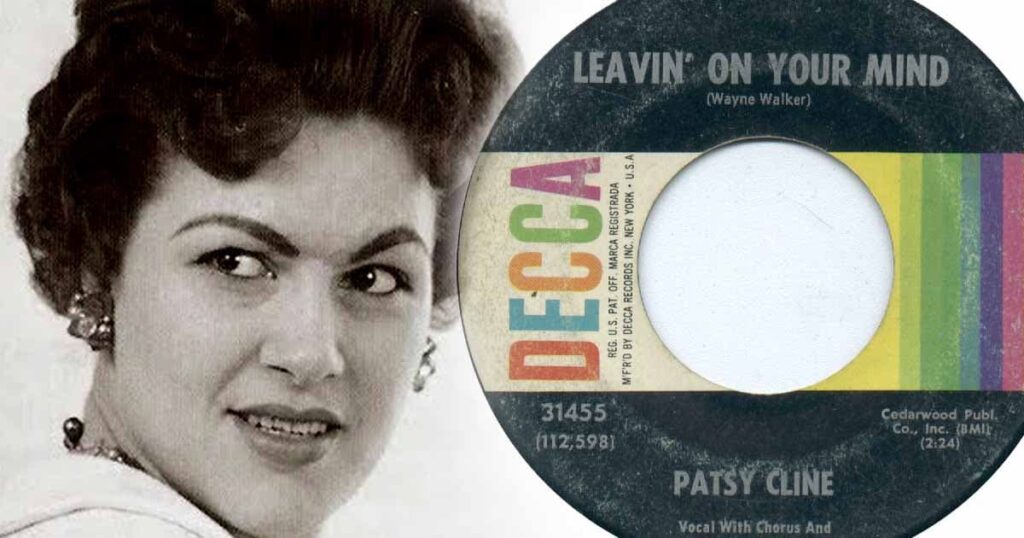
A quietly pleading farewell born from the ache of knowing love may be slipping away “Leavin’ on Your Mind” by Patsy Cline
“Leavin’ on Your Mind” captures the heartbreak of someone sensing a departure before it even arrives, as Patsy Cline sings with resignation, longing, and tender strength.
Released on January 7, 1963 under Decca Records, “Leavin’ on Your Mind” was one of Patsy Cline’s final singles; tragically, it was released just weeks before her fatal plane crash in March of that year. On the U.S. country charts, it climbed to #8 on the Billboard Hot Country Singles, demonstrating that even in her last days, her voice continued to resonate deeply with listeners. Its performance on the pop side was more modest it peaked at #83 on the Billboard Hot 100 but that doesn’t diminish the song’s emotional weight.
The song was written by Wayne Walker and Webb Pierce, two country veterans. Interestingly, the first person to record it was Joyce Smith, a Canadian singer, in 1962. Patsy first heard Smith’s version in the office of her producer Owen Bradley, and she was so taken by it that she fought for the right to record it herself. That decision proved fateful: her version, earnest and aching, would become forever linked with her legacy.
Lyrically, “Leavin’ on Your Mind” is a portrait of emotional vulnerability. Patsy pleads, “If you got leavin’ on your mind / Tell me now, get it over / Hurt me now, get it over,” invoking not just heartbreak, but a desperate desire for clarity. The narrator is caught in that painful limbo she senses her partner’s detachment and would rather face the hurt directly than linger in uncertainty. Music commentators suggest that this is not just a plea for honesty, but a recognition that things must end if they are no longer real.
The emotional meaning goes deeper than a simple break-up song: it’s about dignity, about giving someone a chance to step away cleanly, without dragging out pain. In that sense, the song is almost courageous: the speaker doesn’t beg for more love, only for the truth, even when the truth hurts. As one analysis puts it, she accepts that maybe she will “learn to love again,” but she cannot continue living with the pretense of stability if her partner’s heart is already leaving.
Musically, the arrangement reflects that emotional restraint. Produced by Owen Bradley in Nashville, the instrumentation is gentle yet steady soft piano, subtle steel guitar, and tasteful backing vocals build a soundscape that supports Cline’s voice without overwhelming it. Patsy’s vocal delivery, as always, is deeply expressive: she doesn’t scream her pain, she lets it hang in the air, like a quiet but urgent confession.
What makes “Leavin’ on Your Mind” especially poignant is its place in Patsy Cline’s life. As Country Music Nation recalls, this was her last single released during her lifetime. Listeners who know her story can’t help but hear in the lyrics a sense of foreshadowing the idea that she might have sensed her own fragility, her own impermanence. That lends the song an even greater emotional weight: it’s not only about a relationship, but about an artist’s final gesture, a plea captured just before she left us.
Over time, the song has become a classic in Cline’s catalog. It appears in many of her greatest-hits collections, such as The Patsy Cline Story, and remains beloved by fans and new listeners alike. Its legacy is strengthened by the gentle sorrow of her performance and the universal truth of its lyrics.
For older listeners, “Leavin’ on Your Mind” resonates deeply: it evokes late-night radios in living rooms, the feeling of waiting by the phone, or sitting quietly alone, wondering what is coming. Patsy’s voice tender, clear, a little weary brings comfort even in its pain, reminding us that heartbreak is a shared human experience, and that sometimes, the strongest thing we can do is ask for honesty.
In the end, Patsy Cline’s “Leavin’ on Your Mind” is both a song and a symbolic farewell a gentle, heart-rending reminder that love, when it begins to fade, is often best met with truth, not delay. It stands not just as a country classic, but as a deeply felt piece of her enduring legacy.
 Oldies Songs