
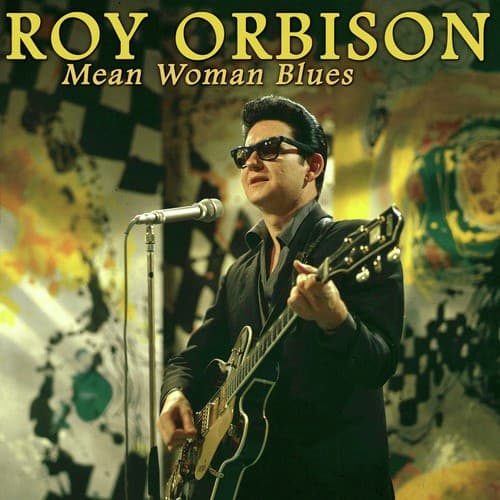
A Spirited Rock ’n’ Roll Moment that Rises Above Its Roots
“Mean Woman Blues” captures Roy Orbison’s rare wild side: gritty, playful, and thrillingly alive yet beneath its fun surface lies the soul of rock ’n’ roll itself.
At first glance, Mean Woman Blues might surprise those who cherish Roy Orbison for his luminous ballads like “Only the Lonely” and “Crying.” This track, released as a single in 1963 with “Blue Bayou” on the opposite side, presents him in a different mood electric, unrestrained, and joyfully rock-infused. It climbed to No. 5 on the Billboard Hot 100, holding a place on the charts for 13 weeks, a testament to its irresistible groove and broad appeal in its era.
Written originally by Claude Demetrius who penned the song for Elvis Presley in 1957 Mean Woman Blues began life not in the dramatic intensity of the dramatic Roy Orbison ballads but as a swaggering rockabilly tune. Presley’s version appeared in his movie Loving You, and though it wasn’t a major hit by his standards, it provided fertile soil for later reinterpretation.
By the time Orbison approached Mean Woman Blues in the early 1960s, he had already established himself as a voice of emotional depth in popular music. Yet here was an opportunity to showcase another facet of his artistry a spirited performance that nods to rhythm and blues roots while letting loose his vocal power in a more rollicking context. The arrangement pulses with energized guitars, brisk percussion, and Roy’s distinctive voice dancing across the melody with playful abandon. This blend makes the song feel alive with youthful exuberance, even decades after its release.
The lyrics themselves playful and direct are part of what makes the track memorable. Lines like “I got a woman, mean as she can be / Sometimes I think she’s almost mean as me” carry a blend of humor and roguish charisma that only Orbison could deliver with such charismatic ease. It’s not the poetic heartbreak of In Dreams or the aching longing of Crying it’s something looser, more mischievous, almost like a wink in sonic form.
Yet beneath this playful veneer lies a deeper truth about Orbison as an artist: he was never content to be one thing. While his reputation is often tied to soaring balladry and emotional vulnerability, he also understood the roots of rock ’n’ roll and rhythm and blues that underpinned his entire musical identity. Mean Woman Blues stands as a celebration of that heritage a song that respects the blues tradition while letting a vibrant personality take center stage.
It’s also worth remembering that Mean Woman Blues was paired with Blue Bayou, another beloved Orbison track that would later become a hit for artists like Linda Ronstadt (though that version’s fame would come in the 1970s). The double-sided single showcases the breadth of Orbison’s gift: from introspective, haunting melodies to spirited, dance-floor friendly rockers.
For listeners of a certain generation, Mean Woman Blues evokes more than just a moment on the radio it recalls a soundscape of smoky juke joints, vinyl crackling under a needle, and evenings lit by excitement and possibility. It’s a reminder that rock ’n’ roll at its best was never just about virtuosity: it was about feeling, expression, and a shared pulse that connected singer and listener with electric warmth.
Today, when we revisit Roy Orbison’s version of Mean Woman Blues, we hear not just a cover of an earlier tune, but a reinvention that stands proudly on its own. It’s a piece of musical history that reveals Orbison’s versatility a spark of spirited energy nestled among his more contemplative masterpieces. And even as decades pass, that spark continues to ignite memories and smiles in those who know and love the story of rock ’n’ roll.